Integrated Sensing and Communication in 6G Networks

  • Home
  • Integrated Sensing and Communication in 6G Networks
Patent Intelligence Report  ·  6G Technology Series

Integrated Sensing & Communication
in 6G Networks

A comprehensive technology and patent intelligence analysis of ISAC — the architecture converging communication and sensing into the unified radio infrastructure of next-generation wireless networks.

Report details

ISAC in 6G Networks — Technology & Patent Intelligence

Publisher Scintillation Research
Chapters 10 structured chapters
IP coverage Patent landscape + whitespace
Industry verticals 10+ sectors analyzed
Standards coverage 5G-Advanced & 6G roadmap
Audience IP, R&D, Strategy, Investment
10+ Industry verticals
6G Standards & roadmap
IP Patent landscape analysis
AI Signal processing coverage
360° Competitive ecosystem view
Introduction

Why ISAC is the defining architecture of 6G

The global wireless communications industry is entering a new phase as networks evolve beyond traditional connectivity toward intelligent, context-aware, and autonomous systems.

Emerging applications such as autonomous vehicles, industrial automation, smart cities, extended reality (XR), robotics, drone networks, and digital twins require not only high-speed communication but also accurate environmental sensing and real-time situational awareness. Conventional wireless networks have traditionally focused on data transmission, often depending on separate sensing technologies — radar, LiDAR, cameras, positioning systems — leading to increased infrastructure costs, greater system complexity, and fragmented operational architectures.

Integrated Sensing and Communication (ISAC) has emerged as a promising solution to these challenges and is increasingly regarded as a key enabling technology for 6G networks. By integrating communication and sensing functions within the same radio infrastructure, spectrum resources, and hardware platform, ISAC enables networks to simultaneously transmit data while detecting, localizing, tracking, and characterizing objects and environments.

This convergence transforms wireless networks into intelligent sensing platforms capable of supporting advanced applications while improving spectrum efficiency, reducing infrastructure duplication, enhancing network intelligence, and enabling a new generation of location-aware and context-aware services.

Inside ISAC Technology

Key features & technical innovations

ISAC converges communication and sensing into a single radio platform — eliminating the need for separate sensing infrastructure while unlocking a new class of network capabilities.

Spectrum convergence
Simultaneous sensing and communication across shared spectrum resources, removing duplication between radar and cellular bands.
Waveform design
Joint waveform architectures — OFDM-based and novel designs — optimized for dual sensing and communication performance simultaneously.
AI-enabled signal processing
Deep learning applied to target detection, channel estimation, interference management, and environment reconstruction from radio signals.
Distributed sensing frameworks
Cooperative multi-node architectures enabling wide-area 3D environment mapping using the base station grid as a distributed sensor array.
Localization technologies
Sub-centimeter positioning capabilities, high-resolution object tracking, and gesture recognition using 6G radio infrastructure alone.
Network intelligence
Self-configuring, context-aware networks that adapt beam management, scheduling, and resource allocation using real-time sensing data.
Radio sensing
Millimeter-wave and sub-THz radar sensing embedded natively in 6G base stations and user equipment for passive environment monitoring.
Joint communication-sensing architectures
Unified hardware platforms combining antenna arrays, signal chains, and baseband processing for concurrent sensing-communication operation.
Report chapters

What each chapter covers

Eight substantive chapters connect technical innovation to intellectual-property strategy and commercial positioning.
01–02
Executive Summary & Purpose of the Report
Condensed findings, intended audience, and how to use the report as a strategic intelligence resource
Overview
03
Introduction — Challenges in Conventional Wireless Systems
Fragmented sensing infrastructure, spectrum inefficiency, escalating deployment costs, and the 6G imperative for environmental intelligence
Technical
04
Inside ISAC Technology — Key Features, Problems & Applications
Core architecture, waveform design, AI signal processing, localization, distributed frameworks, and potential applications across verticals
Technical
05
Future Outlook & Commercialization
Technology roadmap from 5G-Advanced to 6G; deployment timeline, ecosystem maturity, and value-chain monetization pathways
Commercial
06
ISAC Patent Landscape — 7-Part Deep Dive
Methodology, assignee benchmarking, filing trends, jurisdiction mapping, technology segmentation, legal status, and whitespace analysis
IP Strategy
07
What This Means For You
Stakeholder-specific takeaways for R&D teams, IP counsel, business development, and investment professionals
Actionable
08–10
Conclusion, About Scintillation Research & Disclaimer
Synthesis of findings, research methodology, publisher profile, and full legal disclaimer
Reference
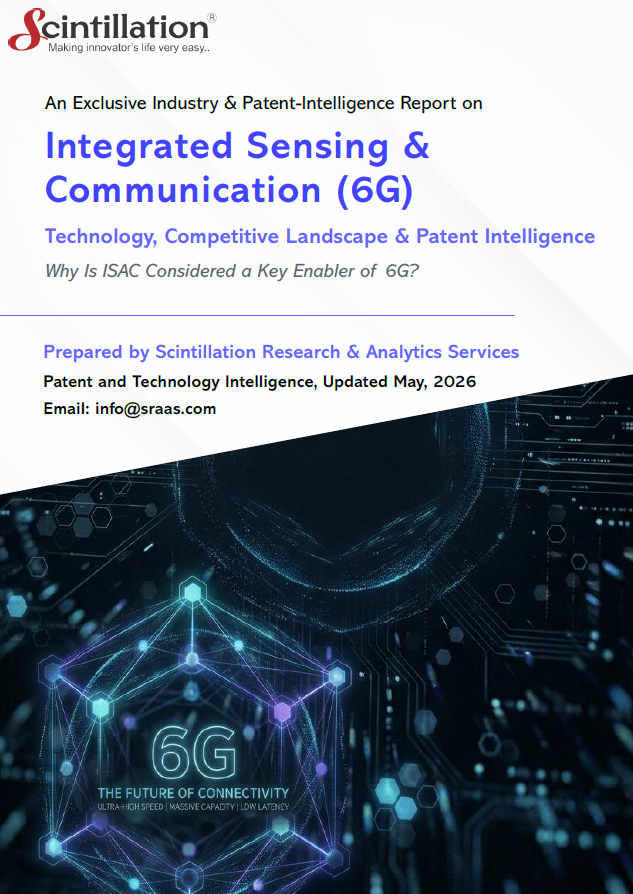
ISAC report cover

Request Your Sample Report Now!

    For a quick demo, schedule a meeting now!

    Shopping Cart (0 items)

    Subscribe to our newsletter

    Sign up to receive latest news, updates, promotions, and special offers delivered directly to your inbox.
    No, thanks
    Select your currency