How is Stretchable Display Technology Aiming to Break Past the Limits of OLED and LCD

  • Home
  • How is Stretchable Display Technology Aiming to Break Past the Limits of OLED and LCD
Patent Intelligence Report  ·  Display Technology Series

How Stretchable Display Technology Is Breaking Past the Limits of OLED and LCD

A data-grounded look at who is filing, where, and why it matters now.

A comprehensive technology and patent intelligence analysis of stretchable displays — examining elastic deformation architectures, serpentine patterning, mass transfer manufacturing, multi-axis stretch capabilities, and the evolving IP landscape across wearable electronics, healthcare, automotive, and next-generation human-machine interfaces.

Multi-axisElastic deformation
Beyond OLEDConformable surfaces
E-skinConvergence pathway
8-partPatent landscape analysis

Report details

Stretchable Display Technology — Patent Intelligence Report

Publisher Scintillation Research
Technology Stretchable Displays
Beyond OLED, LCD, foldable, rollable
Key capabilities Multi-axis elastic deformation
IP coverage 8-part patent landscape
Applications Wearables, healthcare, automotive, XR
Audience IP, R&D, Strategy, Investment
Stretch Multi-axis elastic display
3D Surface conformability
Post-OLED Next form factor
IP 8-part patent analysis
360° Ecosystem coverage
Introduction

The display form factor that bends, stretches, and conforms to anything

Stretchable display technology is defined by the ability of a display panel to undergo elastic deformation — stretching, compressing, or conforming to complex 3D surfaces — while maintaining optical and electrical functionality.

Unlike foldable or rollable displays, stretchable systems must accommodate multi-axis deformation without fracture or electrical failure, making them fundamentally more demanding from a materials and engineering standpoint. The field sits at the intersection of semiconductor device engineering, polymer materials science, and advanced manufacturing — including mass transfer, 3D printing, and serpentine patterning.

It is anticipated that stretchable screens will develop into next-generation gadgets that combine sensors to create electronic skin-like structures replicating human skin's suppleness and elasticity — opening pathways to uniformly controllable, totally and innately stretchy display technology that was previously impossible with OLED or LCD architectures.

This report addresses a long-standing mechanical difficulty in stretchable displays and opens the door to new applications in wearable electronics, flexible displays, and data security. By examining both consistent mechanical performance and superior optical capabilities, the report connects the technology's progress to the intellectual-property activity surrounding it — enabling readers to understand who is filing, where the innovation is concentrated, and what it means for IP and technology strategy.

Report structure

Table of contents

Eleven chapters connecting stretchable display technology's scientific foundations and industry story to patent landscape intelligence and commercialization strategy. Click any chapter to expand.

Condensed findings on stretchable display technology, top patent assignees, filing trends, and strategic implications for the display and optoelectronics industry
2.1 Who Will Benefit from This Report — display engineers, materials scientists, IP counsel, consumer electronics strategists, healthcare wearable investors, and optoelectronics analysts
3.1 Challenges in Conventional Display Technologies — rigidity, fracture under stress, limited design adaptability, poor conformability to curved surfaces, and inadequate performance on moving surfaces
Structural components — elastomeric substrates, serpentine interconnects, micro-LED/OLED pixel islands, encapsulation systems, and stretchable conductor networks
4.1 Key Features — multi-axis elastic deformation, 3D surface conformability, optical performance under strain, self-healing materials, and integrated sensor-display architectures
4.2 Problems Aims to Solve — rigidity, fracture failure, design inflexibility, surface incompatibility, and the manufacturing reality of scalable stretch-display production
4.3 Potential Applications & comparison with conventional displays — wearable electronics, smart textiles, healthcare monitors, automotive skins, XR interfaces, and data security surfaces
5.1 Why the Revival Matters for IP — how renewed commercial momentum is reshaping the patent landscape and creating new strategic filing opportunities
5.2 Avoiding the Name Collision — clarifying the distinction between stretchable displays, foldable displays, and rollable displays for accurate IP landscape scoping
Technology readiness, manufacturing scale-up pathways, cost reduction, ecosystem partnerships, and near-term commercial deployment opportunities across verticals
7.1 Methodology & Scope — patent database coverage, search strategy, classification framework, and analytical approach for stretchable display IP
7.2 Top Assignee Picture — leading patent filers with detailed notable assignee profiles across display OEMs, materials companies, and research institutions
7.3 Filing Activity Over Time — trend analysis identifying the pause, breakthrough, and revival pattern in stretchable display IP activity
7.4 Jurisdiction Coverage — KIPO, CNIPA, USPTO, JPO, EPO, WIPO, and regional patent office distributions across the stretchable display landscape
7.5 Technology Segmentation — patents mapped to elastomeric substrates, serpentine interconnects, micro-LED pixel islands, stretchable electrodes, encapsulation, and system integration
7.6 Foundational Anchor Patents — core IP defining the stretchable display landscape and their competitive strategic significance
7.7 Representative Publications Across the Field — key academic and industry publications shaping stretchable display research and commercialization direction
7.8 Whitespace & Strategic Opportunities — unprotected technology domains and emerging filing opportunities across the stretchable display IP ecosystem
Stakeholder-specific takeaways for display engineers, IP counsel, consumer electronics strategists, healthcare wearable developers, automotive designers, and optoelectronics investors
Synthesis of stretchable display technology's trajectory, IP landscape dynamics, and strategic implications for the future of flexible and conformable electronics
Publisher profile, research methodology, and service overview — patent analytics, technology scouting, competitive intelligence, and strategic research
Full legal disclaimer covering information accuracy, IP ownership, and terms of use for this intelligence report
Inside Stretchable Display Technology

Structural components & key features

Stretchable displays require an entirely different engineering paradigm from OLED or LCD — combining elastomeric substrates, serpentine interconnects, island-bridge architectures, and strain-tolerant encapsulation to maintain optical performance under multi-directional mechanical deformation.

Elastomeric substrates
PDMS, Ecoflex, and polyurethane-based substrate materials with Young's modulus matched to human skin — enabling up to 100%+ biaxial strain without delamination or optical degradation.
Serpentine interconnects
S-curve and horseshoe-shaped metal conductor geometries that absorb mechanical strain through geometric unfolding rather than elastic material deformation — the key to failure-free stretchable wiring.
Micro-LED & OLED pixel islands
Rigid pixel device islands bonded to stretchable substrates via mass transfer — enabling conventional high-brightness display emitters to operate reliably within an overall stretchable system architecture.
Multi-axis elastic deformation
Unlike foldable displays that bend along a single axis, stretchable displays accommodate simultaneous stretching, compression, and twisting across three dimensions — enabling truly conformal integration on curved surfaces.
Stretchable conductor networks
AgNW, carbon nanotube, and graphene-based transparent conducting layers maintaining electrical continuity and optical transparency across the full strain range of the display system.
Optical performance under strain
Strain-invariant pixel brightness, color gamut, and viewing angle — achieved through careful decoupling of optical and mechanical functions within the display layer stack.
Integrated sensor-display convergence
Co-integration of touch, pressure, temperature, and biometric sensors within the stretchable display layer — enabling simultaneous display and environmental sensing functions on the same conformal surface.
Mass transfer manufacturing
Precision pick-and-place transfer of micro-device arrays from rigid growth substrates to stretchable receiving substrates — the enabling manufacturing process for scalable stretchable display production.
Conventional vs stretchable displays

Why stretchable goes beyond OLED and LCD

Stretchable displays represent a fundamentally different engineering paradigm — not an incremental improvement on OLED or LCD, but a new class of display technology enabling form factors and applications impossible with conventional display substrates.

Capability LCD OLED Foldable OLED Stretchable Display
Mechanical deformation Rigid — none Rigid — none Single-axis fold Multi-axis stretch & conform
3D surface conformability None None Limited Full 3D conformal
Fracture resistance Low Moderate Improved Engineered strain tolerance
Wearable integration Not possible Not possible Limited — flat surfaces Full skin-contour integration
Sensor co-integration Separate layers Touch only Touch only Multi-modal on-skin sensing
Design flexibility Fixed rectangular Fixed or curved Foldable shapes Arbitrary 3D morphology
Technology story

Pause, breakthrough, revival — and why it matters for IP

The Stretchable Display Story
Three phases that shaped the current IP landscape
The stretchable display field did not develop linearly. An early phase of foundational research was followed by a period of reduced commercial activity, before a significant revival driven by materials breakthroughs, micro-LED progress, and renewed industrial interest. Understanding this timeline is essential for interpreting the current patent landscape.
The Pause
Early research established the serpentine interconnect and island-bridge architecture concepts, but manufacturing complexity and yield challenges slowed commercial progress
The Breakthrough
Advances in mass transfer manufacturing, elastomeric materials science, and micro-LED technology unlocked viable pathways to scalable stretchable display production
The Revival
Renewed industrial filing activity — particularly from display OEMs and electronics conglomerates — signals accelerating IP positioning ahead of anticipated commercial deployment
Why it matters for IP
The revival creates both filing opportunities in under-claimed areas and freedom-to-operate risks as leading players build defensive portfolios — making landscape analysis critical now
Challenges addressed

Why OLED and LCD reach their limits

Stretchable display technology directly targets five structural constraints that prevent conventional flat-panel displays from serving the next generation of wearable, conformal, and bio-integrated applications.
01
Rigid form factor limiting design adaptability
OLED and LCD panels are manufactured on rigid or semi-rigid substrates that cannot conform to non-planar surfaces. Stretchable display architectures use elastomeric substrates and deformation-tolerant device layouts to enable integration on any surface geometry
Rigidity
02
Fracture under mechanical stress
Conventional display conductors and thin-film transistors fail under even small mechanical deformation. Serpentine interconnects, island architectures, and stretchable conductor networks distribute and absorb mechanical strain — enabling reliable operation through thousands of stretch-release cycles
Durability
03
Incompatibility with moving & curved surfaces
Flat displays cannot maintain optical contact or mechanical integrity on moving joints, curved anatomical surfaces, or dynamically deforming substrates. Stretchable displays conform and move with their host surface — enabling wearable, robotics, and automotive skin integration
Conformability
04
Single-function display surfaces
Conventional displays are purely visual output devices. Stretchable displays enable co-integration of tactile sensing, biometric monitoring, pressure detection, and temperature sensing on the same conformal surface — creating multifunctional skin-like interfaces
Multi-function
05
Manufacturing scalability at stretch
Adapting semiconductor fabrication processes — originally designed for rigid substrates — to elastomeric systems requires new approaches to lithography, mass transfer, bonding, and encapsulation. The manufacturing reality section addresses current progress and remaining scale-up barriers
Manufacturing
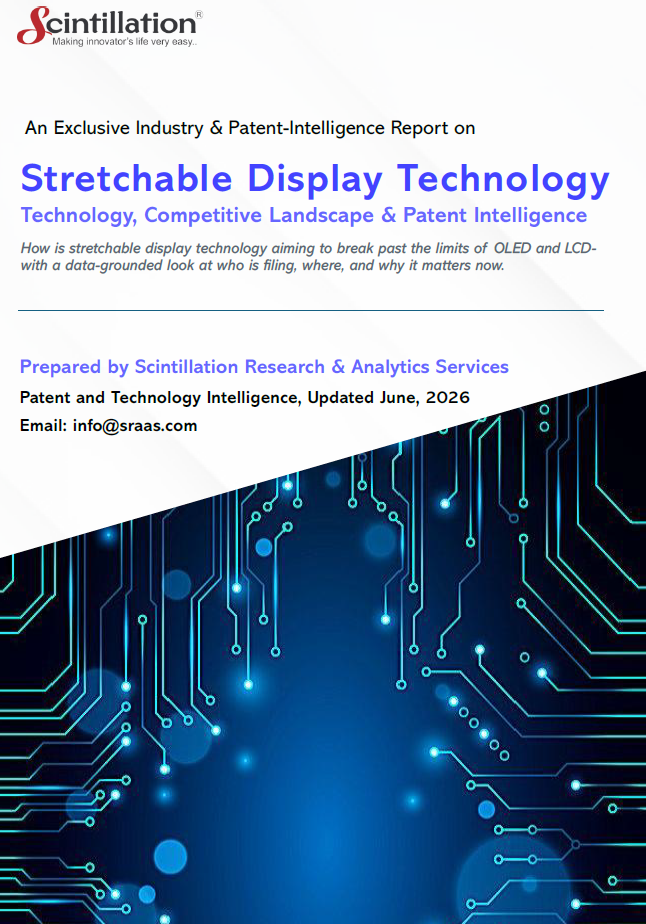
Stretchable Display report cover

Request Your Sample Report Now!

    For a quick demo, schedule a meeting now!

    Shopping Cart (0 items)

    Subscribe to our newsletter

    Sign up to receive latest news, updates, promotions, and special offers delivered directly to your inbox.
    No, thanks
    Select your currency