DNA Computing: Where Biology Meets Computation

  • Home
  • DNA Computing: Where Biology Meets Computation
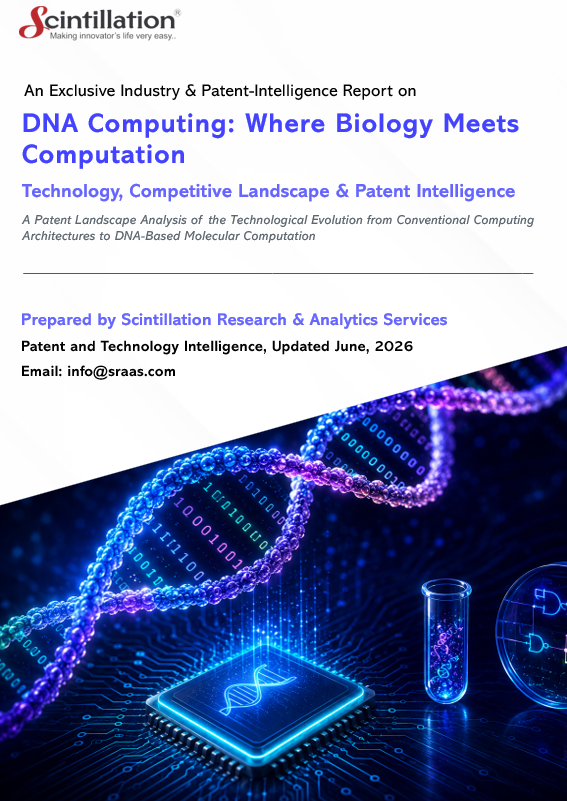
DNA Computing: A Patent Landscape Analysis of the Technological Evolution from Conventional Computing Architectures to DNA-Based Molecular Computation | Scintillation Research
Patent Intelligence Report  ·  Emerging Computing Paradigms Series

DNA Computing: Where Biology Meets Computation

A data-grounded look at who is filing, where innovation is concentrated, and why DNA computing is emerging as a strategically important alternative paradigm for future information-processing systems.

A comprehensive technology and patent intelligence analysis of DNA computing — examining DNA data storage, molecular computing, strand-displacement systems, DNA logic networks, biomolecular neural networks, and AI-enabled biomolecular computing as conventional silicon-based computing approaches the physical limits of miniaturization.

DNA StorageMolecular-scale data density
Strand DisplacementProgrammable molecular circuits
Logic GatesBoolean computation in DNA
PatentLandscape & whitespace analysis

Report details

DNA Computing — Technology & Patent Landscape Intelligence Report

Publisher Scintillation Research
Technology DNA Computing
Focus area Molecular & Biomolecular Computation
Key segments DNA Storage, Strand Displacement, Logic
IP coverage Patent landscape study
Applications Data Storage, Diagnostics, AI, Security
Audience IP, R&D, Strategy, Investment
DNA Molecular computation
4 Nucleotide-base logic alphabet
SDS Strand-displacement systems
IP Patent landscape study
AI+Bio AI-enabled biomolecular computing
Introduction

When silicon-based computing approaches the physical limits of miniaturization

DNA computation is an emerging computing paradigm that employs oligonucleotides instead of traditional silicon chips, while maintaining similar logical architectures to silicon-based computation. It has the ability to perform Boolean logic gates and numeric calculations, but with reduced size and increased gate throughput.

As traditional silicon-based computers approach the physical limits of miniaturization, the pace of Moore's Law is slowing and may no longer be effective. The transition of DNA computing from theoretical concepts to practical applications has highlighted several key approaches, including DNA strand displacement circuits, molecular logic gates, DNA-based data storage, and biomolecular neural networks.

Over the past decade, significant advances in synthetic biology, nanotechnology, and molecular engineering have accelerated the development of DNA computing technologies. Researchers have successfully demonstrated DNA-based algorithms, programmable molecular circuits, and large-scale data storage systems, establishing DNA as a promising medium for future computing architectures.

Report structure

Table of contents

Twelve chapters connecting DNA computing's technical foundations to patent landscape intelligence and commercialization strategy. Click any chapter to expand.

Condensed findings on DNA computing technology, patent filing trends, assignee dynamics, and strategic implications for molecular computation IP
Who Will Benefit from This Report — synthetic biology researchers, computing strategists, IP counsel, biotech investors, and technology scouts tracking molecular computation
3.1 Limitations of Conventional Computing Technologies — scalability constraints, energy consumption, slowing pace of Moore's Law, and data-storage capacity limits of silicon-based architectures
Core Components of DNA Computing — oligonucleotide design, strand-displacement circuits, molecular logic gates, and DNA-based data encoding architectures
4.1 Challenges Addressed by DNA Computing — silicon scaling limits, energy efficiency, massive data-storage density, and parallel computation capacity
4.2 Key Features of DNA Computing — molecular-scale miniaturization, massive parallelism, programmable molecular circuits, and ultra-dense information storage
4.3 Applications of DNA Computing — archival data storage, molecular diagnostics, biomolecular neural networks, and AI-enabled biomolecular computing platforms
The technological trajectory from early theoretical DNA computation concepts to programmable molecular circuits and large-scale demonstrated systems
Strategic signals — convergence with synthetic biology and AI, accelerating R&D investment, and DNA computing's positioning as a post-silicon computation alternative
Commercialization roadmap, manufacturing and synthesis scalability, integration with conventional computing infrastructure, and near-term deployment opportunities
8.1 Methodology & Scope — patent database coverage, search strategy, classification framework, and analytical approach for DNA computing IP
8.2 Interesting Strategic Insights — notable filing patterns, cross-domain convergence signals, and standout strategic moves across the DNA computing landscape
8.3 Assignee Picture — leading filers across academic institutions, biotech companies, and computing technology firms shaping the DNA computing IP landscape
8.4 Filing Activity Over Time — trend analysis identifying R&D acceleration and IP maturity signals across DNA computing technology domains
8.5 Jurisdiction Coverage — USPTO, CNIPA, KIPO, JPO, EPO, and WIPO distributions across the DNA computing patent landscape
8.6 Technology Segmentation — patents mapped to DNA data storage, molecular computing, strand-displacement systems, DNA logic networks, and AI-enabled biomolecular computing
8.7 Representative Publications Across the Field — key academic and industry publications shaping DNA computing research direction
8.8 Whitespace & Strategic Opportunities — underprotected technology domains and emerging filing opportunities across the DNA computing IP ecosystem
Stakeholder-specific takeaways for synthetic biology researchers, computing strategists, IP counsel, and biotech investors
Synthesis of DNA computing's technical trajectory, IP landscape dynamics, and strategic implications for next-generation molecular computation commercialization
Publisher profile, research methodology, and service overview — patent analytics, technology scouting, competitive intelligence, and strategic research across emerging computing domains
Full legal disclaimer covering information accuracy, IP ownership, and terms of use for this intelligence report
DNA Computing: A Next Generation Computing Technology

Core components & key features

DNA computing replaces silicon transistor logic with oligonucleotide-based molecular reactions — leveraging the programmability, massive parallelism, and information density inherent to DNA to perform computation and store data at molecular scale.

Oligonucleotide design & synthesis
Engineered short DNA sequences designed for predictable hybridization behavior — the fundamental building block enabling programmable molecular logic and data encoding.
DNA strand-displacement circuits
Programmable molecular circuits where one DNA strand displaces another through complementary base-pairing — enabling cascading logical operations entirely within a test tube or chip environment.
Molecular logic gates
DNA-based implementations of Boolean logic — AND, OR, NOT, and more complex gates — built from hybridization reactions, enabling computation with massively parallel reaction throughput.
DNA-based data storage
Encoding digital information directly into base-pair sequences — leveraging DNA's extraordinary information density and multi-century stability for archival-scale data storage.
Biomolecular neural networks
DNA-based circuits engineered to mimic neural network computation — weighted molecular interactions performing pattern recognition and classification tasks at the molecular scale.
Massive molecular parallelism
Trillions of DNA molecules reacting simultaneously in solution — enabling combinatorial search and parallel computation at a scale unachievable with sequential silicon logic.
AI-enabled biomolecular computing
Machine-learning-guided design of DNA sequences and reaction networks — accelerating circuit design, error correction, and the practical reliability of molecular computation systems.
Read/write & error-correction architectures
Sequencing-based readout and encoding schemes paired with redundancy and error-correction strategies — addressing synthesis and sequencing error rates inherent to molecular information systems.
Challenges addressed

Why conventional computing architectures cannot meet future scaling demands

DNA computing directly targets the structural constraints that limit how far silicon-based computing can continue to scale, while introducing new technical hurdles of its own around speed, reliability, and integration that the field is actively working to resolve.

01
Slowing pace of Moore's Law
Silicon transistor miniaturization is approaching fundamental physical limits, causing the historical doubling of transistor density to slow. DNA computing's molecular-scale logic elements are not bound by the same lithographic scaling constraints
Scaling limits
02
Energy consumption at scale
Conventional computing's energy demands grow substantially with increasing computational throughput, particularly for large-scale parallel search and optimization problems. DNA-based molecular reactions can perform massively parallel computation with comparatively low energy input
Energy efficiency
03
Data-storage capacity limits
Conventional magnetic and solid-state storage media face physical density limits and require ongoing energy input for long-term data retention. DNA's extraordinarily high information density and multi-century molecular stability offer a fundamentally different archival storage paradigm
Storage density
04
Sequential processing bottlenecks
Silicon architectures largely process instructions sequentially or with limited parallelism per core. DNA computing exploits the inherent parallelism of trillions of molecules reacting simultaneously, offering a fundamentally different approach to combinatorial and search-based computation
Parallelism
05
Read/write speed & reliability
DNA synthesis and sequencing remain substantially slower and more error-prone than conventional electronic read/write operations, and integrating molecular computation with existing digital infrastructure introduces interface and error-correction challenges that remain active areas of R&D
Speed & reliability
Technology evolution

From theoretical concept to demonstrated molecular systems

DNA computing's trajectory reflects a steady progression from foundational theoretical proofs of concept to increasingly sophisticated, programmable, and AI-augmented molecular computing systems.

Foundational concept
Theoretical DNA computation & combinatorial proof-of-concept
Early demonstrations established that DNA hybridization reactions could solve combinatorial problems and implement basic logical operations, establishing molecular computation as a viable theoretical paradigm.
Circuit design
Strand-displacement circuits & molecular logic gates
Researchers developed programmable strand-displacement cascades capable of implementing Boolean logic gates and simple digital circuits using only DNA hybridization chemistry.
Data storage demonstration
DNA-based data storage at increasing scale
Successful encoding and retrieval of digital files into synthesized DNA sequences demonstrated DNA's viability as a high-density, long-term archival storage medium.
Biomolecular intelligence
Biomolecular neural networks & pattern recognition
Molecular circuits were engineered to perform weighted computation analogous to neural network operations, enabling rudimentary pattern classification entirely in molecular form.
AI convergence
AI-enabled biomolecular computing design & optimization
Machine-learning tools are increasingly applied to design DNA sequences, predict reaction behavior, and correct errors — accelerating the practical reliability and scalability of molecular computing systems.
Why DNA computing is a technology to watch

Strategic signals driving renewed attention

Several converging trends are elevating DNA computing from a niche academic pursuit to a technology attracting strategic interest across computing, biotechnology, and information-security domains.
01
Convergence with synthetic biology
Maturing synthetic biology tools and falling DNA synthesis costs are making molecular computation increasingly practical and economically viable.
02
A genuine post-silicon alternative
As silicon scaling slows, DNA computing represents one of few fundamentally different computational substrates with a credible technical foundation.
03
AI-accelerated circuit design
Machine-learning-guided sequence design is compressing development cycles that previously required extensive trial-and-error wet-lab experimentation.
04
Archival storage economics
Exponential growth in global data generation is increasing demand for ultra-high-density, long-lived storage media that DNA is uniquely positioned to offer.

Download Your Sample Report Now:

    Application areas

    Where DNA computing creates emerging impact

    DNA computing's information density, parallelism, and molecular programmability are most compelling in applications where conventional computing or storage approaches face fundamental scaling, energy, or longevity limits.

    Archival Data Storage
    Ultra-high-density, long-term data storage leveraging DNA's molecular information capacity and multi-century stability
    Molecular Diagnostics
    DNA-based logic circuits performing in-vitro and point-of-care diagnostic computation directly within biological samples
    Combinatorial Optimization
    Massively parallel molecular search applied to complex combinatorial and optimization problems beyond practical reach of sequential computing
    Biomolecular AI & Pattern Recognition
    DNA-based neural network analogs performing classification and pattern recognition tasks at the molecular scale
    Information Security & Steganography
    DNA-encoded data and molecular cryptographic schemes offering novel approaches to secure information storage and transmission
    Synthetic Biology Platforms
    Programmable molecular circuits integrated into broader synthetic biology systems for sensing, control, and computation
    Biomedical Research & Drug Discovery
    Molecular computation applied to combinatorial chemistry, sequence design, and high-throughput biological screening
    Hybrid Bio-Electronic Computing
    Emerging integration architectures connecting molecular computation modules with conventional digital infrastructure
    Patent intelligence

    The DNA computing patent landscape

    The patent landscape chapter delivers data-grounded IP intelligence — from methodology and strategic insights to assignee profiling, filing trends, jurisdiction coverage, technology segmentation, representative publications, and whitespace identification across the full DNA computing ecosystem.

    Filing & jurisdiction intelligence
    • Methodology and scope defining the boundaries of DNA computing patent analysis
    • Interesting strategic insights — notable filing patterns and cross-domain convergence signals across the DNA computing landscape
    • Assignee picture — academic institutions, biotech companies, and computing technology firms shaping the DNA computing IP landscape
    • Filing activity over time and jurisdiction coverage across USPTO, CNIPA, KIPO, JPO, EPO, and WIPO
    Technology & strategic analysis
    • Technology segmentation — DNA data storage, molecular computing, strand-displacement systems, DNA logic networks, and AI-enabled biomolecular computing
    • Representative publications across the field — key academic and industry papers shaping DNA computing research direction
    • Whitespace & strategic opportunities — underprotected technology domains and emerging filing and licensing opportunities
    • Strategic implications for freedom-to-operate, partnership, and acquisition decisions across the DNA computing ecosystem
    Who will benefit

    Who should read this report

    Synthetic Biology & Molecular Engineering Researchers
    Researchers designing oligonucleotide circuits, strand-displacement systems, and molecular logic gates for next-generation computing and storage applications.
    Computing Strategists & Architects
    Technology strategists evaluating DNA computing as a post-silicon computational paradigm and assessing integration pathways with conventional digital infrastructure.
    IP Counsel & Patent Teams
    Attorneys and patent professionals assessing portfolio positioning, whitespace, freedom-to-operate, and filing strategy across DNA storage, molecular logic, and biomolecular computing technologies.
    Biotech & Deep-Tech Investors
    Investment professionals tracking the molecular computing ecosystem, the DNA computing IP landscape, and emerging companies in DNA storage and synthetic biology computation.
    Data Storage & Infrastructure Strategists
    Strategy professionals evaluating DNA-based archival storage economics, scalability, and competitive positioning against conventional storage media.
    R&D Strategists & Industry Analysts
    Researchers and consultants mapping the competitive DNA computing landscape across academic institutions, biotech companies, and computing technology firms driving adoption.
    Technology & Patent Intelligence · Scintillation Research

    Understand who is building the IP foundation for DNA-based molecular computation

    Get the complete technology and patent intelligence report on DNA Computing — from strand-displacement circuits and DNA data storage to the patent landscape revealing who is filing, where innovation is concentrated, and why DNA computing is emerging as a strategically important alternative computing paradigm.

    Scintillation Research · DNA Computing · Patent Intelligence Series

    For a quick demo, schedule a meeting now!

    Service Demo Booking
    About

    About Scintillation Research

    Scintillation Research & Analytics Services is a specialized intellectual property and technology intelligence firm delivering patent analytics, technology scouting, competitive intelligence, and strategic research services.

    Through comprehensive patent and technology intelligence reports, we help organizations understand emerging innovations, identify market opportunities, monitor competitors, and make data-driven decisions across rapidly evolving technology domains. Our reports are designed for professionals at the intersection of technology strategy, IP management, and competitive intelligence.

    Shopping Cart (0 items)

    Subscribe to our newsletter

    Sign up to receive latest news, updates, promotions, and special offers delivered directly to your inbox.
    No, thanks
    Select your currency