
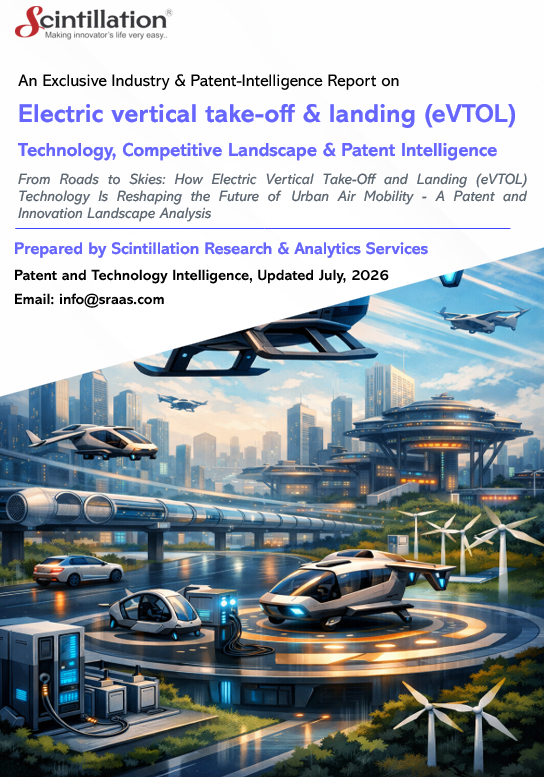
From Roads to Skies: How Electric Vertical Take-Off and Landing (eVTOL) Technology Is Reshaping the Future of Urban Air Mobility
A data-grounded look at who is filing, where innovation is concentrated, and why eVTOL technology is solidifying its position as the foundational platform for next-generation aviation and the Advanced Air Mobility revolution.
A comprehensive technology and patent intelligence analysis of eVTOL technology — examining distributed electric propulsion, tilt-rotor and tilt-wing architectures, battery and energy management systems, autonomous flight control, AI-enabled avionics, detect-and-avoid technologies, hydrogen-electric propulsion, lightweight composite structures, and Urban Air Mobility / Advanced Air Mobility ecosystem enabling technologies.
Report details
eVTOL Technology — Patent & Innovation Landscape Analysis Report
When roads, rails, and conventional aviation can no longer meet the urban mobility demands of the 21st century
Electric Vertical Take-Off and Landing (eVTOL) technology represents an emerging interdisciplinary domain that converges electric propulsion, aerospace engineering, advanced battery systems, lightweight composite materials, artificial intelligence, autonomous flight control, sophisticated avionics, and digital air traffic management to enable electrically powered aircraft capable of vertical take-off, hover, and landing.
Distinguished from conventional helicopters and fixed-wing aircraft, eVTOL platforms leverage distributed electric propulsion, high-efficiency electric motors, and intelligent flight control architectures to deliver quieter, lower-emission, and more cost-efficient air transportation across urban, regional, and specialized mobility applications.
The technology is attracting mounting global attention for its potential to address pressing challenges in urban traffic congestion, transportation efficiency, greenhouse gas emissions, noise pollution, and regional connectivity. Core innovations driving this transformation include distributed electric propulsion (DEP), tilt-rotor and tilt-wing aircraft architectures, vectored-thrust propulsion systems, high-energy-density battery technologies, hydrogen-electric propulsion, autonomous flight control, AI-enabled navigation, detect-and-avoid systems, advanced energy management, and integrated Urban Air Mobility (UAM) and Advanced Air Mobility (AAM) ecosystems.
Recent breakthroughs in battery chemistry, electric motor design, power electronics, lightweight structural materials, autonomous navigation, artificial intelligence, digital air traffic management, and aircraft certification frameworks are propelling eVTOL technology beyond prototype development and flight testing toward full-scale commercial deployment.
Table of contents
Nine chapters connecting eVTOL's technical foundations to patent landscape intelligence and commercialization strategy. Click any chapter to expand.
Core enabling technologies & key features
eVTOL aircraft integrate electric propulsion, autonomous control, and advanced materials into platforms that can take off and land vertically without a runway — enabling low-noise, low-emission urban air mobility at a cost and scale that conventional rotorcraft cannot approach.
Why conventional aviation and surface transport cannot meet urban mobility demands
eVTOL technology directly targets the congestion, emissions, noise, and accessibility constraints that prevent conventional aviation and surface transport from scaling to the demands of 21st-century urban mobility — while confronting new technical and regulatory hurdles specific to electric urban air operations.
Request Your Sample Report Now!
