Vision Language Industrial Robots for Smart Manufacturing

  • Home
  • Vision Language Industrial Robots for Smart Manufacturing
Patent & Innovation Landscape Analysis  ·  Smart Manufacturing Series

Robots That See and Understand: How Vision-Language Industrial Robots Are Powering the Next Era of Smart Manufacturing

A data-grounded look at who is filing, where innovation is concentrated, and why vision-language AI is turning conventional factory automation into adaptive, autonomous production.

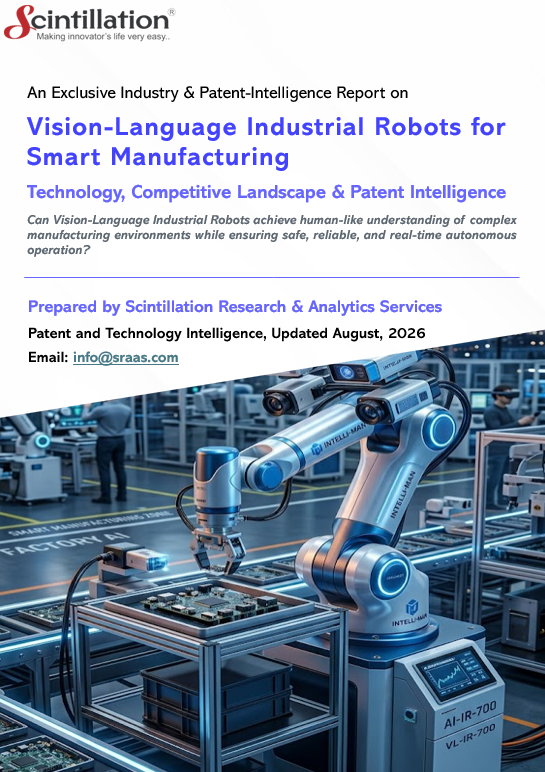
A technology and patent intelligence analysis of vision-language industrial robots for smart manufacturing — examining how the integration of vision-language artificial intelligence with industrial robotics is transforming conventional manufacturing into more intelligent, adaptive, and autonomous production systems.

VLMVision-language models
MultimodalSee, read, and act
Industry 4.0/5.0Smart manufacturing
PatentLandscape & whitespace

Report details

Vision-Language Industrial Robots for Smart Manufacturing — Patent & Innovation Landscape Analysis Report

PublisherScintillation Research
TechnologyVision-Language Industrial Robots
Focus areaAdaptive, autonomous production
Key segmentsVLMs, Perception, Task Planning, Manipulation
IP coverage6-part patent landscape
ApplicationsAssembly, Inspection, Handling, Logistics
AudienceIP, R&D, Strategy, Investment
Vision + LanguageMultimodal understanding
AdaptiveFlexible production
AutonomousIntelligent manufacturing
IP6-part patent analysis
Purpose of the report

Mapping innovation, patents, and commercialization potential

The purpose of this report is to analyze the emerging technology landscape of vision-language industrial robots for smart manufacturing, with a focus on recent innovations, patent activity, key industry participants, and future commercialization potential.

The report evaluates how integrating vision-language AI with industrial robotics is transforming conventional manufacturing into more intelligent, adaptive, and autonomous production systems. It identifies technology trends, leading patent assignees, geographical filing patterns, R&D directions, and innovation opportunities, while highlighting the technical challenges that currently limit large-scale commercial deployment.

It also offers insight into the competitive IP landscape, helping organizations identify collaboration opportunities, technology gaps, and strategic areas for future research and investment — a resource for businesses, researchers, investors, and technology developers supporting informed decisions in innovation, patent strategy, and commercialization planning.

Who will benefit from this report

Built for everyone shaping smart manufacturing

From automation companies and AI developers to investors, policymakers, and IP teams, the report turns an emerging field into decisions each audience can act on.

01
Industrial Automation Companies
Identify emerging technologies, evaluate competitors, and develop next-generation smart manufacturing solutions.
02
Robotics Manufacturers
Understand innovation trends in vision-language robotics and identify opportunities for autonomous and adaptive robotic systems.
03
AI & Computer Vision Developers
Explore the integration of vision-language models, multimodal AI, and robotics for industrial applications.
04
Manufacturing Enterprises
Assess future automation technologies that can improve productivity, flexibility, quality control, and operational efficiency.
05
Patent Professionals & IP Strategists
Analyze patent filing trends, leading assignees, technology evolution, and potential whitespace for innovation.
06
Research Institutions & Universities
Identify current research directions and emerging opportunities in AI-driven industrial robotics.
07
Technology Investors & VC Firms
Evaluate commercialization potential and investment opportunities in intelligent manufacturing technologies.
08
Government & Industry Policymakers
Understand technological advances that can support smart manufacturing initiatives and Industry 4.0/5.0 strategies.
09
System Integrators & Solution Providers
Identify future technologies for advanced factory automation and digital transformation projects.
Introduction

When a robot can read the scene and the instruction

Vision-language models let a machine interpret what its cameras see together with what people tell it, so a robot can be directed in plain language and reason about the parts, tools, and conditions in front of it.

In manufacturing, this shifts robots from rigidly scripted routines to flexible systems that can recognize variation, understand task descriptions, plan steps, and adapt on the fly. That makes short production runs, mixed-product lines, and fast changeovers more practical, and is drawing growing interest from automation vendors, AI developers, and manufacturers pursuing Industry 4.0 and 5.0 goals.

Report structure

Table of contents

Ten chapters connecting vision-language industrial robots to patent landscape intelligence and commercialization strategy. Click any chapter to expand.

—Condensed findings on vision-language industrial robots, leading assignees, filing trends, and strategic implications
—Who Will Benefit from This Report — automation companies, robotics makers, AI developers, manufacturers, IP professionals, researchers, investors, policymakers, and system integrators
3.1Challenges in Traditional Vision-Language Industrial Robots for Smart Manufacturing
4.1Key Features
4.2Problems Addressed
4.3Potential Applications
—Technology maturity, deployment barriers, and the path to large-scale commercial adoption in smart manufacturing
6.1Methodology & Scope
6.2Who Is Filing
6.3Filing Activity Over Time
6.4Jurisdiction Coverage
6.5Technology Segmentation
6.6Whitespace & Strategic Opportunities
—Stakeholder-specific takeaways for automation companies, AI developers, manufacturers, investors, IP teams, and policymakers
—Synthesis of the technical trajectory, IP dynamics, and strategic implications
—Overview of Scintillation Research and its patent and technology intelligence services
—Legal disclaimer covering information accuracy, IP ownership, and terms of use
Inside the technology

Key features & enabling technologies

Vision-language industrial robots combine multimodal understanding with robot perception, planning, and control so that factory machines can interpret scenes and instructions and act on them.

Vision-language models
Multimodal AI that links what cameras see with natural-language descriptions, questions, and instructions.
Visual perception & scene understanding
Recognizing parts, tools, defects, and workspace conditions in cluttered, variable factory environments.
Natural-language task instruction
Directing robots with plain-language commands instead of detailed manual programming.
Task reasoning & planning
Breaking a goal into steps and adjusting the plan when parts, positions, or conditions change.
Adaptive manipulation
Grasping and handling varied objects with control guided by visual and language context.
Intelligent quality inspection
Detecting and describing defects visually, with explanations operators can read and act on.
Edge deployment & real-time operation
Running multimodal models close to the robot to meet factory latency, reliability, and data-privacy needs.
Factory ecosystem integration
Connection to MES, PLCs, digital twins, and wider Industry 4.0/5.0 systems.
Problems addressed & challenges

Where traditional factory robots fall short

Conventional industrial robots excel at repetition but struggle with variation. Vision-language approaches target that gap, while facing their own barriers to large-scale deployment.

01
Rigid programming and slow changeovers
Reprogramming for each product or variation is slow and costly. Language-driven instruction and visual understanding speed up reconfiguration
Flexibility
02
Limited understanding of unstructured scenes
Classic vision systems handle narrow, pre-defined cases. Multimodal models generalize better to new objects and conditions
Perception
03
Reliability and safety of AI decisions
Model errors and unpredictable outputs are hard to accept on a production line, so verification and guardrails are essential
Reliability
04
Latency, compute, and data needs
Large models must meet real-time limits on factory hardware and adapt to domain-specific data that is often scarce or proprietary
Compute
05
Integration and commercialization barriers
Fitting with existing automation, standards, and workflows, and proving return on investment, still limit large-scale commercial deployment
Scale-up
Potential applications

Where vision-language robots create value

Any production task that benefits from seeing, understanding, and adapting is a candidate.

Flexible assembly
Mixed products and fast changeovers
Quality inspection
Visual defect detection with explanations
Pick-and-place & handling
Varied, unstructured parts
Human–robot collaboration
Instruction by voice and demonstration
Intralogistics
Material movement and kitting
Smart factory operations
Monitoring and process support
Patent landscape study

Who is filing, where, and in which technology areas

The landscape study maps innovation activity to reveal competitive positioning, technology clusters, and whitespace for new IP.

Scope & players
  • Methodology and scope: database coverage, search strategy, and classification framework
  • Who is filing: leading assignees and organization types
  • Filing activity over time and IP maturity signals
Landscape analytics
  • Jurisdiction coverage across major patent offices
  • Technology segmentation across VLMs, perception, planning, manipulation, and control
  • Whitespace and strategic opportunities for new filings and licensing
Request Your Sample Report Now!

    For a quick demo, schedule a meeting now!

    Shopping Cart (0 items)

    Subscribe to our newsletter

    Sign up to receive latest news, updates, promotions, and special offers delivered directly to your inbox.
    No, thanks