Closed Loop AI Digital Twins for Autonomous Manufacturing

  • Home
  • Closed Loop AI Digital Twins for Autonomous Manufacturing
Patent & Innovation Landscape Analysis  ·  Autonomous Manufacturing Series

Factories That Learn From Themselves: How Closed-Loop AI Digital Twins Are Enabling Autonomous Manufacturing

A data-grounded look at how digital twins are evolving from monitoring and simulation tools into self-optimizing systems that sense, predict, decide, and control.

Closed-loopContinuous feedback
PredictiveReal-time analytics
AutonomousSelf-optimizing factories
PatentLandscape & whitespace

Report details

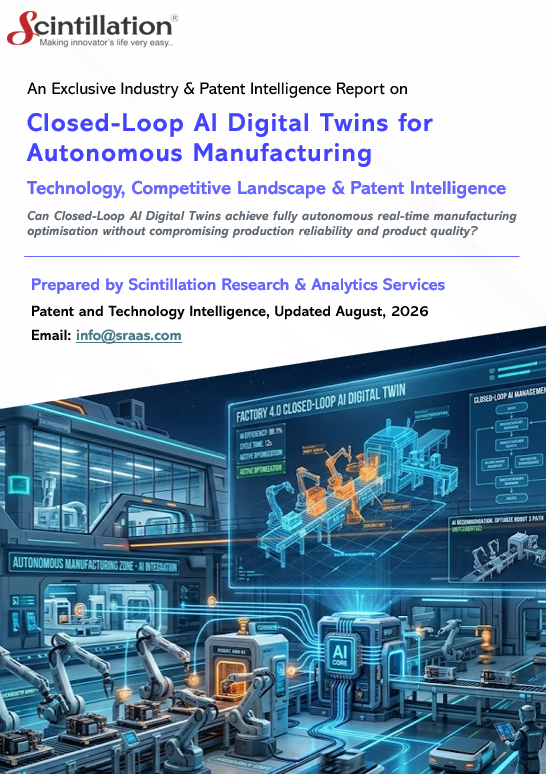
Closed-Loop AI Digital Twins for Autonomous Manufacturing — Patent & Innovation Landscape Analysis Report

PublisherScintillation Research
TechnologyClosed-Loop AI Digital Twins
Focus areaAutonomous manufacturing
Key segmentsTwins, Analytics, Control, Robotics
IP coverage6-part patent landscape
AudienceIP, R&D, Strategy, Investment
Purpose of the report

Assessing maturity, patents, and commercial potential

This report assesses the technological maturity, patent landscape, innovation trends, and commercialization potential of closed-loop AI digital twins for autonomous manufacturing, and how they are evolving from monitoring and simulation platforms into self-optimizing systems that continuously sense, predict, decide, and control manufacturing operations.

It analyzes AI-driven digital twins, real-time industrial data integration, predictive analytics, autonomous process optimization, robotics, and closed-loop control, and evaluates patent activity and major players to show where future opportunities lie for manufacturers, technology providers, and investors.

Who will benefit from this report

Built for everyone shaping autonomous factories

Each audience gets a clear view of the landscape and what to do with it.

01
Manufacturers & Smart Factory Operators
Improve efficiency, predictive maintenance, quality control, and autonomous process optimization.
02
Automation & Robotics Companies
Integrate AI-driven digital twins with robots, machines, sensors, and automated production systems.
03
Technology Developers & AI Providers
Find gaps in AI-based simulation, real-time analytics, closed-loop control, and autonomous decision-making.
04
Patent Owners & R&D Teams
Track patent activity, key players, and whitespace for future R&D and patenting strategies.
05
IP & Patent Professionals
Support landscaping, competitor intelligence, technology scouting, FTO and validity work, and cluster identification.
06
Investors & Strategy Teams
Evaluate maturity, commercialization potential, competitive positioning, and investment opportunities.
07
System Integrators & Software Providers
Connect digital twins with MES, SCADA, ERP, IoT platforms, robotics, and factory-control systems.
08
Researchers & Academia
Gain insight into emerging research directions and unresolved technical challenges.
09
Government & Industry Policymakers
Understand autonomous manufacturing progress and support Industry 4.0 and advanced-manufacturing initiatives.
Introduction

From watching the factory to running it

A digital twin is a live virtual model of a machine, line, or plant. In a closed-loop system, that model does more than mirror reality: AI uses real-time data to predict what will happen, decides on an adjustment, and sends it back to the physical system to act on, then checks the result and repeats. This continuous feedback is what moves factories from monitored to self-optimizing.

Report structure

Table of contents

Ten chapters, from closed-loop digital twin fundamentals to patent landscape intelligence. Click any chapter to expand.

—Key findings on closed-loop AI digital twins, leading filers, trends, and strategic implications
—Who Will Benefit from This Report
3.1Challenges in Traditional Closed-Loop AI Digital Twins for Autonomous Manufacturing
4.1Key Features
4.2Problems Addressed
4.3Potential Applications
—Technology maturity, adoption barriers, and the path to commercial deployment
6.1Methodology & Scope
6.2Who Is Filing
6.3Filing Activity Over Time
6.4Jurisdiction Coverage
6.5Technology Segmentation
6.6Whitespace & Strategic Opportunities
—Stakeholder-specific takeaways for manufacturers, technology providers, IP teams, and investors
—Synthesis of the technical trajectory, IP dynamics, and strategic implications
—Overview of Scintillation Research and its patent and technology intelligence services
—Legal disclaimer covering information accuracy, IP ownership, and terms of use
Key features

Core technologies behind closed-loop twins

From live data in to autonomous action out.

AI-driven digital twins
Virtual models that learn and update from the behavior of the real system.
Real-time data integration
Continuous streams from sensors, machines, and plant systems.
Predictive analytics
Forecasting faults, quality drift, and performance before they happen.
Autonomous process optimization
AI that tunes parameters and schedules without waiting for a person.
Closed-loop control
Decisions sent back to the line, with results fed into the next cycle.
Robotics & factory integration
Links to robots, MES, SCADA, ERP, and IoT platforms.
Problems addressed

Where one-way digital twins fall short

Closed-loop twins target the gap between knowing and acting, while facing their own barriers to scale.

01
Insight without action
Monitoring and simulation twins show what is happening but leave the response to people
02
Reactive maintenance and quality loss
Faults and drift are caught late. Prediction and automatic correction act earlier
03
Slow, manual optimization
Tuning processes by hand cannot keep pace with changing demand and conditions
04
Trust, integration, and scale barriers
Model accuracy, safe autonomous control, data quality, and legacy system integration remain open
Potential applications

Where closed-loop twins create value

Anywhere production can be sensed, predicted, and adjusted continuously.

Predictive maintenance
Quality control
Autonomous process optimization
Production scheduling
Robotic cell control
Energy and resource efficiency
Patent landscape study

Who is filing, where, and in which areas

The study covers methodology and scope, who is filing, filing activity over time, jurisdiction coverage, technology segmentation across digital twins, analytics, control, and robotics, and the whitespace and strategic opportunities for new filings and licensing.
Request Your Sample Report Now!

    For a quick demo, schedule a meeting now!

    Shopping Cart (0 items)

    Subscribe to our newsletter

    Sign up to receive latest news, updates, promotions, and special offers delivered directly to your inbox.
    No, thanks