Personalized mRNA Cancer Vaccines

  • Home
  • Personalized mRNA Cancer Vaccines
Patent & Innovation Landscape Analysis  ·  Precision Oncology Series

One Tumor, One Vaccine: How Personalized mRNA Cancer Vaccines Turn Tumor Mutations Into Individualized Treatment

A data-grounded look at who is developing these technologies, where innovation is concentrated, and what it means for research, commercialization, and IP strategy.

NeoantigensTumor-specific targets
mRNAEngineered to instruct
LNPLipid nanoparticle delivery
PatentLandscape & whitespace

Report details

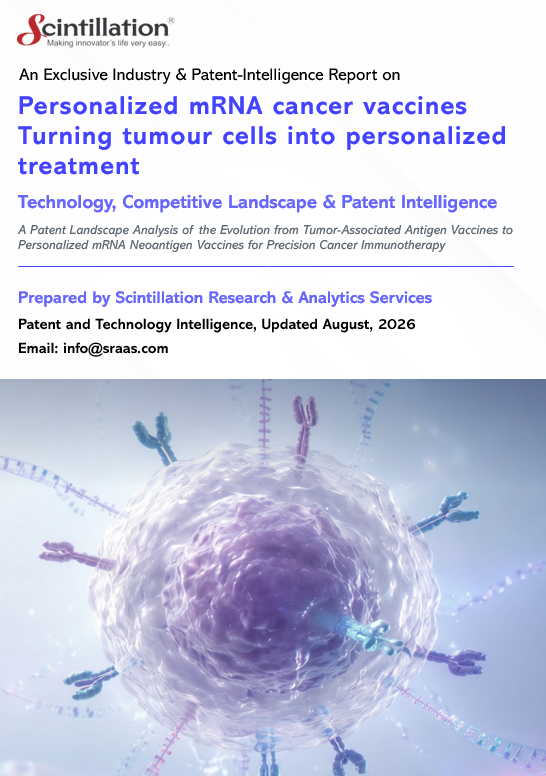
Personalized mRNA Cancer Vaccines — Patent & Innovation Landscape Analysis Report

PublisherScintillation Research
TechnologyPersonalized mRNA Cancer Vaccines
Focus areaPatient-specific cancer immunotherapy
Key segmentsSequencing, Neoantigens, mRNA, LNP, Manufacturing
IP coverage8-part patent landscape
AudienceIP, R&D, Biopharma, Investment
Purpose of the report

Mapping a next-generation approach to precision cancer immunotherapy

This report explores personalized mRNA cancer vaccines that turn tumor-specific mutations into individualized treatments, a next-generation approach to precision cancer immunotherapy. It examines the foundations, evolving applications, innovation landscape, and IP activity, showing who is developing these technologies, where innovation is concentrated, and what that means for research, commercialization, and IP strategy.

It covers tumor genomic profiling, next-generation sequencing, neoantigen identification and prediction, AI-assisted antigen selection, mRNA engineering, modified nucleosides, lipid nanoparticle delivery, immune-cell activation, personalized vaccine manufacturing, and combination immunotherapy, along with leading innovators, filing trends, competitive dynamics, whitespace, and the outlook for patient-specific vaccines designed to generate targeted immune responses against individual tumors.

Who will benefit from this report

Built for everyone shaping personalized cancer immunotherapy

Each audience gets a clear view of the landscape and what to do with it.

01
Patent Attorneys, Agents & IP Analysts
Assignees, filing trends, jurisdictions, and segments to support prosecution, FTO, invalidity, and portfolio work.
02
Licensing & Business Development
Foundational and emerging portfolios in mRNA platforms, neoantigen discovery, sequencing, delivery, and manufacturing, with licensing and collaboration targets.
03
In-house IP & R&D Leaders
Competitive intelligence on personalized vaccines, mRNA, neoantigen prediction, delivery, and immune activation.
04
Investors & Market Analysts
An evidence-based view of innovation activity, commercialization trends, leading developers, and clinical-development approaches.
05
Biotech, Pharma, Diagnostics & Technology Companies
Insight into sequencing, AI antigen prediction, mRNA design, LNP delivery, personalized manufacturing, and combination therapies.
06
Academia & Research Organizations
Benchmarking on leading groups, neoantigen discovery methods, vaccine platforms, and collaboration opportunities.
Introduction

Turning each tumor's own mutations into a treatment

Every tumor carries its own set of mutations, some of which produce abnormal proteins, called neoantigens, that the immune system can learn to recognize. A personalized mRNA cancer vaccine starts by sequencing a patient's tumor, uses computational methods to select the most promising neoantigens, and then encodes them in mRNA delivered, typically in lipid nanoparticles, to teach the immune system to target that patient's cancer. Making a different vaccine for each patient is a new kind of medicine, and it raises distinctive challenges in speed, cost, and manufacturing.

Report structure

Table of contents

Twelve chapters, from the science of personalized mRNA vaccines to patent landscape intelligence. Click any chapter to expand.

—Key findings on personalized mRNA cancer vaccines, leading assignees, filing trends, and strategic implications
—Who Will Benefit from This Report
3.1Limitations of Conventional Cancer Therapies
—Core Components of Personalized mRNA Cancer Vaccine Systems
4.1Challenges Addressed by Personalized mRNA Cancer Vaccines
4.2Key Features of Personalized mRNA Cancer Vaccines
4.3Applications of Personalized mRNA Cancer Vaccines
—How the field has progressed from tumor sequencing and mRNA platforms to patient-specific vaccines
—The scientific, clinical, and commercial signals that make the field strategically important
—Clinical-development approaches, commercialization pathways, and future directions
8.1Methodology & Scope
8.2Interesting Strategic Insights
8.3Assignee Picture
8.4Filing Activity Over Time
8.5Jurisdiction Coverage
8.6Technology Segmentation
8.7Representative Publications Across the Field
8.8Whitespace & Strategic Opportunities
—Stakeholder-specific takeaways for IP teams, licensing professionals, R&D leaders, investors, and biopharma companies
—Synthesis of the technical trajectory, IP dynamics, and strategic implications
—Overview of Scintillation Research and its patent and technology intelligence services
—Legal disclaimer covering information accuracy, IP ownership, and terms of use
Core components & key features

The building blocks of a personalized mRNA vaccine

From reading the tumor to delivering the instructions.

Tumor genomic profiling & sequencing
Next-generation sequencing to find the mutations that make each patient's tumor unique.
Neoantigen identification & AI-assisted selection
Predicting which mutated proteins are the best targets for an immune response.
mRNA engineering & modified nucleosides
Designing the mRNA so it is stable, efficiently translated, and well tolerated.
Lipid nanoparticle delivery
Carriers that protect the mRNA and deliver it into cells.
Immune-cell activation
Approaches that train T cells and other immune cells to recognize and attack tumor cells.
Personalized manufacturing & combination therapy
Fast, patient-specific production, often paired with other immunotherapies.
Challenges addressed

Why one-size-fits-all cancer treatment falls short

What personalized vaccines aim to address, and the hurdles that remain.

01
Tumor diversity between patients
Each cancer has a different mutation profile, so standardized treatments may not target it well
02
Choosing the right targets
Telling which mutations will actually provoke an immune response is hard. Better prediction and AI tools aim to improve selection
03
Speed, cost, and manufacturing of individual vaccines
Producing a unique product per patient on a clinically useful timeline is a major operational challenge
04
Strong, lasting immune responses
Delivery, immune activation, and tumor immune evasion all influence how well a vaccine works, which is why combination approaches are being explored
Applications

Where personalized mRNA vaccines could create value

Settings where individualized, immune-based treatment is being explored.

Patient-specific cancer vaccines
Precision oncology
Combination immunotherapy
Neoantigen-targeted therapy
Emerging cancer indications
Patent landscape study

Who is filing, where, and in which areas

The study covers methodology and scope, strategic insights, the assignee picture, filing activity over time, jurisdiction coverage, technology segmentation across sequencing, neoantigen prediction, mRNA design, delivery, and manufacturing, representative publications, and the whitespace and strategic opportunities for new filings and licensing.
Request Your Sample Report Now!

    For a quick demo, schedule a meeting now!

    Shopping Cart (0 items)

    Subscribe to our newsletter

    Sign up to receive latest news, updates, promotions, and special offers delivered directly to your inbox.
    No, thanks