Precision Fermentation

  • Home
  • Precision Fermentation
Patent & Innovation Landscape Analysis  ·  Industrial Biotechnology Series

Brewing Proteins, Enzymes, and Ingredients: How Precision Fermentation Is Moving From the Lab to Commercial Scale

A data-grounded look at who holds the patents, which technology areas are leading, and where the next innovation and IP opportunities lie.

Engineered microbesProgrammed to produce
ProteinsEnzymes and ingredients
Scale-upLab to commercial
PatentLandscape & whitespace

Report details

Precision Fermentation — Patent & Innovation Landscape Analysis Report

PublisherScintillation Research
TechnologyPrecision Fermentation
Focus areaMicrobial production of high-value products
Key segmentsStrains, Bioreactors, Downstream, Scale-up
IP coverage8-part patent landscape
AudienceFood-tech, Biotech, IP, Investment
Purpose of the report

From laboratory strains to scalable, commercial production

This report provides a comprehensive overview of the precision fermentation technology landscape, focusing on technological developments, patent activity, key players, and emerging innovation trends. It assesses how the technology is evolving from laboratory-scale microbial engineering toward scalable, commercially viable production of proteins, enzymes, specialty ingredients, and other high-value products.

It also identifies leading patent holders, major technology areas, application trends, commercialization activity, and emerging innovation opportunities, highlighting whitespace where further technology development and IP creation may be possible.

Who will benefit from this report

Built for everyone across the precision fermentation value chain

Each audience gets a clear view of the landscape and what to do with it.

01
Biotechnology & Food-Tech Companies
Understand emerging technologies, competitors, patent activity, and innovation opportunities.
02
Alternative Protein & Ingredient Manufacturers
Track production of dairy proteins, egg proteins, enzymes, fats, and other functional ingredients.
03
Investors & VC Firms
Assess technology maturity, competitive positioning, commercialization potential, and emerging companies.
04
R&D & Innovation Teams
Identify emerging technologies, research directions, and areas for product or process development.
05
Patent & IP Professionals
Evaluate patent trends, leading assignees, technology clusters, whitespace, and FTO considerations.
06
Academic & Research Institutions
Understand research trends and areas that need further technical development.
07
Strategic Planners & Business Leaders
Evaluate market direction, competitive landscapes, commercialization pathways, and strategic opportunities.
08
Pharmaceutical & Healthcare Companies
Explore production of therapeutic proteins, enzymes, vitamins, and other bio-based compounds.
09
Cosmetics & Personal Care Companies
Evaluate fermentation-derived proteins, peptides, oils, and functional bioactives.
10
Animal Feed Companies
Investigate alternative sources of proteins, amino acids, enzymes, and nutritional ingredients.
11
Chemical & Materials Manufacturers
Find opportunities in bio-based chemicals, polymers, specialty materials, and industrial enzymes.
12
Equipment & Bioprocess Technology Providers
Understand demand for bioreactors, fermentation systems, downstream processing, purification, and monitoring.
13
CDMOs
Assess opportunities to offer fermentation, scale-up, purification, and manufacturing services.
14
Sustainability & ESG Teams
Evaluate potential reductions in land use, water, resources, and reliance on conventional biological production.
Introduction

Programming microbes to make specific molecules

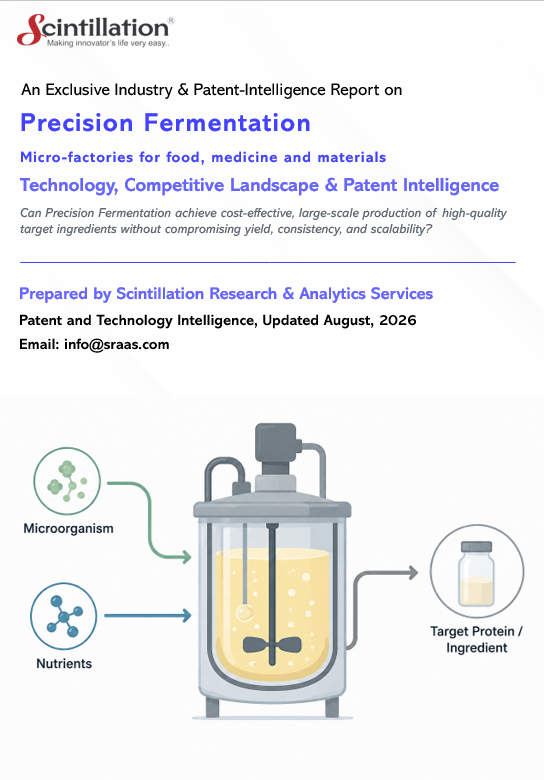
Precision fermentation uses microorganisms such as yeast, bacteria, or fungi that have been genetically engineered to produce a specific target molecule, for example a milk protein, an enzyme, a fat, or a vitamin. The microbes grow in controlled bioreactors, and the product is then separated and purified. Because it relies on fermentation rather than animals, crops, or chemical extraction, it offers a way to make familiar ingredients with a different resource profile. The central question is whether it can be done at commercial scale, at competitive cost, and with consistent quality.

Report structure

Table of contents

Twelve chapters, from precision fermentation fundamentals to patent landscape intelligence. Click any chapter to expand.

—Key findings on precision fermentation, leading assignees, filing trends, and strategic implications
—Who Will Benefit from This Report
3.1Limitations of Conventional Production Methods
—Core Components of Precision Fermentation
4.1Challenges Addressed by Precision Fermentation
4.2Key Features of Precision Fermentation
4.3Applications of Precision Fermentation
—How precision fermentation has progressed from laboratory microbial engineering to commercial production
—The technical, commercial, and IP signals that make the field strategically important
—Scale-up pathways, commercialization, and future directions
8.1Methodology & Scope
8.2Interesting Strategic Insights
8.3Assignee Picture
8.4Filing Activity Over Time
8.5Jurisdiction Coverage
8.6Technology Segmentation
8.7Representative Publications Across the Field
8.8Whitespace & Strategic Opportunities
—Stakeholder-specific takeaways across food-tech, biotech, healthcare, materials, bioprocess, and investment
—Synthesis of the technical trajectory, IP dynamics, and strategic implications
—Overview of Scintillation Research and its patent and technology intelligence services
—Legal disclaimer covering information accuracy, IP ownership, and terms of use
Core components & key features

What a precision fermentation process is made of

From the engineered microbe to the purified product.

Engineered host strains
Yeast, bacteria, or fungi designed to produce a specific protein, enzyme, or compound.
Genetic & metabolic engineering
Tools to improve expression, yield, and productivity of the target molecule.
Bioreactors & fermentation systems
Controlled vessels where the microbes grow and produce at increasing scale.
Downstream processing & purification
Separating and purifying the product to the required quality and consistency.
Process monitoring & control
Sensing and control that keep fermentation stable, efficient, and reproducible.
Scale-up & formulation
Moving from lab to commercial volumes and turning the product into usable ingredients.
Challenges addressed

Limits of conventional production, and barriers to scale

What precision fermentation aims to address, and what it still has to prove.

01
Resource intensity of conventional sources
Animal agriculture and crop-based extraction use significant land, water, and other resources
02
Variability and supply constraints
Biological sources can vary with season, location, and supply chain. Fermentation offers more controlled, consistent output
03
Yield, cost, and scale-up from the lab
Reaching competitive productivity and cost at commercial volumes is the central technical and economic challenge
04
Downstream purification and capacity
Separating products cost-effectively and securing bioreactor capacity remain bottlenecks for emerging companies
Applications

Where precision fermentation creates value

Any sector that needs proteins, enzymes, or specialty molecules made in a controlled way.

Dairy and egg proteins
Enzymes
Fats and functional ingredients
Therapeutic proteins and vitamins
Cosmetic and personal care ingredients
Animal feed ingredients
Bio-based chemicals and materials
Patent landscape study

Who is filing, where, and in which areas

The study covers methodology and scope, strategic insights, the assignee picture, filing activity over time, jurisdiction coverage, technology segmentation across strains, bioreactors, downstream processing, and applications, representative publications, and the whitespace and strategic opportunities for new filings and licensing.
Request Your Sample Report Now!

    For a quick demo, schedule a meeting now!

    Shopping Cart (0 items)

    Subscribe to our newsletter

    Sign up to receive latest news, updates, promotions, and special offers delivered directly to your inbox.
    No, thanks