
Tunneling That Thinks: How Next-Generation Autonomous Tunnel Boring Machines Are Redefining Underground Construction
A data-grounded look at who is innovating, where intellectual-property activity is concentrated, and what it means for research, commercialization, and IP strategy.
Report details
Next-Generation Autonomous Tunnel Boring Machines — Patent Landscape Study Report
From operator-dependent excavation to intelligent tunneling
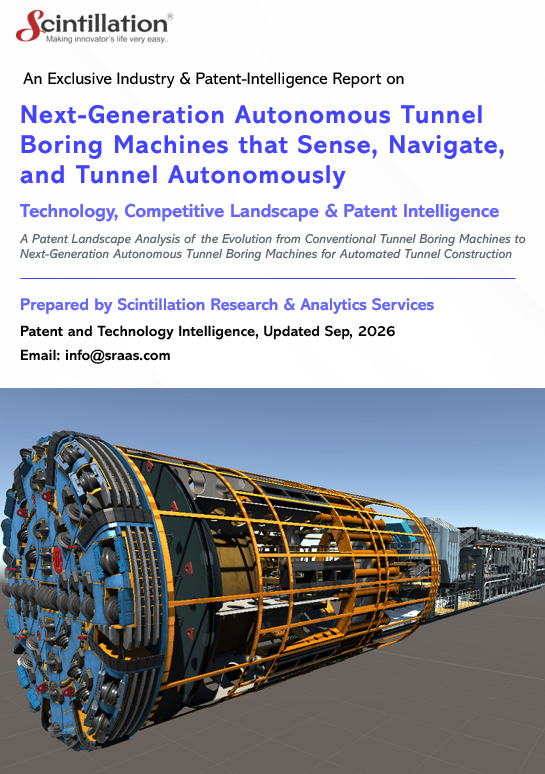
This report explores the emergence of Next-Generation Autonomous Tunnel Boring Machines (TBMs) as an advanced approach to underground construction, enabling tunneling systems to move beyond conventional operator-dependent excavation toward intelligent, automated, and increasingly autonomous tunnel construction. It examines the technology's foundations, evolving applications, innovation landscape, and intellectual-property activity, providing insights into who is developing these technologies, where innovation is concentrated, and what these trends mean for future research, commercialization, and IP strategy.
The report covers key autonomous TBM technologies, including automated excavation, autonomous machine control, geological and geotechnical sensing, machine vision, automated steering and guidance, cutterhead control, cutter wear monitoring, thrust and torque optimization, real-time ground-condition monitoring, inertial navigation, positioning systems, predictive maintenance, digital twins, AI-assisted decision-making, robotic systems, and automated tunnel construction processes. It also examines leading innovators, patent-filing trends, technology evolution, application areas, competitive dynamics, whitespace opportunities, and the future outlook for intelligent tunneling systems capable of sensing underground conditions, adapting excavation parameters, optimizing machine performance, and reducing operator intervention.
Built for everyone shaping the future of underground construction
Each audience gets a clear view of the landscape and what to do with it.
When the ground is unpredictable, the machine has to adapt
Tunnel boring machines excavate transit lines, utilities, water and energy conduits, and other underground infrastructure, but conventional operation depends heavily on skilled operators making judgments from limited information about the ground ahead. Changing geology, mixed-face conditions, water ingress, cutter wear, and tight alignment tolerances can lead to delays, unplanned interventions, and safety exposure. Next-generation autonomous TBMs combine geological and geotechnical sensing, machine vision, navigation and positioning, automated steering, cutterhead and thrust-and-torque control, predictive maintenance, digital twins, and AI-assisted decision-making so that the machine can sense underground conditions, adapt excavation parameters, and reduce operator intervention. The shift is promising but not without limits: reliable sensing in harsh underground environments, trustworthy autonomy under uncertain geology, integration with segment erection and logistics, safety certification, and operator and owner acceptance all remain open challenges on the path from assisted operation toward full autonomy.
Table of contents
Twelve chapters, from autonomous TBM fundamentals to patent landscape intelligence. Click any chapter to expand.
Core capabilities of next-generation autonomous TBMs
The capabilities that let a tunneling machine sense, decide, and act with less operator intervention.
Why conventional tunneling is under pressure, and what stays hard
What autonomous TBM technology aims to address, and where the limits are.
Where autonomous tunnel boring creates value
Use cases where tunneling speed, safety, and predictability are a competitive edge.
Who is innovating, where, and in which areas
The study covers methodology and scope, strategic insights, the assignee picture, filing activity over time, jurisdiction coverage, technology segmentation across geological sensing, autonomous control and steering, cutterhead and cutter monitoring, predictive maintenance, digital twins and AI, and robotic systems, representative publications across the field, and the whitespace and strategic opportunities for new filings and licensing.
Request Your Sample Report Now!
