
From Answering to Acting: How Agentic AI and Autonomous Decision Systems Are Redefining What AI Can Do
A data-grounded look at who is innovating, where IP activity is concentrated, and what it means for research, commercialization, and IP strategy.
Report details
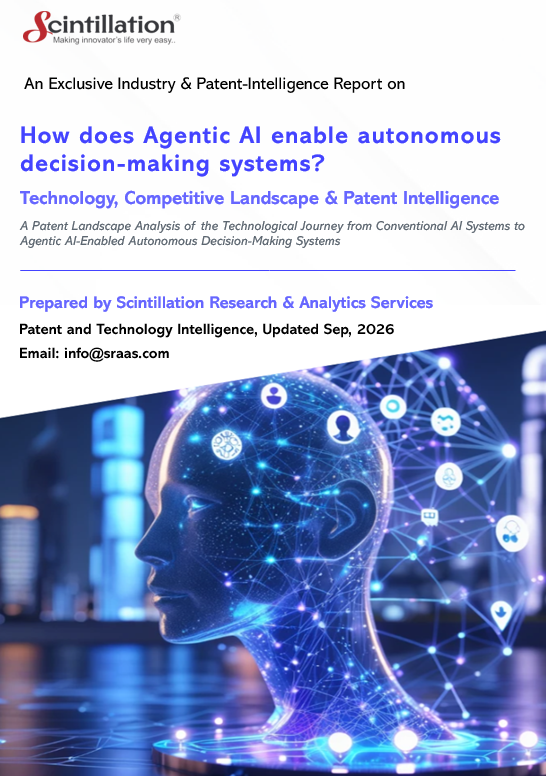
Agentic AI and Autonomous Decision Systems — Patent & Innovation Landscape Analysis Report
A next-generation AI paradigm and its IP landscape
This report explores the emergence of Agentic AI and Autonomous Decision Systems as a next-generation AI paradigm that lets AI systems independently perceive environments, reason over complex information, make decisions, and execute actions with limited human intervention. It examines core architectures, enabling AI technologies, and the evolving patent landscape, showing who is innovating, where IP activity is concentrated, and what that means for research, commercialization, and IP strategy.
It covers key Agentic AI technologies, leading assignees, filing trends, technology evolution, autonomous decision-making and orchestration, enterprise and industry applications, competitive dynamics, whitespace, and the outlook for autonomous agents, multi-agent systems, intelligent automation, and AI-driven decision-making.
Built for everyone shaping agentic AI
Each audience gets a clear view of the landscape and what to do with it.
AI that pursues goals instead of waiting for prompts
Most AI today responds to a single request and stops. Agentic AI is built to pursue a goal: it senses its environment, breaks the goal into steps, decides what to do, uses tools to act, checks the result, and adjusts, with limited human intervention. Several agents can also work together, dividing tasks and coordinating through orchestration layers. This shift from answering to acting brings new opportunities in automation and decision-making, along with new questions about reliability, oversight, and accountability.
Table of contents
Twelve chapters, from agentic AI fundamentals to patent landscape intelligence. Click any chapter to expand.
What an agentic AI system is made of
The building blocks that let an AI system pursue goals on its own.
Limits of non-agentic AI, and what stays hard
What agentic systems aim to address, and the hurdles that remain.
Where agentic AI could create value
Settings where goals, not just prompts, drive the work.
Who is filing, where, and in which areas
The study covers methodology and scope, strategic insights, the assignee picture, filing activity over time, jurisdiction coverage, technology segmentation across agent architectures, planning, orchestration, and multi-agent coordination, representative publications, and the whitespace and strategic opportunities for new filings and licensing.
Request Your Sample Report Now!
