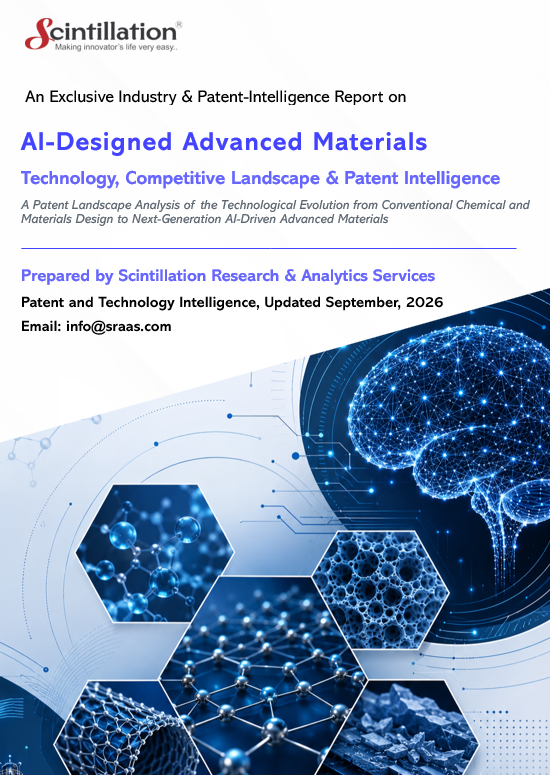
AI-Designed Advanced Materials

  • Home
  • AI-Designed Advanced Materials
Patent & Innovation Landscape Analysis  ·  Advanced Materials Series

Discovering Materials at the Speed of Computation: How AI-Designed Advanced Materials Are Accelerating Innovation

A data-grounded look at who is innovating, where IP activity is concentrated, and what it means for research, commercialization, and IP strategy.

GenerativeMaterials design
MLProperty prediction
ScreeningHigh-throughput discovery
PatentLandscape & whitespace

Report details

AI-Designed Advanced Materials — Patent & Innovation Landscape Analysis Report

PublisherScintillation Research
TechnologyAI-Designed Advanced Materials
Focus areaAI-enabled materials discovery and design
Key segmentsGenerative Design, Screening, Modeling
IP coverage8-part patent landscape
AudienceIP, R&D, Materials, Investment
Purpose of the report

A next-generation platform for materials discovery and its IP

This report explores the emergence of AI-designed advanced materials as a next-generation innovation platform for accelerating the discovery, design, and optimization of high-performance materials. It examines how artificial intelligence, machine learning, computational modeling, and materials science are being integrated, showing who is innovating, where IP activity is concentrated, and what that means for research, commercialization, and IP strategy.

It covers key AI-driven materials-design technologies, leading assignees, filing trends, technology evolution, industrial applications, competitive dynamics, whitespace, and the outlook for AI-enabled materials discovery and advanced material development.

Who will benefit from this report

Built for everyone shaping AI-enabled materials innovation

Each audience gets a clear view of the landscape and what to do with it.

01
Patent Attorneys, Agents & IP Analysts
Assignees, filing trends, jurisdictions, segments, and emerging areas to support prosecution, FTO, invalidity, and portfolio work.
02
Licensing & Business Development
Foundational and emerging portfolios, with licensing opportunities, collaboration targets, and key technology owners.
03
In-house IP & R&D Leaders
Competitive intelligence on AI and ML in materials discovery, computational design, generative engineering, and optimization.
04
Investors & Market Analysts
An evidence-based view of innovation activity, commercialization trends, and emerging technology areas.
05
Materials, Chemical, Semiconductor, Energy & Manufacturing Companies
Insight into AI-driven discovery, generative design, high-throughput screening, nanomaterials, polymers, composites, battery materials, catalysts, and electronic materials.
06
Academia & Translational Research Organizations
Benchmarking on leading groups, commercialization pathways, patenting activity, and partnership opportunities.
Introduction

From trial and error to design by computation

Discovering a new material has traditionally meant years of trial and error across an enormous space of possible compositions and structures. AI-designed materials use machine learning and computational modeling to predict properties, screen candidates at scale, and even generate new structures aimed at a target performance, so that researchers test far fewer and better candidates. The approach is powerful but not without limits: it depends on good data, models that generalize beyond known materials, and the ability to actually synthesize and validate what the AI proposes.

Report structure

Table of contents

Twelve chapters, from AI-designed materials fundamentals to patent landscape intelligence. Click any chapter to expand.

—Key findings on AI-designed advanced materials, leading assignees, filing trends, and strategic implications
—Who Will Benefit from This Report
3.1Limitations of AI-Designed Advanced Materials
4.1Challenges Addressed by AI-Designed Advanced Materials
4.2Key Features of AI-Designed Advanced Materials
4.3Applications of AI-Designed Advanced Materials
—How materials discovery has progressed from trial and error to computational and AI-driven design
—The technical, commercial, and IP signals that make the field strategically important
—Commercialization pathways, open challenges, and future directions
8.1Methodology & Scope
8.2Interesting Strategic Insights
8.3Assignee Picture
8.4Filing Activity Over Time
8.5Jurisdiction Coverage
8.6Technology Segmentation
8.7Representative Publications Across the Field
8.8Whitespace & Strategic Opportunities
—Stakeholder-specific takeaways for IP teams, materials and chemical companies, investors, and researchers
—Synthesis of the technical trajectory, IP dynamics, and strategic implications
—Overview of Scintillation Research and its patent and technology intelligence services
—Legal disclaimer covering information accuracy, IP ownership, and terms of use
Key features

Core capabilities of AI-designed materials

The technologies that turn materials discovery into a computational workflow.

AI-driven materials discovery
Machine learning that learns from data to find promising materials faster.
Generative materials design
Models that propose new compositions and structures aimed at target properties.
High-throughput screening
Evaluating very large candidate sets computationally before any lab work.
Computational modeling
Physics-based and learned models that predict how a material will behave.
Materials optimization
Tuning composition and processing to balance several performance goals at once.
Advanced manufacturing integration
Linking designed materials to the processes needed to make them at scale.
Challenges addressed

Why conventional materials discovery is slow, and what stays hard

What AI-designed materials aim to address, and where the limits are.

01
Slow, costly trial and error
Finding and validating a new material can take years and many experiments
02
An enormous search space
The number of possible compositions and structures is far too large to explore by hand
03
Balancing many properties at once
Real applications need strength, stability, cost, and more together. AI helps optimize across them
04
Data, validation, and manufacturability limits
Models need quality data, generalize unevenly, and their proposals must still be synthesized, tested, and scaled
Applications

Where AI-designed materials create value

Material classes and industries where better performance is a competitive edge.

Nanomaterials
Polymers
Composites
Battery materials
Catalysts
Electronic and semiconductor materials
Advanced manufacturing
Patent landscape study

Who is filing, where, and in which areas

The study covers methodology and scope, strategic insights, the assignee picture, filing activity over time, jurisdiction coverage, technology segmentation across generative design, screening, modeling, and optimization, representative publications, and the whitespace and strategic opportunities for new filings and licensing.
Request Your Sample Report Now!

    For a quick demo, schedule a meeting now!

    Shopping Cart (0 items)

    Subscribe to our newsletter

    Sign up to receive latest news, updates, promotions, and special offers delivered directly to your inbox.
    No, thanks