AI-Driven Autonomous Smart Grids

  • Home
  • AI-Driven Autonomous Smart Grids
Patent & Innovation Landscape Analysis  ·  Energy & Grid Technology Series

Power Networks That Think for Themselves: How AI-Driven Autonomous Smart Grids Are Transforming Grid Management

A data-grounded look at who is innovating, where IP activity is concentrated, and what it means for research, commercialization, and IP strategy.

PredictiveGrid analytics
Self-healingFault response
DEROrchestration
PatentLandscape & whitespace

Report details

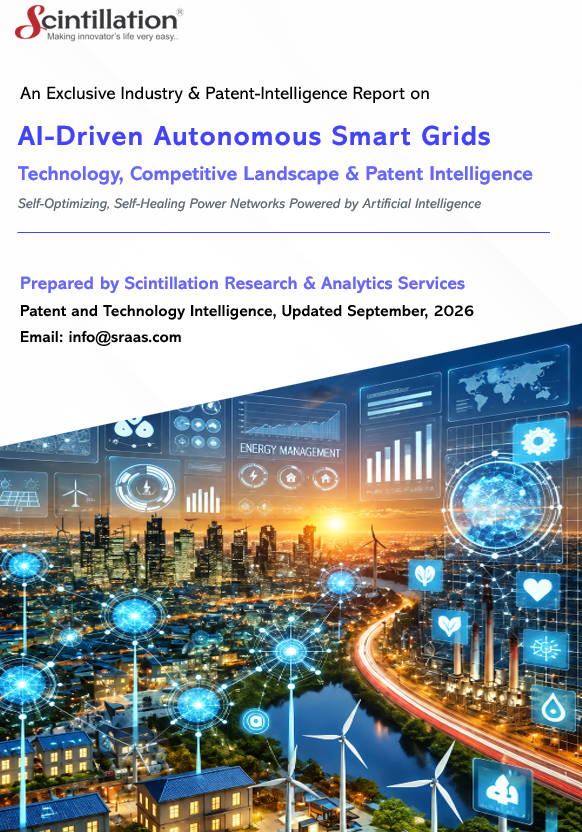
AI-Driven Autonomous Smart Grids — Patent & Innovation Landscape Analysis Report

PublisherScintillation Research
TechnologyAI-Driven Autonomous Smart Grids
Focus areaSelf-optimizing, self-healing power infrastructure
Key segmentsForecasting, Fault Response, DER, Grid-Edge, Cybersecurity
IP coverage8-part patent landscape
AudienceIP, R&D, Utilities, Investment
Purpose of the report

A next-generation platform for managing complex power networks

This report explores the emergence of AI-driven autonomous smart grids as a next-generation platform for managing increasingly complex, decentralized, and weather-exposed power networks. It examines the technology's foundations, operational applications, and evolving patent landscape, providing insight into who is innovating, where intellectual-property activity is concentrated, and what these trends mean for future research, commercialization, and IP strategy.

The report covers the core building blocks of autonomous grid intelligence, leading assignees, patent-filing trends, technology evolution, operational applications, competitive dynamics, whitespace opportunities, and the future outlook for self-optimizing and self-healing power infrastructure.

Who will benefit from this report

Built for everyone shaping autonomous grid innovation

Each audience gets a clear view of the landscape and what to do with it.

01
Patent Attorneys, Agents & IP Analysts
A structured overview of the AI-driven smart grid landscape, including key assignees, filing trends, jurisdictions, and technology segments, supporting prosecution, freedom-to-operate (FTO), invalidity, and portfolio-development activities.
02
Licensing & Business Development Professionals
Insights into foundational and emerging patent portfolios, helping identify potential licensing opportunities, collaboration targets, and commercially significant technology owners.
03
In-house IP & R&D Leaders at Utilities and Grid-Technology Companies
Competitive intelligence on predictive grid analytics, autonomous fault response, DER orchestration, and AI-based control-system trends to support strategic planning and innovation roadmaps.
04
Investors & Market Analysts
An evidence-based view of innovation activity, commercialization trends, leading assignees, and emerging technology opportunities within the rapidly evolving AI-for-energy sector.
05
Utilities, Grid Operators & Energy-Technology Companies
Insights into key technology domains, including load forecasting, self-healing network reconfiguration, DER optimization, grid-edge sensing, and cybersecurity for autonomous systems.
06
Regulators, Standards Bodies & Academic / Research Institutions
Benchmarking information on leading innovators, emerging deployment patterns, and potential partnership or standardization opportunities within the autonomous-grid ecosystem.
Introduction

From manually operated networks to self-managing grids

Power grids were designed around large central generators and predictable one-way flows of electricity. Today they must absorb variable renewables, distributed energy resources, electric-vehicle charging, and more frequent extreme weather, often faster than human operators and rule-based control systems can respond. AI-driven autonomous smart grids apply machine learning, real-time sensing, and automated control to forecast demand, detect and isolate faults, and balance distributed resources with minimal manual intervention. The approach is powerful but not without limits: it depends on reliable data and sensing, models that remain trustworthy in rare or extreme conditions, cybersecurity for autonomous systems, and regulatory and operator confidence in handing control to software.

Report structure

Table of contents

Twelve chapters, from AI-driven smart grid fundamentals to patent landscape intelligence. Click any chapter to expand.

—Key findings on AI-driven autonomous smart grids, leading assignees, filing trends, and strategic implications
—Who Will Benefit from This Report
3.1Limitations of Conventional Grid Management Technologies
4.1Challenges Addressed by AI-Driven Autonomous Smart Grids
4.2Key Features of AI-Driven Autonomous Smart Grids
4.3Applications of AI-Driven Autonomous Smart Grids
—How grid management has progressed from manual operation and SCADA to automated and AI-driven autonomous control
—The technical, commercial, and IP signals that make the field strategically important
—Commercialization pathways, open challenges, and future directions
8.1Methodology & Scope
8.2Interesting Strategic Insights
8.3Assignee Picture
8.4Filing Activity Over Time
8.5Jurisdiction Coverage
8.6Technology Segmentation
8.7Representative Publications Across the Field
8.8Whitespace & Strategic Opportunities
—Stakeholder-specific takeaways for IP teams, utilities and grid operators, investors, regulators, and researchers
—Synthesis of the technical trajectory, IP dynamics, and strategic implications
—Overview of Scintillation Research and its patent and technology intelligence services
—Legal disclaimer covering information accuracy, IP ownership, and terms of use
Key features

Core capabilities of AI-driven autonomous smart grids

The technologies that let a grid sense, decide, and act on its own.

Predictive grid analytics
Machine learning that forecasts load, generation, and equipment health ahead of time.
Autonomous fault response
Fast detection, isolation, and diagnosis of faults without waiting on manual action.
Self-healing reconfiguration
Rerouting power around damaged sections to restore supply quickly.
DER orchestration
Coordinating solar, storage, EVs, and flexible loads as one responsive resource.
Grid-edge sensing
Real-time visibility into conditions at feeders, transformers, and customer sites.
Cybersecurity for autonomous systems
Protecting AI-based control systems from intrusion, manipulation, and data compromise.
Challenges addressed

Why conventional grid management struggles, and what stays hard

What AI-driven autonomous smart grids aim to address, and where the limits are.

01
Growing complexity and decentralization
Millions of distributed resources and two-way power flows outpace manual and rule-based control
02
Variability from renewables and demand
Fluctuating generation and new loads such as EV charging make balancing harder in real time
03
Weather exposure and slow restoration
Storms and extreme events cause outages. Autonomous response can shorten detection and recovery
04
Data quality, trust, and security limits
Models need reliable data, must hold up in rare events, and autonomous control raises cybersecurity and accountability questions
Applications

Where AI-driven autonomous grids create value

Operational domains where faster, smarter grid decisions are a competitive and reliability edge.

Load and renewable forecasting
Fault detection and self-healing
DER and storage optimization
Predictive asset maintenance
Microgrids and resilience
EV charging management
Grid cybersecurity
Patent landscape study

Who is filing, where, and in which areas

The study covers methodology and scope, strategic insights, the assignee picture, filing activity over time, jurisdiction coverage, technology segmentation across forecasting, fault response, DER orchestration, grid-edge sensing, and cybersecurity, representative publications, and the whitespace and strategic opportunities for new filings and licensing.
Request Your Sample Report Now!

    For a quick demo, schedule a meeting now!

    Shopping Cart (0 items)

    Subscribe to our newsletter

    Sign up to receive latest news, updates, promotions, and special offers delivered directly to your inbox.
    No, thanks