
Infrastructure That Understands Itself: How AI-Driven Cognitive Digital Twins Are Redefining Buildings & Infrastructure Management
A data-grounded look at the emerging technologies, patent landscape, and commercialization outlook for digital twins that go beyond monitoring to understand, predict, and decide.
Report details
AI-Driven Cognitive Digital Twins for Buildings & Infrastructure — Patent Landscape Study Report
Beyond monitoring and visualization toward decision-oriented infrastructure
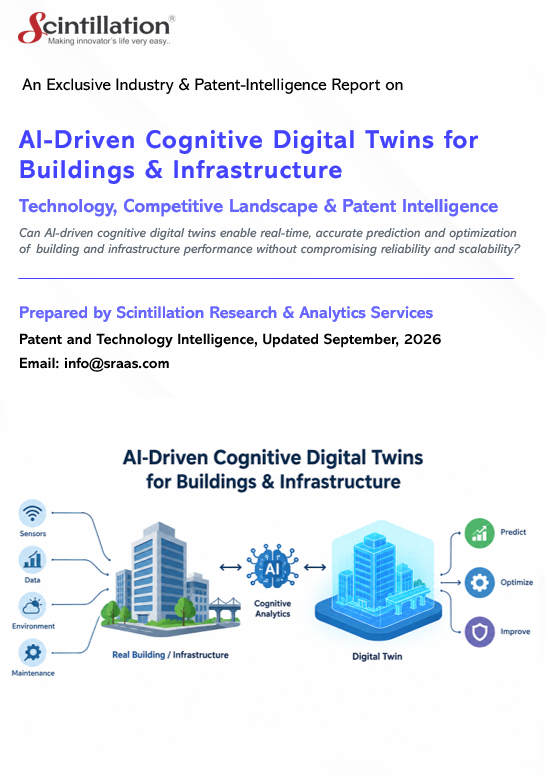
The purpose of this report is to provide a comprehensive overview of the emerging technology landscape surrounding AI-Driven Cognitive Digital Twins for Buildings & Infrastructure. The report examines how artificial intelligence, machine learning, IoT sensors, real-time data, computer vision, simulation, and advanced analytics are being combined with digital twin platforms to create intelligent virtual representations of buildings, bridges, roads, utilities, and other infrastructure assets. Unlike conventional digital twins that primarily monitor and visualize asset conditions, cognitive digital twins aim to understand changing conditions, predict future behavior, identify potential problems, and support or automate maintenance and operational decisions.
The report is intended to assess the current state and technological maturity of AI-driven cognitive digital twins and determine how far the technology has progressed beyond basic monitoring and visualization toward autonomous and decision-oriented infrastructure management. It evaluates emerging approaches for continuous asset monitoring, anomaly detection, predictive maintenance, energy optimization, structural health assessment, risk prediction, scenario simulation, and automated decision support. Particular attention is given to the integration of real-world sensor data with AI models and digital representations to enable continuous learning and adaptive responses.
Another key purpose of the report is to identify major technology developers, patent holders, research organizations, and emerging innovators working in this space. Patent activity and filing trends can provide insights into where innovation is concentrated, which companies are building strong intellectual-property positions, and which technical approaches are receiving increasing attention. The report also examines technology evolution and application trends across different infrastructure domains to identify areas where cognitive digital twins are gaining practical relevance.
Finally, the report evaluates whether AI-Driven Cognitive Digital Twins for Buildings & Infrastructure are approaching widespread commercial adoption or remain primarily at the pilot, research, and early-deployment stages. By analyzing the technology landscape, patent trends, key players, applications, challenges, and whitespace areas, the report is intended to support strategic decisions related to R&D investment, technology development, partnerships, commercialization, competitive positioning, and future infrastructure-management strategies.
Built for everyone shaping the future of intelligent infrastructure
Each audience gets a clear view of the landscape and what to do with it.
When a digital twin can show a problem but cannot reason about it
Buildings, bridges, roads, and utilities are costly to operate and maintain, and much of that cost comes from finding problems late and scheduling maintenance by calendar rather than by condition. Conventional digital twins connect sensors and models to give a live, visual picture of an asset, but they largely stop at monitoring: people still interpret the data, spot anomalies, and decide what to do. Cognitive digital twins add AI on top, combining machine learning, computer vision, simulation, and analytics with continuous sensor data so the twin can understand changing conditions, detect anomalies, predict failures and risks, simulate scenarios, and support or automate maintenance and operating decisions, learning continuously as new data arrives. The approach is promising but not without limits: sensor coverage and data quality vary widely across aging assets, models must be validated against physical behavior, integrating building and infrastructure systems is difficult, cybersecurity and data governance matter, and many deployments remain at the pilot or early-deployment stage rather than widespread adoption.
Table of contents
Twelve chapters, from cognitive digital twin fundamentals to patent landscape intelligence. Click any chapter to expand.
Core capabilities of AI-driven cognitive digital twins
The capabilities that move a digital twin from showing conditions to understanding and acting on them.
Why conventional digital twins fall short, and what stays hard
What cognitive digital twins aim to address, and where the limits are.
Where cognitive digital twins create value
Use cases where understanding and predicting asset behavior is a competitive edge.
Who is innovating, where, and in which areas
The study covers methodology and scope, strategic insights, the assignee picture, filing activity over time, jurisdiction coverage, technology segmentation across digital twin platforms, IoT sensing and computer vision, anomaly detection and predictive maintenance, structural health assessment, scenario simulation, and automated decision support, representative publications across the field, and the whitespace and strategic opportunities for new filings and licensing.
Request Your Sample Report Now!
