
From Maps to Meaning: How AI-Driven Context-Aware Semantic Mapping and Reasoning Is Redefining Autonomous Warehouse Robots
A data-grounded look at the emerging technologies, patent landscape, and commercialization pathways shaping how warehouse robots understand, reason about, and act within their environment.
Report details
AI-Driven Context-Aware Semantic Mapping and Reasoning for Autonomous Warehouse Robots — Patent Landscape Study Report
Moving warehouse robots from geometry to understanding
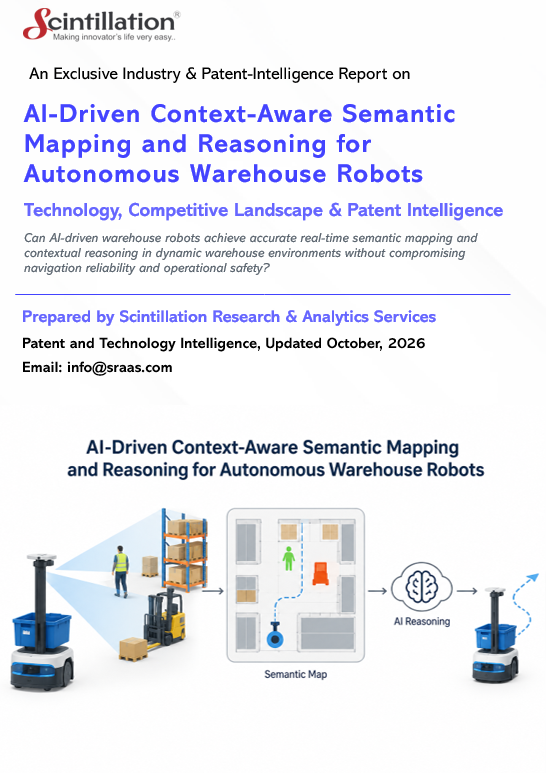
The purpose of this report is to provide a comprehensive assessment of the emerging technology landscape surrounding AI-Driven Context-Aware Semantic Mapping and Reasoning for Autonomous Warehouse Robots, with emphasis on how artificial intelligence is enabling warehouse robots to move beyond conventional mapping, localization, and obstacle avoidance toward deeper environmental understanding and autonomous decision-making.
The report examines the convergence of semantic mapping, computer vision, SLAM, sensor fusion, spatial intelligence, contextual reasoning, and autonomous navigation. It focuses on how these technologies can enable robots to recognize warehouse elements such as workers, forklifts, pallets, racks, inventory, restricted areas, and temporary obstacles while understanding their location, meaning, relationships, and operational relevance.
Another key purpose is to evaluate the transition from static geometric maps toward dynamic, context-aware semantic representations. The report explores how autonomous robots could continuously update their understanding of changing warehouse environments and use contextual information to improve route planning, obstacle avoidance, task execution, human-aware navigation, and multi-robot coordination.
The report also aims to identify key technology developments, patenting trends, major innovators, emerging research directions, technical challenges, and potential commercialization pathways. Particular attention is given to technologies that remain at the research, emerging, or early-commercialization stage, rather than conventional AMR navigation capabilities that are already widely deployed.
Overall, the report is intended to help warehouse automation companies, robotics developers, logistics providers, technology investors, research institutions, and IP professionals understand how context-aware semantic intelligence could shape the next generation of autonomous warehouse robotics and identify opportunities for R&D, patent development, technology partnerships, investment, and future commercialization.
Built for everyone shaping the future of warehouse automation
Each audience gets a clear view of the landscape and what to do with it.
When a map shows where things are, but not what they mean
Autonomous mobile robots are now common in warehouses, but most rely on geometric maps built with SLAM and treat anything in their path as a generic obstacle. They can tell that something is there, but not whether it is a worker, a forklift, a pallet, a rack, or a restricted zone, so they cannot adjust their behavior to what the object is or how it is likely to move. Static maps also fall out of date as pallets, inventory, and layouts change throughout the day. Context-aware semantic mapping adds meaning to the map: computer vision, sensor fusion, and spatial AI recognize warehouse elements and their relationships, and reasoning layers use that understanding to plan routes, avoid obstacles, coordinate with other robots, and behave safely around people. The approach is promising but not without limits: real warehouses are dynamic and cluttered, semantic understanding must stay current in real time, perception and reasoning must run within tight on-robot compute budgets, systems must generalize across sites and handle uncertainty, and sharing maps across robots and warehouse software adds integration complexity.
Table of contents
Twelve chapters, from context-aware semantic mapping fundamentals to patent landscape intelligence. Click any chapter to expand.
Core capabilities of context-aware semantic mapping and reasoning
The capabilities that let a warehouse robot understand what it sees and act on it.
Why conventional warehouse robot navigation falls short, and what stays hard
What context-aware semantic mapping aims to address, and where the limits are.
Where context-aware semantic intelligence creates value
Use cases where understanding the warehouse, not just mapping it, is a competitive edge.
Who is innovating, where, and in which areas
The study covers methodology and scope, strategic insights, the assignee picture, filing activity over time, jurisdiction coverage, technology segmentation across semantic SLAM and mapping, multimodal perception and sensor fusion, contextual reasoning and planning, human-aware navigation, multi-robot coordination, and edge-AI computing, representative publications across the field, and the whitespace and strategic opportunities for new filings and licensing.
Request Your Sample Report Now!
