AI-Driven Cross Modal Engineering Data Alignment for Intelligent Manufacturing

  • Home
  • AI-Driven Cross Modal Engineering Data Alignment for Intelligent Manufacturing
Patent Landscape Analysis  ·  Intelligent Manufacturing Series

Making Every Drawing, Model, and Record Agree: How AI-Driven Cross-Modal Engineering Data Alignment Is Redefining Intelligent Manufacturing

A data-grounded look at the emerging technologies, patent landscape, and commercialization opportunities shaping how engineering data is interpreted, aligned, and connected across the product lifecycle.

Multimodal AIVision, language & geometry
AlignmentCAD, 3D, BOM & records
Knowledge GraphsAutomated relationship discovery
PatentLandscape & whitespace

Report details

AI-Driven Cross-Modal Engineering Data Alignment for Intelligent Manufacturing — Patent Landscape Study Report

PublisherScintillation Research
TechnologyCross-Modal Engineering Data Alignment
Focus areaIntelligent manufacturing and the digital thread
Key segmentsCAD Interpretation, Semantic Matching, Knowledge Graphs, Foundation Models
Coverage8-part landscape study
AudienceIP, R&D, Industry, Investment
Purpose of the report

Connecting heterogeneous engineering information with AI

The primary purpose of this report is to provide a comprehensive assessment of the emerging technological developments, patent landscape, innovation opportunities, and commercialization potential of AI-Driven Cross-Modal Engineering Data Alignment for Intelligent Manufacturing. The report aims to examine how artificial intelligence, multimodal machine learning, computer vision, natural language processing, and advanced data integration technologies can enable the automated interpretation, alignment, and synchronization of heterogeneous engineering information across complex manufacturing environments.

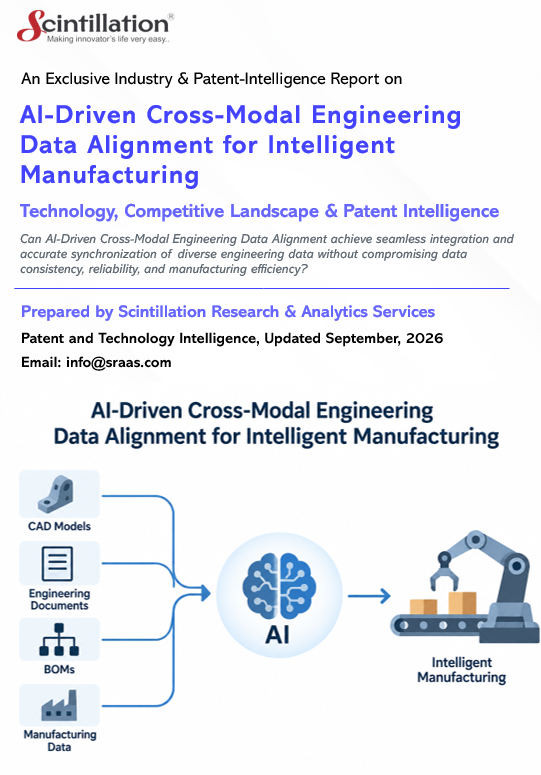
The report seeks to evaluate the limitations of conventional engineering data management and integration systems, particularly the challenges associated with fragmented engineering databases, incompatible data formats, inconsistent component identification, disconnected software platforms, and manual data-matching processes. It examines how AI-driven cross-modal alignment technologies can address these limitations by establishing meaningful relationships between CAD drawings, 3D models, bills of materials (BOMs), technical specifications, manufacturing records, and quality inspection data, thereby improving engineering data consistency, traceability, and accessibility throughout the product lifecycle.

A key objective of the report is to investigate emerging technological innovations in multimodal engineering data understanding and automated relationship discovery. This includes examining AI-based CAD drawing interpretation, geometric feature recognition, semantic document matching, engineering knowledge graphs, multimodal foundation models, automated component identification, and cross-modal data synchronization. The report aims to identify how these technologies can support the development of intelligent engineering data platforms capable of interpreting complex engineering information and identifying relationships across different data formats and representations.

Ultimately, the report aims to provide manufacturers, industrial AI developers, engineering software providers, technology investors, and research institutions with actionable insights into the future development of AI-driven cross-modal engineering data alignment. By examining technological advancements, intellectual property activity, commercialization opportunities, and potential innovation gaps, the report seeks to support strategic research and development planning, patent portfolio development, technology differentiation, and investment decisions related to next-generation intelligent manufacturing solutions.

Who will benefit from this report

Built for everyone shaping the future of engineering data intelligence

Each audience gets a clear view of the landscape and what to do with it.

01
Manufacturing Companies & Original Equipment Manufacturers (OEMs)
To identify emerging AI-driven technologies for integrating heterogeneous engineering data across CAD drawings, 3D models, bills of materials (BOMs), technical specifications, and manufacturing records.
02
Industrial AI & Manufacturing Software Companies
To identify emerging technological opportunities in multimodal AI, engineering data interpretation, automated relationship discovery, and intelligent manufacturing data integration.
03
CAD, PLM, ERP & MES Software Providers
To explore opportunities for integrating AI-driven cross-modal engineering alignment capabilities into existing engineering and manufacturing software platforms.
04
Automotive, Aerospace & Industrial Machinery Companies
To assess how advanced cross-modal engineering data alignment can support complex product development, component identification, engineering change management, and manufacturing quality control.
05
Engineering Design, R&D & Product Development Companies
To identify emerging AI-based approaches for interpreting and aligning engineering drawings, 3D models, technical specifications, and historical product development records.
06
Semiconductor, Electronics & Precision Manufacturing Companies
To investigate opportunities for aligning complex engineering specifications, component designs, manufacturing process data, and quality inspection records using advanced multimodal AI.
07
AI Technology Developers & Research Institutions
To identify research opportunities in multimodal foundation models, geometric deep learning, computer vision, natural language processing, and engineering knowledge graphs.
08
Intellectual Property (IP) Professionals & Patent Research Organizations
To understand the evolving patent landscape surrounding AI-driven engineering data alignment, multimodal engineering intelligence, and intelligent manufacturing data integration.
09
Technology Investors, Venture Capital Firms & Strategic Investment Groups
To evaluate the technological maturity, commercialization potential, and emerging business opportunities associated with advanced AI-driven engineering data alignment platforms.
10
System Integrators & Industrial Digital Transformation Companies
To identify opportunities for integrating AI-driven engineering data alignment solutions into existing manufacturing infrastructure and enterprise software ecosystems.
11
Engineering Data Management & Digital Thread Solution Providers
To identify emerging AI-driven technologies for establishing seamless connections between product designs, engineering specifications, manufacturing records, and quality inspection data throughout the product lifecycle.
12
Industrial Automation & Smart Factory Technology Providers
To identify opportunities for integrating AI-driven cross-modal engineering data alignment into automated production systems, smart factories, and intelligent manufacturing platforms.
13
Component Manufacturers & Industrial Suppliers
To explore opportunities for automatically aligning customer engineering drawings, component specifications, bills of materials, and manufacturing requirements across different data formats.
14
Quality Assurance, Inspection & Manufacturing Compliance Companies
To identify emerging AI-based technologies for aligning engineering specifications, CAD drawings, dimensional requirements, manufacturing records, and quality inspection results.
15
Cloud Computing, Industrial Data Platform & AI Infrastructure Providers
To identify opportunities for developing scalable cloud-based platforms capable of processing, integrating, and aligning large volumes of heterogeneous engineering and manufacturing data.
Introduction

When the same part lives in a dozen formats that don't talk to each other

A single manufactured product generates engineering information in many forms: CAD drawings, 3D models, bills of materials, technical specifications, manufacturing records, and quality inspection data, often held in separate databases and software platforms with incompatible formats and inconsistent component identification. Connecting these representations has traditionally meant manual data matching, which is slow, error-prone, and difficult to keep current as designs change, undermining traceability, engineering change management, and quality control. AI-driven cross-modal alignment applies multimodal machine learning, computer vision, natural language processing, and geometric understanding to interpret drawings, recognize features, match documents semantically, and automatically discover relationships across data types, often organizing them in engineering knowledge graphs or multimodal foundation models. The approach is promising but not without limits: engineering data is specialized and often proprietary, labeled training data is scarce, tolerances and standards demand high accuracy, results must be explainable and traceable, and integration with established CAD, PLM, ERP, and MES platforms is complex.

Report structure

Table of contents

Twelve chapters, from cross-modal engineering data alignment fundamentals to patent landscape intelligence. Click any chapter to expand.

—Key findings on AI-driven cross-modal engineering data alignment, leading assignees, filing trends, and strategic implications
—Who Will Benefit from This Report
3.1Limitations of Conventional Engineering Data Management and Integration Systems
—Core Components of AI-Driven Cross-Modal Engineering Data Alignment for Intelligent Manufacturing
4.1Challenges Addressed by AI-Driven Cross-Modal Engineering Data Alignment for Intelligent Manufacturing
4.2Key Features of AI-Driven Cross-Modal Engineering Data Alignment for Intelligent Manufacturing
4.3Applications of AI-Driven Cross-Modal Engineering Data Alignment for Intelligent Manufacturing
—How engineering data integration has progressed from manual matching and rule-based tools toward multimodal AI and knowledge-graph-driven alignment
—The technical, commercial, and innovation signals that make the field strategically important
—Commercialization pathways, open challenges, and future directions
8.1Methodology & Scope
8.2Interesting Strategic Insights
8.3Assignee Picture
8.4Filing Activity Over Time
8.5Jurisdiction Coverage
8.6Technology Segmentation
8.7Representative Publications Across the Field
8.8Whitespace & Strategic Opportunities
—Stakeholder-specific takeaways for manufacturers, software providers, AI developers, IP teams, integrators, and investors
—Synthesis of the technical trajectory, innovation dynamics, and strategic implications
—Overview of Scintillation Research and its patent and technology intelligence services
—Legal disclaimer covering information accuracy, IP ownership, and terms of use
Key features

Core capabilities of AI-driven cross-modal engineering data alignment

The capabilities that let AI read, relate, and synchronize engineering information across formats.

AI-based CAD drawing interpretation
Reads engineering drawings to extract dimensions, annotations, and part information automatically.
Geometric feature recognition
Identifies shapes and features in 3D models so they can be matched to drawings and specifications.
Semantic document matching
Links specifications, BOMs, and records by meaning rather than exact text or identifiers.
Engineering knowledge graphs
Structured relationships among parts, documents, and processes that support traceability and reasoning.
Multimodal foundation models
Models that jointly understand images, geometry, and text across engineering data types.
Automated component identification and synchronization
Recognizes components across sources and keeps related records consistent as designs change.
Challenges addressed

Why conventional engineering data integration falls short, and what stays hard

What cross-modal alignment aims to address, and where the limits are.

01
Fragmented databases and incompatible formats
Engineering data is spread across disconnected platforms. Cross-modal alignment builds relationships between them
02
Inconsistent component identification
The same part is named and described differently across sources. Semantic and geometric matching resolves it
03
Manual, error-prone data matching
Hand matching is slow and hard to keep current through engineering changes. Automation improves consistency and traceability
04
Accuracy, data scarcity, and integration limits
Precision requirements, scarce labeled data, explainability needs, and integration with PLM, ERP, and MES systems remain hard
Applications

Where cross-modal engineering data alignment creates value

Use cases where connected, consistent engineering data is a competitive edge.

Digital thread and product lifecycle traceability
Engineering change management
BOM and drawing reconciliation
Automated component identification
Quality inspection and compliance alignment
Supplier and customer drawing intake
Smart factory and PLM/ERP/MES integration
Patent landscape study

Who is innovating, where, and in which areas

The study covers methodology and scope, strategic insights, the assignee picture, filing activity over time, jurisdiction coverage, technology segmentation across CAD drawing interpretation, geometric feature recognition, semantic document matching, engineering knowledge graphs, multimodal foundation models, and component identification, representative publications across the field, and the whitespace and strategic opportunities for new filings and licensing.
Request Your Sample Report Now!

    For a quick demo, schedule a meeting now!

    Shopping Cart (0 items)

    Subscribe to our newsletter

    Sign up to receive latest news, updates, promotions, and special offers delivered directly to your inbox.
    No, thanks