AI-Driven Network Digital Twin for Autonomous 6G Network Management

  • Home
  • AI-Driven Network Digital Twin for Autonomous 6G Network Management
Patent & Innovation Landscape Analysis  ·  Autonomous Networks Series

Rehearse the Network Before Changing It: How AI-Driven Network Digital Twins Are Enabling Autonomous 6G Network Management

A data-grounded look at who is patenting, where innovation is concentrated, and how networks are moving from manual management toward AI-enabled, closed-loop autonomous operation.

TwinVirtual 6G network
Closed-loopSimulate, predict, act
AI-nativeRL, edge AI, generative AI
PatentLandscape & whitespace

Report details

AI-Driven Network Digital Twins for Autonomous 6G Network Management — Patent & Innovation Landscape Analysis Report

PublisherScintillation Research
TechnologyAI-Driven Network Digital Twins
Focus areaAutonomous 6G network management
Key segmentsModeling, Prediction, Slicing, Optimization
IP coverage8-part patent landscape
AudienceTelecom, Equipment, IP, Investment
Purpose of the report

From conventional management to closed-loop autonomous operation

The primary purpose of this report is to provide a comprehensive understanding of AI-driven network digital twins for autonomous 6G network management. It examines how digital twins combined with AI can create dynamic virtual representations of 6G networks for monitoring, simulation, prediction, optimization, and autonomous decision-making, and assesses the patent landscape and technology development around network digital twins, AI-native networking, and autonomous management, including real-time network modeling, network-state synchronization, AI-based prediction, traffic management, resource allocation, network slicing, anomaly detection, and automated optimization.

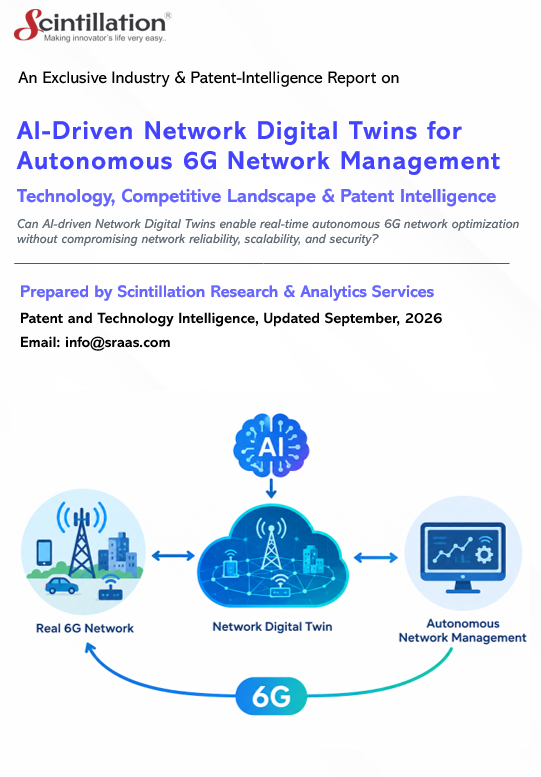
It also traces the transition to AI-enabled closed-loop operation, where a twin continuously receives network data, reproduces conditions virtually, simulates possible actions, predicts their impact, and supports or executes optimized configurations in the physical network. Particular attention goes to reinforcement learning, predictive analytics, generative AI, distributed and edge intelligence, and automated orchestration for dynamic traffic, mobility, spectrum, energy, and resource demands.

Who will benefit from this report

Built for everyone shaping autonomous 6G networks

Each audience gets a clear view of the landscape and what to do with it.

01
Telecom & Mobile Network Operators
Understand how AI digital twins support autonomous management, optimization, and resource allocation in 6G.
02
Network Equipment Manufacturers
Identify technologies and patent trends for integrating twins and AI into RAN, core, transport, and management products.
03
AI & Machine Learning Developers
Apply ML, reinforcement learning, generative AI, and predictive analytics to network monitoring, optimization, and control.
04
Cloud & Edge Computing Companies
See opportunities in distributed twins, edge intelligence, real-time simulation, and low-latency management.
05
Semiconductor & Hardware Companies
Identify needs for AI acceleration, edge processing, telemetry, and real-time twin execution in 6G infrastructure.
06
6G Research Institutions & Universities
Find research directions in AI-native networks, twin architectures, autonomous control, simulation, and orchestration.
07
Telecommunications R&D Teams
Spot emerging approaches, research gaps, and chances to build differentiated management solutions.
08
Patent & IP Teams
Use trends, assignees, clusters, and whitespace for strategy, competitive intelligence, FTO, and portfolio work.
09
Network Software & Orchestration Providers
Add twin-based prediction and autonomous control to orchestration, automation, and monitoring platforms.
10
Enterprise & Industrial Network Providers
Evaluate twins for planning, predictive maintenance, optimization, fault management, and autonomous operation in private 5G/6G.
11
Technology Investors & Strategy Teams
Understand maturity, innovation activity, competitive position, and commercialization opportunities.
12
Standards & Industry Organizations
Get an overview of emerging approaches in AI-native 6G, twins, autonomous management, and closed-loop automation.
13
Startups & Emerging Technology Companies
Use technology gaps and whitespace to build specialized AI-driven 6G management solutions.
14
System Integrators & Consultants
Combine twins, AI, cloud/edge, and 6G into integrated autonomous network-management solutions.
15
Government & Telecom Policy Stakeholders
A technology-level view of emerging 6G capabilities, AI-enabled communications, and digital infrastructure competitiveness.
Introduction

A virtual copy of the network that can think ahead

6G networks will be far more dynamic and complex than today's, with shifting traffic, mobility, spectrum use, and energy demands. A network digital twin is a continuously synchronized virtual replica of the real network. AI can use it to forecast problems, test configuration changes safely in simulation, and then apply the best option to the live network, which makes closed-loop, autonomous operation possible. Building twins that stay accurate in real time, that run at the edge with low latency, and that operators can trust to act on their own is where the technology and IP activity are concentrating.

Report structure

Table of contents

Twelve chapters, from network digital twin fundamentals to patent landscape intelligence. Click any chapter to expand.

—Key findings on AI-driven network digital twins, leading assignees, filing trends, and strategic implications
—Who Will Benefit from This Report
3.1Limitations of Conventional Network Management and Network Modeling
—Core Components of AI-Driven Network Digital Twins for Autonomous 6G Network Management
4.1Challenges Addressed by AI-Driven Network Digital Twins
4.2Key Features of AI-Driven Network Digital Twins
4.3Applications of AI-Driven Network Digital Twins
—How network management has progressed from manual and rule-based to AI-enabled, closed-loop autonomous operation
—The technical, standardization, and commercial signals that make the field strategically important
—Commercialization pathways, open challenges, and future directions for autonomous 6G networks
8.1Methodology & Scope
8.2Interesting Strategic Insights
8.3Assignee Picture
8.4Filing Activity Over Time
8.5Jurisdiction Coverage
8.6Technology Segmentation
8.7Representative Publications Across the Field
8.8Whitespace & Strategic Opportunities
—Stakeholder-specific takeaways for operators, equipment makers, technology developers, IP teams, and investors
—Synthesis of the technical trajectory, IP dynamics, and strategic implications
—Overview of Scintillation Research and its patent and technology intelligence services
—Legal disclaimer covering information accuracy, IP ownership, and terms of use
Core components & key features

What an AI-driven network digital twin is made of

The building blocks that let a virtual network guide the real one.

Real-time network modeling & state synchronization
A virtual replica that continuously mirrors the live network's conditions.
AI-based prediction
Reinforcement learning and predictive analytics that forecast traffic, faults, and performance.
What-if simulation
Testing configuration changes virtually and predicting their impact before applying them.
Traffic management, resource allocation & slicing
Dynamic control of capacity, spectrum, and network slices as demand shifts.
Anomaly detection & automated optimization
Spotting issues early and applying optimized settings with little human input.
Edge AI, generative AI & orchestration
Distributed intelligence and automated orchestration that make closed-loop operation practical.
Challenges addressed

Limits of conventional network management, and what stays hard

What network digital twins aim to address, and where the hurdles are.

01
Manual, reactive network operations
Conventional management reacts to problems and relies on people and fixed rules to respond
02
Highly dynamic 6G demands
Traffic, mobility, spectrum, and energy conditions change too fast for static optimization
03
Risk of trying changes on a live network
A twin lets operators simulate and validate actions first, instead of experimenting on production traffic
04
Fidelity, latency, trust, and standards
Keeping twins accurate and synchronized, running them at the edge, trusting autonomous actions, and agreeing on standards remain open
Applications

Where network digital twins create value

Network management tasks that benefit from prediction and safe simulation.

Network optimization
Resource allocation
Network slicing
Anomaly and fault management
Predictive maintenance
Energy efficiency
Private 5G/6G and industrial networks
Patent landscape study

Who is filing, where, and in which areas

The study covers methodology and scope, strategic insights, the assignee picture, filing activity over time, jurisdiction coverage, technology segmentation across network modeling, state synchronization, AI prediction, slicing, and automated optimization, representative publications, and the whitespace and strategic opportunities for new filings and licensing.
Request Your Sample Report Now!

    For a quick demo, schedule a meeting now!

    Shopping Cart (0 items)

    Subscribe to our newsletter

    Sign up to receive latest news, updates, promotions, and special offers delivered directly to your inbox.
    No, thanks