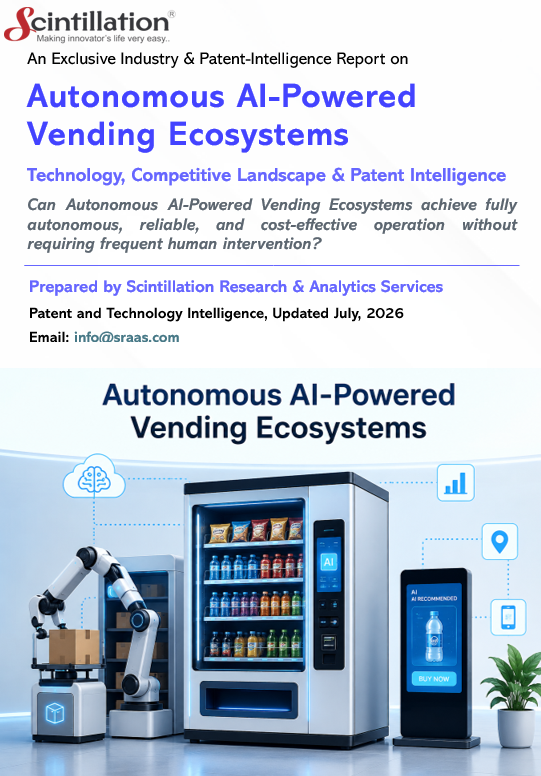
Autonomous AI-Powered Vending Ecosystems

  • Home
  • Autonomous AI-Powered Vending Ecosystems
Patent & Innovation Landscape Analysis  ·  Autonomous Retail Series

From Coin Slots to Cognition: How Autonomous AI-Powered Vending Ecosystems Are Redefining Unattended Retail

A data-grounded look at who is filing, where innovation is concentrated, and why AI-driven vending is becoming a core platform for autonomous retail.

A technology and patent intelligence analysis of autonomous AI-powered vending ecosystems — examining how artificial intelligence, computer vision, IoT, cloud computing, robotics, and advanced analytics are transforming traditional vending machines into intelligent, autonomous retail platforms.

AIDemand & inventory intelligence
VisionComputer vision checkout
IoTConnected fleet operations
PatentLandscape & whitespace

Report details

Autonomous AI-Powered Vending Ecosystems — Patent & Innovation Landscape Analysis Report

PublisherScintillation Research
TechnologyAI-Powered Autonomous Vending
Focus areaIntelligent autonomous retail
Key segmentsAI, Vision, IoT, Robotics, Analytics
IP coverage6-part patent landscape
AudienceIP, R&D, Strategy, Investment
24/7Unattended operation
AIAutonomous decisioning
IoTConnected fleet
IP6-part patent analysis
Purpose of the report

A strategic resource for autonomous vending decisions

The purpose of this report is to provide a comprehensive overview of Autonomous AI-Powered Vending Ecosystems, including their technological evolution, key innovations, market landscape, and commercialization potential.

The report examines how the integration of artificial intelligence (AI), computer vision, IoT, cloud computing, robotics, and advanced analytics is transforming traditional vending machines into intelligent, autonomous retail platforms — and serves as a strategic resource for informed business, technology, and innovation decisions.

Who will benefit from this report

Built for every stakeholder in autonomous retail

From machine makers and retailers to investors and IP teams, the report turns a fast-moving field into decisions each audience can act on.

01
Vending Machine Manufacturers
Understand emerging technologies, product innovation opportunities, and competitive trends.
02
Retailers & Convenience Store Operators
Evaluate autonomous vending for operational efficiency and better customer experience.
03
AI, Robotics & IoT Providers
Identify integration opportunities and emerging market demands.
04
Food & Beverage Companies
Explore new autonomous retail channels for distribution and consumer engagement.
05
Smart City & Infrastructure Developers
Assess intelligent vending for public spaces, transportation hubs, and urban environments.
06
Investors & Venture Capital Firms
Identify high-growth technology areas and emerging business opportunities.
07
Patent & IP Professionals
Analyze patent trends, innovation activity, and competitive positioning.
08
R&D Teams
Identify technology gaps, future research directions, and collaboration opportunities.
09
Healthcare, Education & Hospitality
Evaluate autonomous vending for contactless, 24/7 product distribution.
10
Strategy & Innovation Teams
Support technology roadmaps, commercialization strategies, and strategic decision-making.
Introduction

When a vending machine can see, predict, and decide on its own

Autonomous AI-powered vending ecosystems combine artificial intelligence, computer vision, IoT connectivity, cloud platforms, robotics, and analytics to turn a static dispensing box into a self-managing retail point that understands inventory, customers, and demand.

Where traditional machines simply dispense on payment, intelligent ecosystems recognize products and shoppers, personalize offers, forecast stock needs, flag faults before they cause downtime, and coordinate restocking across an entire fleet — enabling contactless, round-the-clock retail in places where staffed stores are impractical.

Report structure

Table of contents

Ten chapters connecting the technical foundations of autonomous AI-powered vending to patent landscape intelligence and commercialization strategy. Click any chapter to expand.

—Condensed findings on autonomous AI-powered vending, key patent filers, filing trends, and strategic implications
—Who Will Benefit from This Report — manufacturers, retailers, technology providers, food and beverage brands, smart city developers, investors, IP professionals, R&D teams, and strategy teams
3.1Challenges in Traditional Vending Machines — limited intelligence, manual restocking, stock-outs, payment friction, and lack of real-time visibility
4.1Key Features — AI decisioning, computer vision, IoT connectivity, cloud analytics, and robotics
4.2Problems Addressed — operating cost, downtime, inventory waste, and limited customer experience
4.3Potential Applications — retail, transportation hubs, healthcare, education, hospitality, and smart cities
—Commercialization readiness, deployment models, adoption drivers, and near-term milestones
6.1Methodology & Scope — database coverage, search strategy, and classification framework
6.2Who Is Filing — leading assignees and organization types
6.3Filing Activity Over Time — trend analysis and IP maturity signals
6.4Jurisdiction Coverage — filing distribution across major patent offices
6.5Technology Segmentation — patents mapped to AI, vision, IoT, robotics, and analytics
6.6Whitespace & Strategic Opportunities — underprotected domains and emerging filing opportunities
—Stakeholder-specific takeaways for manufacturers, retailers, technology providers, investors, and IP teams
—Synthesis of the technical trajectory, IP dynamics, and strategic implications
—Overview of Scintillation Research and its patent and technology intelligence services
—Legal disclaimer covering information accuracy, IP ownership, and terms of use
Inside the technology

Key features & core enabling technologies

Autonomous vending ecosystems layer intelligence over every step of the retail loop — from recognizing the shopper to restocking the shelf.

AI decisioning & personalization
Machine-learning models for dynamic pricing, product recommendations, and demand forecasting.
Computer vision
Product recognition and frictionless, cashier-less checkout through cameras and sensor fusion.
IoT connectivity
Real-time telemetry on stock, temperature, faults, and sales across a connected fleet.
Cloud & advanced analytics
Centralized platforms for route optimization, predictive maintenance, and fleet-level insight.
Robotics & automation
Robotic dispensing, in-machine handling, and automated preparation for fresh and complex items.
Seamless digital payments
Contactless, mobile, and account-based payment with secure identity and transaction handling.
Problems addressed

Why traditional vending cannot keep up with modern retail

Conventional machines are unconnected and reactive. Autonomous ecosystems close those gaps, while facing their own technical and commercial hurdles.

01
Manual operations and stock-outs
Fixed restocking routes lead to empty slots and wasted trips. Predictive replenishment matches visits to actual demand
Operations
02
Downtime and maintenance costs
Faults are found only after customers complain. Connected diagnostics detect issues early and cut service calls
Uptime
03
Limited customer experience
Static menus and cash-based payment limit engagement. AI personalization and frictionless checkout raise convenience and basket value
Experience
04
Technical & commercialization barriers
Recognition accuracy, hardware cost, data security, integration complexity, and regulatory fit remain the main hurdles to scale
Scale-up
Potential applications

Where autonomous vending creates value

The same intelligent platform adapts to very different environments and product categories.

Retail & convenience
Unattended micro-stores
Transportation hubs
Airports, stations, transit
Healthcare
24/7 contactless supplies
Education & campuses
Food, supplies, devices
Hospitality
Hotels and venues
Smart cities
Public spaces and urban hubs
Patent landscape study

Who is filing, where, and in which technology areas

The landscape study maps innovation activity to reveal competitive positioning, maturing technology clusters, and whitespace for new IP.

Methodology & scope
  • Patent database coverage and search strategy for autonomous AI-powered vending
  • Classification framework spanning AI, vision, IoT, robotics, and analytics
  • Who is filing: leading assignees and organization types
Landscape analytics
  • Filing activity over time and IP maturity signals
  • Jurisdiction coverage across major patent offices
  • Technology segmentation and whitespace opportunities
Request Your Sample Report Now!

    For a quick demo, schedule a meeting now!

    Shopping Cart (0 items)

    Subscribe to our newsletter

    Sign up to receive latest news, updates, promotions, and special offers delivered directly to your inbox.
    No, thanks