GLOBAL AUTONOMOUS BIOCHEMICAL SENSING MARKET REPORT, 2025-2031
Autonomous Biochemical Sensing market size, share, and forecast 2025-2031. By Applications (Healthcare & Medical Diagnostics, Environmental Monitoring, Industrial & Process Monitoring, Agriculture & Food System, Defense Security & Public Safety, and Research Pharma & Life Sciences). By Region (North America, Asia-Pacific, and Europe). Key growth drivers, market opportunities and restraints, market regulatory drivers, major OEMs, Vendors, and Suppliers
Autonomous biochemical sensing refers to systems that can detect and analyse biochemical substances (e.g., ions, proteins, DNA, metabolites, or toxins) without human intervention. This technology can generate detailed, high-resolution data useful for a wide range of applications, including healthcare, environmental monitoring, agriculture, and food production.
This report provides a detailed analysis of the Autonomous Biochemical Sensing market trends, patent filings, and top players involved in the technology development.
An in-depth analysis was performed for the patents filed for Autonomous Biochemical Sensing. The filing trend over the years, including a list of top assignees, top priority countries, and technical areas of the patent applications filed, is included in the report.
In addition, Porter’s Five Forces analysis was conducted to assess the competitive intensity and attractiveness of the Autonomous Biochemical Sensing market by evaluating the bargaining power of buyers and suppliers, the threat of new entrants and substitute products, and the intensity of rivalry among existing competitors.
Autonomous biochemical sensing is emerging as a critical technology for the next generation of healthcare, environmental monitoring, industrial safety, and biosecurity systems. By enabling continuous, real-time detection of biochemical signals without constant human intervention, these systems significantly improve responsiveness, accuracy, and scalability of monitoring operations. Their integration with AI, IoT, and miniaturized biosensor platforms allows rapid identification of pathogens, toxins, metabolic markers, and environmental contaminants, supporting faster decision-making and preventive action.
As industries increasingly demand decentralized diagnostics, smart monitoring infrastructure, and early warning capabilities, autonomous biochemical sensing is poised to become a foundational component of digital health and intelligent sensing ecosystems, driving innovation and new market opportunities across multiple sectors.
The Autonomous Biochemical Sensing market is expected to grow at a CAGR of 18% from 2025 to 2031. Rapid progress in sensor miniaturization, microfluidics, nanomaterials, and bio-recognition elements is a major driver of the autonomous biochemical sensing market.
This report aims to provide comprehensive analysis of the evolving landscape of autonomous biochemical sensors. This report serves as a strategic tool for stakeholders, governments, healthcare companies, investors, and innovators to understand where the Autonomous Biochemical Sensing market is headed, enabling informed decision-making, risk assessment, and opportunity identification in a sector poised for significant global impact.
- 1. Purpose of the report
-
+
2. Technology
- 2.1 Introduction of the technology
- 2.2 Key Application Areas
- 2.3 Stage of the evolution
-
+
3. Market research
- 3.1 Market size and growth
- 3.1.1 Key growth factors
- 3.2 Market opportunities
- 3.3 Market Restraints
-
+
3.4 Regional Outlook
- 3.4.1 North American market
- 3.4.2 APAC market
- 3.4.3 European Market
- 3.5 Regulatory Drivers
- 3.6 Startups & their fundings
- 3.7 M&A/Collaborations
- 3.8 Key Industry Players
-
+
4. Patent Analysis
- 4.1 Patent focus
- 4.2 Filing Trend
- 4.3 Top Patent Assignees
- 4.4 Geographical protection
-
+
5. Porter’s five forces analysis
- 5.1 Intensity of Competition
- 5.2 Potential New Entrants
- 5.3 Bargaining Power of Buyers
- 5.4 Bargaining Power of Suppliers
- 5.5 Availability of Substitutes
- 6. Conclusion
A comprehensive search was performed across multiple patent databases for patents related explicitly to Autonomous Biochemical Sensing. A combination of search strings, IPC/CPC classifications, backward and forward citations, assignees, and specific keywords was used.
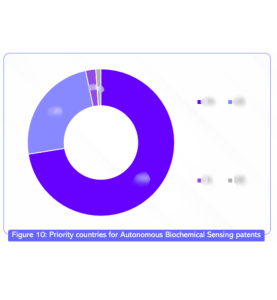
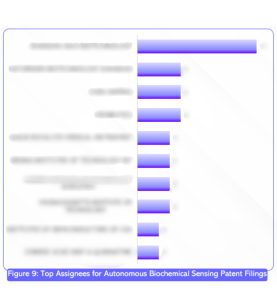
The patent filing trend exhibits a consistent growth in filings between 2020 and 2024. The top patent filers include many Chinese companies and research institutes. The active involvement of these universities resulted in the dominance of China in priority countries, where nearly 2/3rd of the applications were first filed here.
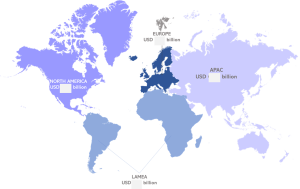
The regional outlook of the Autonomous Biochemical Sensing market revealed that North America held the largest market share with a global revenue of USD 0.42 billion in 2025, followed by APAC.
GET YOUR SAMPLE REPORT NOW
OR SCHEDULE A MEETING