
Can Solid-State Batteries Achieve Significantly Higher Energy Density Without Compromising Safety?
A data-grounded look at who is filing, where next-generation battery innovation is concentrated, and why solid-state battery technology matters now for electric mobility and energy storage.
A comprehensive technology and patent intelligence analysis of Solid-State Battery (SSB) technology — examining solid electrolyte chemistries, lithium-metal anode engineering, cathode materials, interface engineering, cell manufacturing processes, thermal management, and the evolving IP landscape across automotive OEMs, battery manufacturers, materials companies, and research institutions driving next-generation energy storage commercialization.
Report details
Solid-State Batteries (SSB) — Technology & Patent Intelligence Report
When conventional lithium-ion batteries can no longer meet the safety, density, and longevity demands of next-generation electric mobility
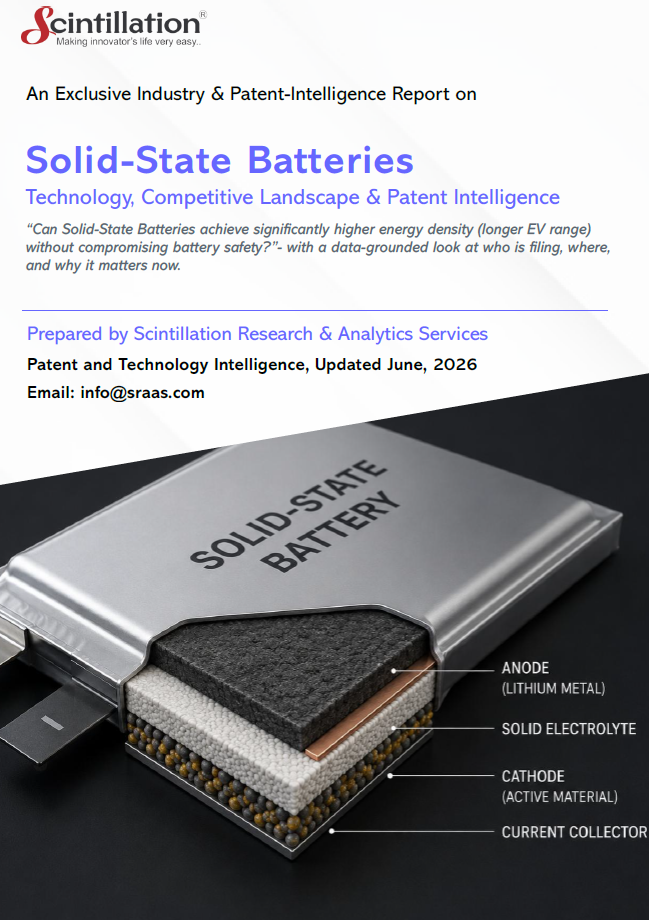
Solid-State Battery technology is an advanced energy storage solution widely regarded as one of the most promising successors to conventional lithium-ion batteries. Unlike traditional lithium-ion cells, which utilize a liquid or gel-based electrolyte to transport lithium ions between the anode and cathode, solid-state batteries employ a solid electrolyte — a fundamental architectural change that unlocks significant improvements in performance, safety, energy density, charging speed, and operational lifespan.
The rapid growth of electric vehicles, renewable energy systems, consumer electronics, and advanced transportation technologies has intensified demand for safer, higher-capacity, and more efficient energy storage solutions. While conventional lithium-ion batteries have enabled widespread electrification, they continue to face limitations that constrain the next generation of applications: flammable liquid electrolytes that create thermal runaway risk, limited energy density approaching the practical ceiling of graphite anode chemistry, long charging times, and gradual performance degradation through cycling.
One of the most significant advantages of solid-state batteries is their ability to utilize lithium-metal anodes, which can store substantially more energy than the graphite anodes used in conventional cells. As a result, solid-state batteries have the potential to provide longer driving ranges for electric vehicles, reduce battery pack size and weight, eliminate the flammability risks associated with liquid electrolytes, and enable faster charging through improved electrochemical kinetics. These advantages make the technology particularly attractive for electric mobility, aerospace, consumer electronics, grid energy storage, and advanced defence applications.
As global demand for sustainable transportation and clean energy solutions continues to grow, solid-state battery technology is expected to play a critical role in the evolution of next-generation energy storage. Although large-scale commercialization is still in development — with significant challenges remaining in solid electrolyte ionic conductivity, electrode–electrolyte interface stability, manufacturing scalability, and cost — solid-state batteries are attracting substantial investment, patent activity, and industry interest from automotive OEMs, battery manufacturers, and materials companies worldwide.
Table of contents
Ten chapters connecting solid-state battery technology foundations to patent landscape intelligence and commercialization strategy. Click any chapter to expand.
Structural components & key features
Solid-state batteries replace the liquid electrolyte with a solid ionic conductor — a change that cascades through every layer of the cell architecture, enabling lithium-metal anodes, wider electrochemical stability windows, and fundamentally improved safety characteristics at the cost of significant interface engineering and manufacturing challenges.
Why conventional lithium-ion batteries cannot meet the next generation of EV performance and safety requirements
Solid-state batteries directly target five fundamental limitations of conventional lithium-ion technology that constrain the performance, safety, and longevity of electric vehicle battery packs — limitations that incremental improvements to liquid-electrolyte cell chemistry cannot fully resolve.
Request Your Sample Report Now!
