Can Space-Based Solar Power Eliminate the Need for Massive Grid-Scale Energy Storage?

  • Home
  • Can Space-Based Solar Power Eliminate the Need for Massive Grid-Scale Energy Storage?
Space-Based Solar Power: Can SBSP Eliminate the Need for Massive Grid-Scale Energy Storage? | Scintillation Research
Patent Intelligence Report  ·  Space Energy Technology Series

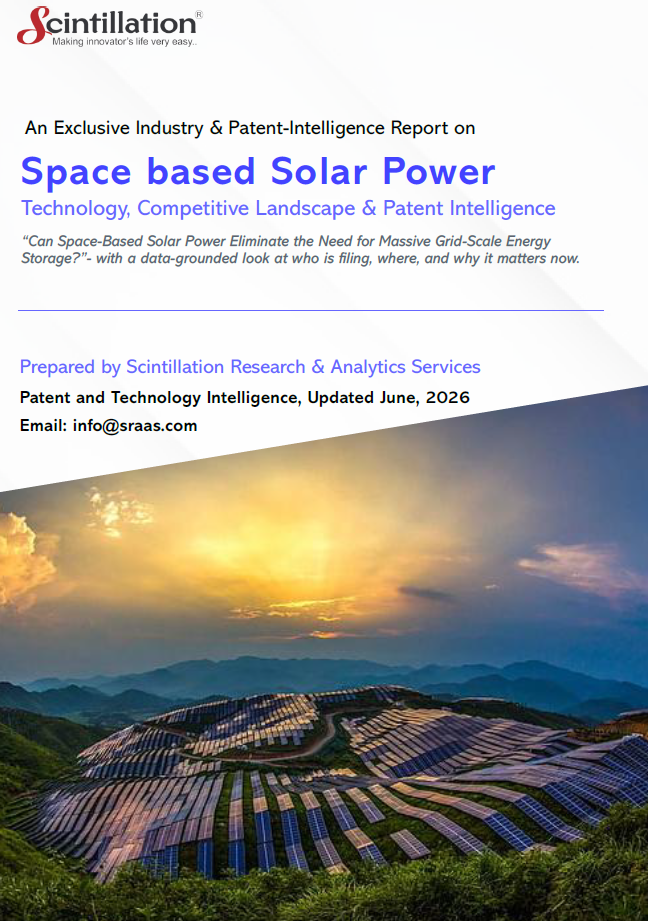
Can Space-Based Solar Power Eliminate the Need for Massive Grid-Scale Energy Storage?

A data-grounded look at who is filing, where, and why it matters now.

A comprehensive technology and patent intelligence analysis of space-based solar power (SBSP) — examining orbital solar arrays, wireless power transmission (microwave and laser), rectenna ground receivers, the GBSP vs SBSP debate, and the evolving IP landscape across energy, defense, and space infrastructure.

36,000 kmGEO orbit altitude
24/7Uninterrupted solar access
MicrowaveWireless power transmission
7-partPatent landscape analysis

Report details

Space-Based Solar Power — Technology & Patent Intelligence Report

Publisher Scintillation Research
Technology Space-Based Solar Power (SBSP)
Core systems Orbital PV, WPT, rectenna receivers
Concept origin Peter Glaser, 1968
IP coverage 7-part patent landscape
Applications Energy, defense, space infrastructure
Audience IP, R&D, Energy, Investment
24/7 Uninterrupted solar
GEO 36,000 km orbit
More solar than ground
IP 7-part patent analysis
360° Ecosystem coverage
Introduction

The world's most abundant energy source, uninterrupted by weather or night

The world is at a crossroads, facing the dual challenge of supplying the power needs of a growing global population while combating climate change. Energy demand is accelerating due to increasing electrification and the growth of big data and AI, making current energy systems increasingly unsustainable.

While terrestrial renewables like wind and solar are crucial, they are intermittent and require vast tracts of land. The concept of space-based solar power — first proposed by Peter Glaser in 1968 — offers a compelling alternative: placing large satellites with solar panels in geostationary orbit, some 36,000 kilometres above the Earth, where they can capture uninterrupted sunlight 24 hours a day, 365 days a year.

This constant stream of solar energy is converted into microwaves and beamed down to receiving stations on the ground. The beam itself is safe — at a peak intensity of around 230W/m², it is approximately a quarter of the strength of the midday sun. In space, solar intensity is significantly higher than at Earth's surface, meaning space-based panels generate far more energy per square metre than their terrestrial counterparts, while freeing up valuable land.

Unlike terrestrial solar farms that are at the mercy of weather and the day-night cycle, SBSP provides consistent, reliable baseload power — something only achievable on Earth with fossil fuels or nuclear energy. This report examines who is building SBSP technology, who owns the key patents, what the manufacturing and deployment reality looks like, and what it all means for the future IP landscape across energy, defense, and space infrastructure sectors.

Report structure

Table of contents

Ten chapters connecting SBSP's technical foundations to patent landscape intelligence, the GBSP vs SBSP debate, and commercialization strategy. Click any chapter to expand.

Condensed findings on SBSP technology, top patent assignees, filing trends, competitive dynamics, and strategic implications for energy, defense, and space infrastructure sectors
2.1 Who Will Benefit from This Report — energy engineers, space technology teams, IP counsel, defense contractors, utility strategists, climate investors, and space infrastructure developers
3.1 Challenges in Ground-Based Renewable Energy Technologies — intermittency, land use, grid storage dependency, transmission losses, and the baseload power gap that SBSP aims to fill
Structural components — orbital solar arrays, power conversion systems, wireless power transmission (microwave and laser), and rectenna ground receiver stations
4.1 Key Features — 24/7 solar access, higher space solar intensity, no weather dependence, scalable transmission, and baseload power delivery without grid storage
4.2 Problems SBSP Aims to Solve — grid storage dependency, intermittency, land use, transmission losses, and carbon baseload gap; including the manufacturing and deployment reality
4.3 Potential Applications & GBSP vs SBSP comparison — energy grid, defense operations, space infrastructure, remote power, and emerging SBSP deployment scenarios vs ground-based solar
Launch cost reduction pathway, demonstration mission timelines, government program investments, regulatory considerations, and commercial deployment outlook across energy and defense markets
6.1 Methodology & Scope — patent database coverage, search strategy, classification framework, and analytical approach for SBSP IP
6.2 Assignee Picture with notable assignee profiles — leading filers across space agencies, defense contractors, energy companies, and emerging SBSP startups
6.3 Filing Activity Over Time — trend analysis identifying R&D acceleration and IP maturity signals in SBSP technology domains
6.4 Jurisdiction Coverage — USPTO, EPO, CNIPA, JAXA/JPO, KIPO, WIPO, and regional patent office distributions across the SBSP landscape
6.5 Technology Segmentation — patents mapped to orbital solar arrays, microwave WPT, laser WPT, rectenna receivers, attitude control, thermal management, and modular satellite assembly
6.6 Foundational Anchor Patents — core IP defining the SBSP landscape from Glaser-era foundations through contemporary innovation and their strategic competitive significance
6.7 Whitespace & Strategic Opportunities — unprotected technology domains and emerging filing opportunities across the SBSP IP ecosystem
Stakeholder-specific takeaways for energy engineers, IP counsel, space agencies, defense contractors, climate investors, utility strategists, and space infrastructure developers
Synthesis of SBSP's technical trajectory, IP landscape dynamics, and strategic implications for the global energy transition and space economy
Publisher profile, research methodology, and service overview — patent analytics, technology scouting, competitive intelligence, and strategic research
Full legal disclaimer covering information accuracy, IP ownership, and terms of use for this intelligence report
Inside SBSP Technology

Structural components & key features

SBSP systems integrate three major technology subsystems — orbital power generation, wireless power transmission, and ground-based energy reception — each representing a distinct domain of patent activity and innovation.

Orbital solar arrays
Large-area photovoltaic or concentrating solar panel arrays deployed in geostationary orbit — capturing uninterrupted, weather-free solar radiation at 8× the average ground-level intensity.
Microwave power transmission (MPT)
Conversion of DC solar power to microwave radiation and directed beam transmission toward Earth. Operating at ~2.45 GHz, MPT beams are safe — peak intensity ~230W/m², roughly a quarter of noon sunlight.
Laser power transmission
Alternative to microwave WPT using high-power laser beams — enabling smaller receiving apertures and potentially higher efficiency in clear-sky conditions, at the cost of atmospheric interference sensitivity.
Rectenna ground receivers
Rectifying antenna arrays converting received microwave power directly back to DC electricity — large-area, lightweight receiver fields that can overlay compatible land uses such as agriculture or parking.
Satellite attitude & beam control
Precision pointing systems maintaining continuous beam alignment between geostationary satellites and ground receivers across a 36,000 km distance — critical for transmission efficiency and safety.
Modular satellite assembly
In-orbit construction and assembly of large-scale SBSP satellite structures from modular components — enabled by robotics, autonomous construction systems, and reusable launch vehicle cost reduction.
Thermal management in orbit
Passive and active thermal control systems managing the extreme temperature cycling experienced by orbital solar hardware — essential for long-lifetime reliability in the space environment.
24/7 baseload power delivery
Unlike terrestrial renewables, SBSP delivers consistent power regardless of weather, season, or time of day — potentially eliminating the need for grid-scale battery storage to back up intermittent renewable generation.
GBSP vs SBSP comparison

How space-based solar stacks up against ground-based solar

The fundamental advantages of space-based solar over ground-based systems stem from physics — not engineering — making SBSP a genuinely different class of energy technology rather than an incremental improvement.

Factor Ground-Based Solar (GBSP) Space-Based Solar (SBSP)
Solar intensity ~170W/m² avg (weather, atmosphere, angle) ~1,360W/m² in GEO orbit — consistent
Availability Intermittent — day only, weather dependent 24/7 — uninterrupted in geostationary orbit
Grid storage need Requires massive grid-scale battery backup Minimal — delivers baseload power directly
Land use High — large land areas per GW capacity Minimal on Earth — receiver arrays can overlay farmland
Transmission losses Long-distance grid losses up to 10–15% WPT beam losses; receiver-to-grid conversion losses
Launch & deployment cost Low — established manufacturing and installation Very high currently; declining with reusable launch
Carbon baseload potential Cannot provide baseload without storage Yes — equivalent to zero-carbon baseload power
Challenges addressed

Why ground-based renewables alone cannot solve the energy problem

SBSP directly targets five structural limitations that prevent ground-based renewable energy systems from fully replacing fossil fuels as a reliable baseload power source.
01
Intermittency & the grid storage problem
Solar and wind generate power only when conditions allow — requiring massive, costly grid-scale battery storage or backup fossil generation to maintain supply reliability. SBSP's continuous power delivery from orbit eliminates the intermittency problem entirely, potentially making large-scale grid-level storage unnecessary
Baseload
02
Massive land requirements for renewables
A solar farm equivalent to national grid demand would require enormous land areas in prime sunlight zones — creating land use conflicts, ecosystem impacts, and geographic concentration of generation assets. SBSP generates power in orbit and delivers it anywhere on Earth's surface, freeing up land for other uses
Land
03
Geographic concentration of solar resource
High-quality solar resources are concentrated in equatorial and desert regions, often far from population centers requiring power. SBSP transmits power directly to any location on Earth's surface, decoupling generation geography from consumption geography and reducing long-distance transmission infrastructure requirements
Geography
04
Carbon baseload power gap
Industrial processes, heating, and data centers require reliable 24/7 power that current renewables cannot consistently provide without fossil fuel backup or nuclear. SBSP offers a genuinely carbon-free baseload power source — the only renewable technology capable of delivering consistent, dispatchable power without energy storage
Carbon
05
Remote & disaster power access
Grid extension to remote areas, military forward operating bases, or disaster zones is expensive and logistically challenging. SBSP's ability to beam power to portable receivers anywhere on Earth could provide resilient, grid-independent power to underserved regions, remote operations, and emergency response scenarios
Remote

Download Your Sample Report Now:

    Application areas

    Where space-based solar power creates strategic value

    SBSP's combination of 24/7 power delivery, location independence, and high energy density creates unique opportunities across sectors where conventional grid power is unavailable, unreliable, or geopolitically constrained.

    National Grid Energy Supply
    Carbon-free baseload power for national grids without storage dependency
    Defense & Military Operations
    Forward operating base power without fuel logistics, remote battlefield energy
    Space Infrastructure
    Power beaming to orbital stations, lunar bases, and deep-space missions
    Remote & Island Communities
    Off-grid power access for communities beyond practical grid extension
    Disaster Response
    Portable rectenna receivers for emergency power after grid destruction
    Data Centers & AI Infrastructure
    Carbon-free 24/7 power for energy-intensive AI training and cloud computing
    Industrial & Hydrogen Production
    Continuous high-density power for green hydrogen electrolysis and industrial processes
    Geopolitically Isolated Nations
    Energy independence for countries with limited fossil fuel access and renewable land constraints
    Patent intelligence

    The SBSP patent landscape — a 7-part analysis

    The patent landscape chapter delivers data-grounded IP intelligence across the SBSP ecosystem — from Glaser-era foundational anchor patents through contemporary assignee profiling, filing trends, technology segmentation, and whitespace identification.

    Assignee & filing intelligence
    • Methodology and scope defining the patent search universe for space-based solar power technology
    • Assignee picture with notable profiles — space agencies, defense contractors, energy companies, and SBSP startups
    • Filing activity over time — trend analysis identifying R&D acceleration and IP maturity signals from the 1970s through today
    • Jurisdiction coverage — USPTO, EPO, CNIPA, JPO, KIPO, WIPO, and regional patent office distributions
    Technology & strategic analysis
    • Technology segmentation — orbital arrays, microwave WPT, laser WPT, rectenna receivers, attitude control, thermal management, modular assembly
    • Foundational anchor patents — from Glaser's 1968 concept through modern SBSP IP defining today's competitive landscape
    • Whitespace & strategic opportunities — unprotected technology domains and emerging SBSP filing opportunities
    • IP implications for future licensing, collaboration, and competitive positioning in the space energy sector
    Who will benefit

    Who should read this report

    Energy Engineers & Space Technology Teams
    Technical teams working on orbital solar arrays, wireless power transmission systems, rectenna receiver design, satellite bus development, and in-orbit assembly technologies for SBSP missions.
    IP Counsel & Patent Teams
    Attorneys and patent professionals assessing SBSP portfolio positioning, whitespace opportunities, freedom-to-operate from Glaser-era anchor patents, and filing strategy across orbital energy technology.
    Climate & Energy Investors
    Investment professionals tracking SBSP development timelines, competitive landscape, cost reduction pathways, and emerging companies in orbital solar power, WPT systems, and rectenna technology.
    Defense & Government Agencies
    National security and government professionals evaluating SBSP for energy independence, military forward power, disaster response infrastructure, and strategic energy security programs.
    Utility & Grid Strategists
    Energy utility planners evaluating SBSP as a long-term baseload carbon-free power source and assessing its implications for grid storage investment, renewable integration, and energy mix planning.
    R&D Strategists & Industry Analysts
    Researchers and consultants mapping the competitive SBSP landscape across space agencies (ESA, JAXA, NASA), defense contractors, energy companies, and emerging space energy startups.
    Technology & Patent Intelligence · Scintillation Research

    Understand who is building the future of space-based energy

    Get the complete technology and patent intelligence report on space-based solar power — from orbital array architectures and wireless power transmission to the patent landscape revealing who is filing, where innovation is concentrated, and why it matters now.

    Scintillation Research · Space-Based Solar Power (SBSP) · Patent Intelligence Series

    For a quick demo, schedule a meeting now!

    Service Demo Booking
    About

    About Scintillation Research

    Scintillation Research & Analytics Services is a specialized intellectual property and technology intelligence firm delivering patent analytics, technology scouting, competitive intelligence, and strategic research services.

    Through comprehensive patent and technology intelligence reports, we help organizations understand emerging innovations, identify market opportunities, monitor competitors, and make data-driven decisions across rapidly evolving technology domains. Our reports are designed for professionals at the intersection of technology strategy, IP management, and competitive intelligence.

    Shopping Cart (0 items)

    Subscribe to our newsletter

    Sign up to receive latest news, updates, promotions, and special offers delivered directly to your inbox.
    No, thanks
    Select your currency