Carbon Negative Concrete and Cement: Decarbonising the Built Environment

  • Home
  • Carbon Negative Concrete and Cement: Decarbonising the Built Environment
Carbon-Negative Concrete & Cement: Patent & Innovation Landscape Analysis | Scintillation Research
Patent Intelligence Report  ·  Sustainable Construction Materials Series

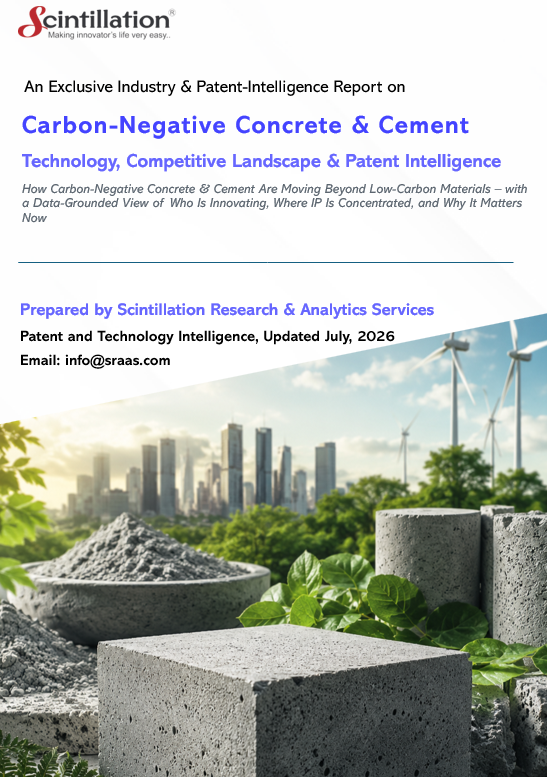
Carbon-Negative Concrete & Cement: Decarbonising the Built Environment — A Patent and Innovation Landscape Analysis

A data-grounded look at who is filing, where innovation is concentrated, and how carbon capture, low-carbon binders, and CO₂ mineralisation are rewriting the rules of construction materials.

A comprehensive technology and patent intelligence analysis covering CCUS, CO₂ mineralisation and curing, alternative binders, supplementary cementitious materials, self-healing concrete, recycled aggregates, clinker substitution, and carbon-sequestering admixtures enabling net-zero and carbon-negative built environments.

8%of global CO₂ from cement production
CCUSCarbon capture & utilisation
SCMsSupplementary cementitious materials
PatentLandscape & whitespace analysis

Report details

Carbon-Negative Concrete & Cement — Technology & Patent Intelligence Report

PublisherScintillation Research
TechnologyCarbon-Negative Concrete & Cement
Focus areaSustainable Construction Materials
Key segmentsCCUS, SCMs, Geopolymers, Admixtures
IP coverage10-part patent landscape
ApplicationsBuildings, Infrastructure, Precast, Transport
AudienceIP, R&D, Strategy, Investment
C−Carbon-negative net lifecycle
4B+Tonnes cement produced annually
CCUSCarbon capture & utilisation
IP10-part patent analysis
Net-0Built environment target
Introduction

When conventional cement can no longer bear the weight of net-zero commitments

Cement and concrete production accounts for approximately 8% of global CO₂ emissions — more than aviation and shipping combined. Conventional Portland cement clinker production is intrinsically carbon-intensive, releasing CO₂ through both energy combustion and the calcination of limestone.

Carbon-negative concrete and cement technologies are reengineering this reality. Through CO₂ mineralisation and curing, alternative binder chemistries, supplementary cementitious materials, and carbon capture integrated into manufacturing processes, these innovations are transforming concrete from one of the world's largest carbon emitters into a potential carbon sink — materials that actively sequester more CO₂ over their lifecycle than was emitted in their production.

The convergence of materials science, process engineering, carbon capture technology, and circular-economy design is producing a new generation of concrete and cement technologies that can serve global decarbonisation goals without sacrificing the structural performance and scalability that the construction industry demands.

Report structure

Table of contents

Ten chapters connecting carbon-negative concrete's technical foundations to patent landscape intelligence and commercialisation strategy. Click any chapter to expand.

Condensed findings on carbon-negative concrete technology, top patent assignees, filing trends, competitive dynamics, and strategic implications for sustainable construction IP
Scope, objectives, and stakeholder value — connecting innovation intelligence to patentability, FTO, licensing, and competitive strategy across the carbon-negative concrete and cement ecosystem
3.1Challenges in Conventional Cement & Concrete — calcination emissions, energy intensity, clinker lock-in, performance trade-offs, and scalability constraints of low-carbon alternatives
Core technologies — CCUS integration, CO₂ mineralisation and curing, alternative binders, SCMs, geopolymers, carbon-sequestering admixtures, and recycled aggregates
4.1Key Features — carbon sequestration capacity, structural performance parity, process compatibility, lifecycle carbon accounting, and circularity
4.2Problems Addressed — production emissions, construction sector decarbonisation gaps, waste utilisation, and clinker dependency
4.3Potential Applications — buildings, infrastructure, precast concrete, ready-mix, transportation infrastructure, industrial construction, and sustainable urban development
Commercialisation roadmap, regulatory and procurement drivers, manufacturing scale-up trajectories, and near-term deployment opportunities across construction market segments
6.1Methodology & Scope — database coverage, search strategy, and classification framework
6.2Scope Corrections — refinements to the initial search boundary following classification review
6.3Revised Assignee Picture & Notable Assignee Profiles — cement majors, construction materials companies, CCUS specialists, and research institutions
6.4Filing Activity Over Time — trend analysis across CO₂ mineralisation, alternative binders, SCMs, and CCUS technology segments
6.5Jurisdiction Coverage — USPTO, CNIPA, EPO, KIPO, JPO, and WIPO distributions
6.6Technology Segmentation — CCUS, CO₂ mineralisation, geopolymers, SCMs, recycled aggregates, admixtures, and bio-based materials
6.7Foundational Anchor Patents — core IP and their strategic competitive significance
6.8Representative Publications — key academic and industry papers shaping research direction
6.9Whitespace & Strategic Opportunities — underprotected domains and emerging filing opportunities
Stakeholder-specific takeaways for IP counsel, licensing professionals, R&D leaders, investors, cement manufacturers, and infrastructure developers
Synthesis of carbon-negative concrete's technical trajectory, IP landscape dynamics, and strategic implications for construction industry decarbonisation
Publisher profile, research methodology, and service overview
Full legal disclaimer covering information accuracy, IP ownership, and terms of use
Inside Carbon-Negative Concrete & Cement

Core technologies & key features

Carbon-negative concrete and cement technologies approach decarbonisation from multiple angles simultaneously — capturing CO₂ during curing, substituting clinker with industrial byproducts, embedding carbon-sequestering admixtures, and integrating industrial carbon capture directly into cement manufacturing.

CO₂ mineralisation & curing
Injecting CO₂ into fresh concrete during curing, where it reacts with calcium to form stable carbonates — permanently mineralising CO₂ within the concrete matrix while accelerating strength development.
Carbon capture, utilisation & storage (CCUS)
Integration of post-combustion CO₂ capture systems into cement kiln operations, with captured CO₂ routed to mineralisation curing, chemical feedstocks, or geological storage.
Alternative & low-carbon binders
Geopolymers, alkali-activated materials, calcium sulfoaluminate cements, and belite-rich clinkers that produce significantly lower CO₂ per tonne of binder compared to ordinary Portland cement.
Supplementary cementitious materials (SCMs)
Fly ash, ground granulated blast-furnace slag, silica fume, calcined clay, and rice husk ash used to replace clinker content — reducing embodied carbon while improving durability and long-term strength.
Carbon-sequestering admixtures
Chemical or biological admixtures that promote in-situ CO₂ sequestration within the concrete matrix during and after curing, extending the material's active carbon capture beyond the initial production stage.
Clinker substitution & reduction
Process and formulation innovations that reduce clinker-to-cement ratios while maintaining structural performance — the most immediately scalable lever for reducing the embodied carbon of concrete at global production volumes.
Recycled & bio-based aggregates
Recycled concrete aggregate, bio-based materials, and industrial waste streams used as aggregate replacements — reducing virgin resource extraction and, in some formulations, contributing additional carbon sequestration.
Lifecycle carbon accounting & verification
Standardised measurement methodologies and digital tools for tracking, verifying, and certifying the net carbon balance of concrete products across production, use, and end-of-life stages.
Challenges addressed

Why conventional cement is the construction industry's hardest decarbonisation problem

Carbon-negative concrete and cement technologies target both the process-level emissions locked into conventional clinker production and the wider construction ecosystem's barriers to adopting low-carbon material alternatives at scale.
01
Calcination process CO₂ — a chemistry-level emission
Around 60% of cement's CO₂ emissions arise from the chemical decomposition of limestone during clinker production — a reaction that cannot be eliminated simply by switching to renewable energy. CO₂ mineralisation, alternative binder chemistries, and clinker substitution are the primary technical routes to addressing this fundamental process emission
Process emissions
02
Structural performance trade-offs from clinker substitution
Higher SCM substitution ratios can affect early-strength gain, setting time, and long-term durability if not properly engineered. Advanced admixture chemistry, optimised SCM blending, and accelerated curing techniques are expanding the performance envelope of low-clinker concrete formulations
Performance
03
Scalability of CO₂ sourcing for mineralisation curing
CO₂ mineralisation curing requires a reliable, proximate supply of CO₂, which depends on CCUS infrastructure that is still being deployed at scale. Integration of on-site carbon capture with concrete batching plants and precast facilities is a key infrastructure challenge for widespread adoption
Infrastructure
04
Regulatory and specification lock-in
Construction standards and specifications in most jurisdictions remain calibrated to ordinary Portland cement performance characteristics, creating inertia against alternative binder adoption even when performance data is available. Updating standards frameworks and gaining procurement acceptance is a critical enabling condition for market scale-up
Regulation
05
Lifecycle carbon measurement and verification
Making credible carbon-negative claims requires robust, standardised methodologies for measuring net CO₂ sequestration across the full concrete lifecycle. The absence of universally accepted carbon accounting frameworks for concrete is limiting the ability to monetise carbon credits and access green procurement programmes
Carbon accounting

Download Your Sample Report Now:

Error: Contact form not found.

Technology & patent intelligence

The carbon-negative concrete & cement patent landscape — a 10-part analysis

The patent landscape chapter delivers data-grounded IP intelligence across the full carbon-negative concrete and cement ecosystem — from revised assignee profiling and filing trends to technology segmentation, anchor patents, and whitespace identification.

Assignee & filing intelligence
  • Methodology, scope, and scope corrections defining the boundaries of carbon-negative concrete patent analysis
  • Revised assignee picture and notable profiles — cement majors, CCUS specialists, chemical companies, and research institutions
  • Filing activity over time — R&D acceleration signals and IP maturity across CO₂ mineralisation, SCMs, geopolymers, and admixtures
  • Jurisdiction coverage — USPTO, CNIPA, EPO, KIPO, JPO, and WIPO distributions across the patent corpus
Technology & strategic analysis
  • Technology segmentation — CCUS integration, CO₂ curing, alternative binders, SCMs, recycled aggregates, and admixtures
  • Foundational anchor patents — core IP and their strategic significance for competitive positioning and FTO
  • Representative publications — key academic and industry papers shaping research and commercialisation roadmaps
  • Whitespace & strategic opportunities — underprotected domains and emerging filing and licensing opportunities
Who will benefit

Who should read this report

Patent Attorneys & IP Analysts
Insights into patent trends, technology clusters, filing activity, and whitespace opportunities for patentability assessments, FTO analysis, and portfolio development across carbon-negative concrete and cement technologies.
Licensing & Business Development
Understanding of emerging high-value patent areas and licensing opportunities in CO₂ mineralisation, low-carbon cement, CCUS integration, and sustainable construction materials.
In-house IP & R&D Leaders
Competitive intelligence on innovation trends, technology leadership, and strategic positioning within the carbon-negative concrete and cement ecosystem to guide internal R&D prioritisation.
Investors & Market Analysts
Visibility into commercialisation readiness, adoption trends, regulatory drivers, and competitive developments influencing future growth across sustainable construction materials markets.
Cement & Concrete Manufacturers
Insights into low-carbon material innovations, CO₂ utilisation technologies, manufacturing challenges, and future technology directions relevant to production decarbonisation strategies.
Construction Companies & Developers
Understanding of material innovation pipelines, supply chain developments, and procurement implications of carbon-negative concrete and cement technologies for green building and infrastructure programmes.
Technology & Patent Intelligence · Scintillation Research

Understand who is building the IP foundation for carbon-negative construction

Get the complete patent intelligence report on Carbon-Negative Concrete & Cement — from CO₂ mineralisation and alternative binders to the patent landscape revealing who is filing, where innovation is concentrated, and how the construction industry is reengineering its most carbon-intensive material.

Scintillation Research · Carbon-Negative Concrete & Cement · Patent Intelligence Series

For a quick demo, schedule a meeting now!

Service Demo Booking
About

About Scintillation Research

Scintillation Research & Analytics Services is a specialised intellectual property and technology intelligence firm delivering patent analytics, technology scouting, competitive intelligence, and strategic research services.

Through comprehensive patent and technology intelligence reports, we help organisations understand emerging innovations, identify market opportunities, monitor competitors, and make data-driven decisions across rapidly evolving technology domains. Our reports are designed for professionals at the intersection of technology strategy, IP management, and competitive intelligence.

Shopping Cart (0 items)

Subscribe to our newsletter

Sign up to receive latest news, updates, promotions, and special offers delivered directly to your inbox.
No, thanks
Select your currency