
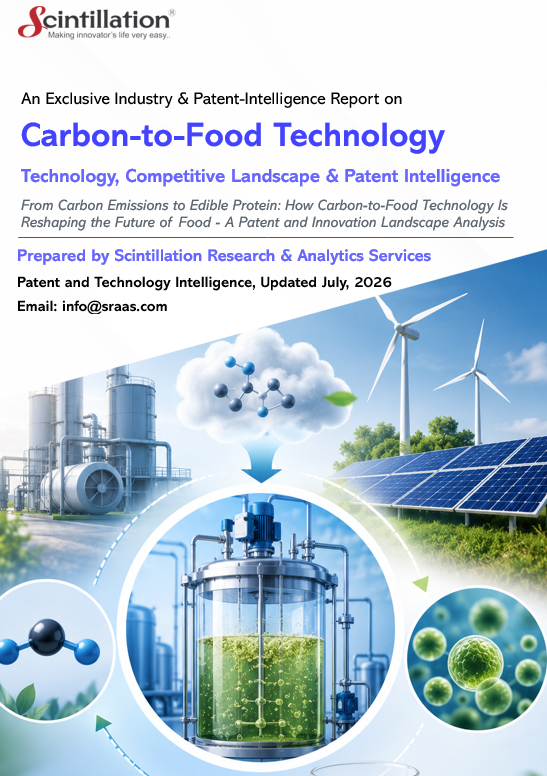
From Carbon Emissions to Edible Protein: How Carbon-to-Food Technology Is Reshaping the Future of Food
A patent and innovation landscape analysis — examining who owns the innovation, who is filing, where technology leadership is concentrated, and what it means for IP and competitive strategy in the carbon-to-food ecosystem.
A comprehensive technology and patent intelligence analysis of Carbon-to-Food Technology — examining CO₂-to-protein conversion processes, gas fermentation, hydrogen-oxidizing microorganisms, engineered microbial strains, precision fermentation, carbon capture integration, AI-driven bioprocess optimization, renewable-energy-powered bioreactors, and the evolving IP landscape across synthetic biology companies, alternative protein producers, industrial biotech firms, and research institutions.
Report details
Carbon-to-Food Technology — Patent & Innovation Landscape Report
When agriculture cannot scale to feed a growing planet — and captured carbon becomes the feedstock for tomorrow's food
Carbon-to-Food Technology is an emerging interdisciplinary field that combines carbon capture and utilization (CCU), industrial biotechnology, synthetic biology, microbial engineering, renewable energy, and advanced fermentation processes to produce sustainable food ingredients by converting carbon dioxide (CO₂) into edible biomass. Unlike conventional agriculture, which relies on arable land, freshwater, and favorable climatic conditions, Carbon-to-Food systems use specialized microorganisms, renewable electricity, and gas fermentation to manufacture protein-rich food ingredients with significantly lower environmental impacts.
The technology is gaining increasing attention due to its potential to address global challenges related to food security, climate change, resource scarcity, and greenhouse gas emissions. Key innovations include CO₂-to-protein conversion, hydrogen-oxidizing microorganisms, engineered microbial strains, precision fermentation, renewable-energy-powered bioreactors, AI-driven bioprocess optimization, and integrated carbon capture systems. These technologies enable highly efficient, scalable, and climate-resilient food production while reducing dependence on conventional agricultural resources and supporting circular carbon economy initiatives.
Recent advances in synthetic biology, microbial strain engineering, carbon capture technologies, renewable hydrogen production, industrial-scale fermentation, artificial intelligence, and process automation are accelerating the transition of Carbon-to-Food technology from pilot-scale demonstrations toward commercial deployment. As organizations seek to develop sustainable and resilient food production systems capable of utilizing captured carbon emissions as a feedstock, Carbon-to-Food technology is emerging as a foundational platform for next-generation alternative proteins and low-carbon food manufacturing.
The growing volume of research activity, patent filings, startup investment, and strategic partnerships highlights the increasing importance of this field and its potential to transform the future of sustainable food production and carbon utilization. This report connects these technological advancements to the underlying intellectual property landscape — enabling readers to move from understanding how Carbon-to-Food technology creates value to understanding who owns the innovation, who is filing, and what it means for IP and competitive strategy.
Table of contents
Eleven chapters connecting Carbon-to-Food technology foundations to patent landscape intelligence and sustainable food commercialization strategy. Click any chapter to expand.
Structural components & key features of Carbon-to-Food systems
Carbon-to-Food systems integrate carbon capture, renewable energy, microbial engineering, and industrial-scale fermentation into a vertically integrated bioprocess that converts atmospheric or point-source CO₂ into protein-rich food ingredients — decoupling food production from arable land, freshwater, and seasonal growing conditions.
Why conventional food production systems cannot meet the sustainability, resilience, and scale demands of a growing world
Carbon-to-Food technology directly targets five fundamental constraints of conventional agricultural protein production that limit the food system's ability to feed a growing global population within planetary boundaries — constraints that incremental improvements to conventional farming and aquaculture cannot resolve.
Request Your Sample Report Now!
