Cell-Free Massive MIMO

  • Home
  • Cell-Free Massive MIMO
Patent & Innovation Landscape Analysis  ·  Next-Generation Wireless Series

No Cell Edges, No Handovers: How Cell-Free Massive MIMO (CF-mMIMO) Is Redefining Wireless Network Architecture

A data-grounded look at who is developing these technologies, where innovation is concentrated, and what it means for research, commercialization, and IP strategy.

DistributedCoordinated access points
User-centricSeamless coverage
5G-A / 6GNext-generation networks
PatentLandscape & whitespace

Report details

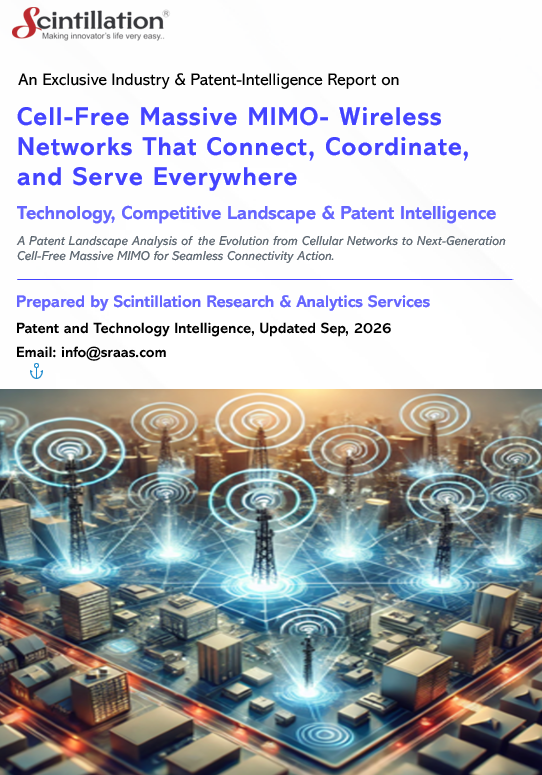
Cell-Free Massive MIMO (CF-mMIMO) — Patent & Innovation Landscape Analysis Report

PublisherScintillation Research
TechnologyCell-Free Massive MIMO
Focus areaDistributed, user-centric wireless
Key segmentsPrecoding, CSI, AP Clustering, Fronthaul
IP coverage8-part patent landscape
AudienceTelecom, IP, R&D, Investment
Purpose of the report

A next-generation wireless architecture and its IP landscape

This report explores the emergence of Cell-Free Massive MIMO (CF-mMIMO) as a next-generation wireless architecture that provides seamless coverage, coordinates distributed access points, improves spectral efficiency, manages interference, and delivers user-centric connectivity. It examines the foundations, evolving applications, innovation landscape, and IP activity, showing who is developing these technologies, where innovation is concentrated, and what that means for research, commercialization, and IP strategy.

It covers key CF-mMIMO technologies, including distributed antenna systems, massive MIMO, coordinated and joint transmission, beamforming, precoding, channel estimation and CSI, AP clustering, power control, interference management, synchronization, fronthaul coordination, resource allocation, and AI-assisted network optimization, along with leading innovators, filing trends, technology evolution, application areas, competitive dynamics, whitespace, and the outlook.

Who will benefit from this report

Built for everyone shaping cell-free wireless networks

Each audience gets a clear view of the landscape and what to do with it.

01
Patent Attorneys, Agents & IP Analysts
Assignees, filing trends, jurisdictions, and segments to support prosecution, FTO, invalidity, and portfolio work.
02
Licensing & Business Development
Foundational and emerging portfolios in massive MIMO, distributed antennas, coordinated transmission, and 5G/6G, with licensing and collaboration targets.
03
In-house IP & R&D Leaders
Competitive intelligence on cell-free architectures, user-centric networking, joint transmission, interference management, and AI-based resource allocation.
04
Investors & Market Analysts
An evidence-based view of innovation activity, commercialization trends, and opportunities across 5G-Advanced and 6G.
05
Telecom, Semiconductor & Networking Companies
Insight into distributed access points, channel estimation, precoding, AP clustering, power control, fronthaul, synchronization, and intelligent optimization.
06
Academia & Research Organizations
Benchmarking on research groups, distributed MIMO, cooperative communication, wireless AI, integrated sensing and communication, and collaboration opportunities.
Introduction

From cells to a cooperating network of access points

Conventional cellular networks divide the map into cells, each served by one base station, so users near a cell edge often suffer weak signals, interference, and handovers. Cell-free massive MIMO removes that boundary: many distributed access points, each with one or more antennas, are connected to a central processing unit and work together to serve every user at the same time. The result can be more uniform coverage, better spectral efficiency, and a user-centric network. Making it practical depends on channel estimation, precoding, access-point clustering, interference and power control, synchronization, and the fronthaul that links everything together.

Report structure

Table of contents

Twelve chapters, from cell-free fundamentals to patent landscape intelligence. Click any chapter to expand.

—Key findings on CF-mMIMO, leading assignees, filing trends, and strategic implications
—Who Will Benefit from This Report
3.1Limitations of Conventional Cellular Technologies
—Core Components of Cell-Free Massive MIMO (CF-mMIMO) Systems
4.1Challenges Addressed by Cell-Free Massive MIMO
4.2Key Features of Cell-Free Massive MIMO (CF-mMIMO)
4.3Applications of Cell-Free Massive MIMO (CF-mMIMO)
—How cell-free networks have progressed from distributed antenna and massive MIMO concepts to 6G architectures
—The technical, standardization, and commercial signals that make the field strategically important
—Commercialization pathways, open challenges, and future directions
8.1Methodology & Scope
8.2Interesting Strategic Insights
8.3Assignee Picture
8.4Filing Activity Over Time
8.5Jurisdiction Coverage
8.6Technology Segmentation
8.7Representative Publications Across the Field
8.8Whitespace & Strategic Opportunities
—Stakeholder-specific takeaways for IP teams, licensing professionals, R&D leaders, investors, and telecom companies
—Synthesis of the technical trajectory, IP dynamics, and strategic implications
—Overview of Scintillation Research and its patent and technology intelligence services
—Legal disclaimer covering information accuracy, IP ownership, and terms of use
Core components & key features

What a cell-free massive MIMO system is made of

From the distributed access points to the processing that coordinates them.

Distributed access points
Many geographically spread access points that jointly serve users instead of one base station per cell.
Massive MIMO & beamforming
Large antenna arrays with precoding and joint transmission that focus energy on each user.
Channel estimation & CSI
Acquiring channel state information across many access points efficiently.
AP clustering & user-centric association
Choosing which access points serve each user to balance performance and complexity.
Power control & interference management
Coordinating transmit power and limiting interference across the whole network.
Fronthaul, synchronization & AI optimization
The links, timing, and AI-assisted resource allocation that make coordinated operation work.
Challenges addressed

Limits of conventional cellular networks, and what stays hard

What CF-mMIMO aims to address, and the engineering hurdles that remain.

01
Cell-edge performance and uneven coverage
Users at the edge of a cell often get the weakest service. Cooperating access points aim for more uniform quality
02
Inter-cell interference and handovers
Cell boundaries create interference and handover overhead that a cell-free design is meant to remove
03
Spectral efficiency and reliability
Joint processing across access points can raise capacity and reliability for many users at once
04
Fronthaul, synchronization, and scalability
Coordinating many access points demands high-capacity links, tight timing, and algorithms that scale with network size
Applications

Where cell-free massive MIMO could create value

Environments that need consistent, high-capacity, user-centric connectivity.

5G-Advanced and 6G networks
Dense urban areas
Stadiums and large venues
Indoor and campus networks
Industrial connectivity
Integrated sensing and communication
Patent landscape study

Who is filing, where, and in which areas

The study covers methodology and scope, strategic insights, the assignee picture, filing activity over time, jurisdiction coverage, technology segmentation across precoding, channel estimation, AP clustering, interference and power control, and fronthaul, representative publications, and the whitespace and strategic opportunities for new filings and licensing.
Request Your Sample Report Now!

    For a quick demo, schedule a meeting now!

    Shopping Cart (0 items)

    Subscribe to our newsletter

    Sign up to receive latest news, updates, promotions, and special offers delivered directly to your inbox.
    No, thanks