
Infrastructure That Looks After Itself: How Closed-Loop Autonomous Maintenance Is Changing the Way Assets Are Kept Safe
A data-grounded look at how infrastructure maintenance is evolving from periodic and predictive approaches toward continuously adaptive, autonomous systems, and who owns the IP.
Report details
Closed-Loop Autonomous Infrastructure Maintenance — Patent & Innovation Landscape Analysis Report
From periodic upkeep to continuously adaptive maintenance
This report assesses the emerging technology and patent landscape of closed-loop autonomous infrastructure maintenance, focusing on technologies that let infrastructure assets continuously monitor their condition, detect and diagnose deterioration, predict failures, determine maintenance needs, and execute or coordinate maintenance actions with minimal human intervention.
It identifies key technology areas, major innovators and assignees, development trends, emerging applications, commercialization opportunities, and whitespace in AI-based predictive maintenance, digital twins, autonomous inspection, robotics, automated repair, and feedback-driven maintenance systems, and shows how maintenance is evolving from conventional and predictive approaches toward fully integrated, autonomous systems.
Built for everyone responsible for keeping infrastructure working
Each audience gets a clear view of the landscape and what to do with it.
Closing the loop between sensing and fixing
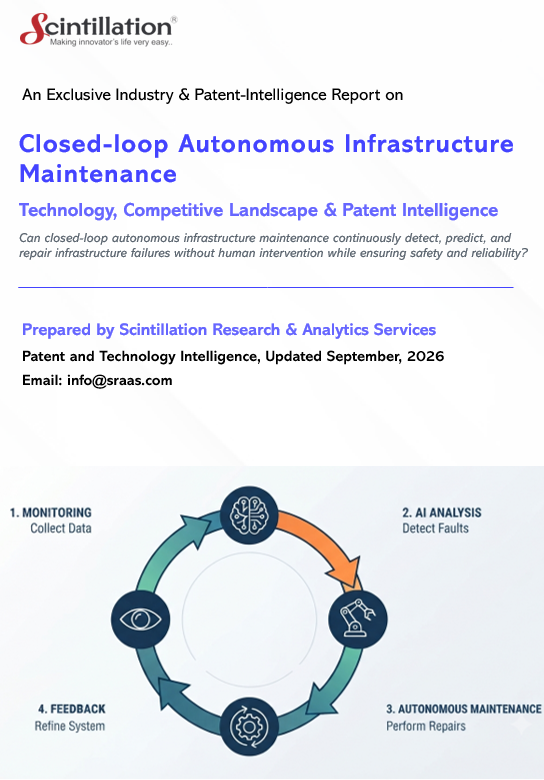
Infrastructure maintenance has long relied on scheduled inspections and reactive repairs, with predictive analytics adding foresight more recently. A closed-loop approach goes a step further: sensors and inspection robots feed a continuously updated digital twin, AI diagnoses deterioration and predicts failures, the system decides what maintenance is needed, and automated tools carry it out, with the results fed back to confirm the fix and refine the next decision. Doing this safely on bridges, roads, tunnels, railways, and buildings is a demanding engineering challenge, and that is where the innovation and IP activity is concentrating.
Table of contents
Twelve chapters, from closed-loop maintenance fundamentals to patent landscape intelligence. Click any chapter to expand.
What a closed-loop maintenance system is made of
The building blocks that sense, decide, and act on infrastructure condition.
Limits of conventional maintenance, and what stays hard
What closed-loop maintenance aims to address, and the barriers that remain.
Where closed-loop maintenance could create value
Assets where reliability and safety matter most.
Who is filing, where, and in which areas
The study covers methodology and scope, strategic insights, the assignee picture, filing activity over time, jurisdiction coverage, technology segmentation across monitoring, AI analytics, digital twins, autonomous inspection, and automated repair, representative publications, and the whitespace and strategic opportunities for new filings and licensing.
Request Your Sample Report Now!
