Collaborative systems allow for near real-time monitoring and quicker decision making by allowing systems to react promptly to changes (e.g., transportation, healthcare, disaster relief) and will enable many of the advanced technologies currently being introduced (e.g., IoT, smart cities, autonomous systems) that continually require the sharing of data and coordination of processes between devices.
The Collaborative Sensing market is expected to grow at a CAGR of 24.3% from 2025 to 2033. The primary growth factor of the collaborative sensing market is the rapid adoption of connected and autonomous vehicles, which require real-time data sharing beyond onboard sensors. This drives demand for V2X communication and cooperative perception systems, significantly accelerating market expansion.
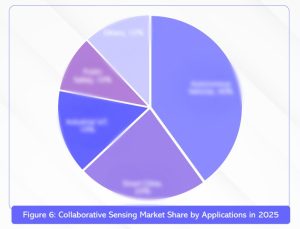
The segmentation of Collaborative Sensing based on applications reveals that Autonomous Vehicles held the largest market share in 2025.
The collaborative sensing market is highly competitive, with major players investing heavily in innovation, which pressures margins. The threat of new entrants is moderate due to high capital, technical, and intellectual property barriers, though niche startups can still enter. Buyer power is moderate to high given multiple supplier options, while supplier power remains moderate due to reliance on specialized components. The threat of substitutes is also moderate, as alternatives exist but lack the real-time, multi-source integration offered by collaborative sensing.
This report aims to provide a comprehensive analysis of the evolving landscape of next-generation Collaborative Sensing technologies. This report serves as a strategic tool for stakeholders, governments, investors, and innovators to understand where the Collaborative Sensing market is headed, enabling informed decision-making, risk assessment, and opportunity identification in a sector poised for significant global impact.
A comprehensive search was performed across multiple patent databases for patents related explicitly to Collaborative Sensing technology. A combination of search strings, IPC/CPC classifications, backward and forward citations, assignees, and specific keywords was used.
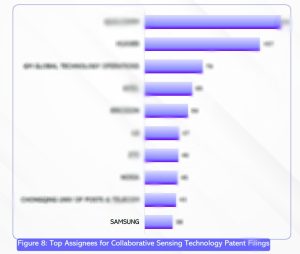
The patent filing trend shows a significant growth from 2019, showcasing the recent innovations and developments in collaborative sensing technologies. Between 2019 and 2025, more than 50 percent of the total applications were filed. The distribution of patents demonstrates that collaborative sensing is closely linked to advanced digital technologies and is driven by companies with strong capabilities in connectivity, data processing, and intelligent systems.
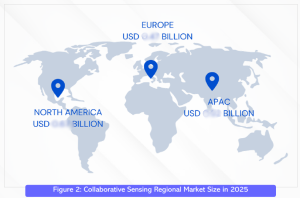
The regional outlook of the Collaborative Sensing market revealed that North America held the largest market share, i.e., 37% of the global revenue in 2025, followed by APAC.