
Many Robots, No Single Controller: How Decentralized AI-Driven Swarm Robotics Is Reshaping Industrial Automation
A data-grounded look at how groups of autonomous robots are learning to coordinate, allocate tasks, and recover from faults without relying entirely on centralized control.
Report details
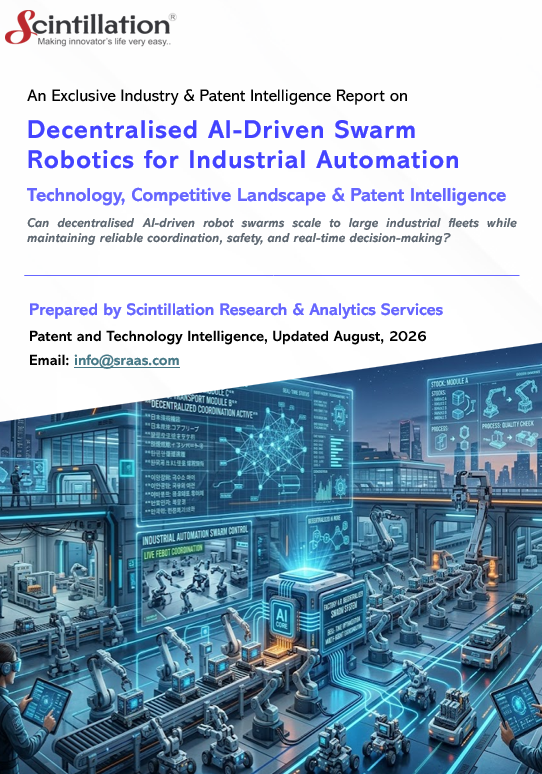
Decentralized AI-Driven Swarm Robotics for Industrial Automation — Patent & Innovation Landscape Analysis Report
Is decentralized swarm robotics ready for the factory floor?
This report evaluates the technological development, patent activity, innovation trends, and commercialization potential of decentralized AI-driven swarm robotics for industrial automation. It assesses how AI, decentralized decision-making, swarm intelligence, multi-robot coordination, and robot-to-robot communication let groups of robots perform industrial tasks collaboratively without relying entirely on centralized control.
It identifies key advances, leading innovators and patent holders, emerging applications, and R&D trends, with emphasis on self-organizing swarms, AI-driven task allocation, dynamic reconfiguration, collective decision-making, and fault-tolerant, scalable operation. It also assesses whether the technology has moved beyond prototypes toward large-scale industrial deployment, and where the gaps and white spaces remain across manufacturing, logistics, inspection, and material handling.
Built for everyone shaping swarm-based automation
Each audience gets a clear view of the landscape and what to do with it.
From one controller to many cooperating robots
Traditional multi-robot systems often depend on a central controller that plans and directs every machine. In a decentralized swarm, each robot makes local decisions, shares information with its neighbors, and the group organizes itself to get the job done. AI strengthens this approach with learned task allocation, adaptive coordination, and collective decision-making, which can make a fleet more scalable and more resilient when individual robots fail or conditions change.
Table of contents
Ten chapters, from swarm robotics fundamentals to patent landscape intelligence. Click any chapter to expand.
Core capabilities of decentralized swarms
What lets many robots act as one flexible system.
Where centralized multi-robot control falls short
Decentralized swarms target these limits, while facing their own barriers to deployment.
Where swarm robotics creates value
Tasks that benefit from many robots working in parallel and adapting together.
Who is filing, where, and in which areas
The study covers methodology and scope, who is filing, filing activity over time, jurisdiction coverage, technology segmentation across swarm intelligence, task allocation, robot communication, and fault-tolerant coordination, and the whitespace and strategic opportunities for new filings and licensing.
Request Your Sample Report Now!
