Direct Lithium Extraction

  • Home
  • Direct Lithium Extraction
Patent & Innovation Landscape Analysis  ·  Critical Minerals Series

Pulling Lithium From Brine, Selectively: How Direct Lithium Extraction (DLE) Could Reshape the Battery Supply Chain

A data-grounded look at who is patenting, which technologies are leading, and whether DLE can move from pilots to economically viable, large-scale deployment.

SelectiveLithium recovery
Multi-routeSorbents, membranes, electrochemical
Scalable?Pilot to commercial
PatentLandscape & whitespace

Report details

Direct Lithium Extraction (DLE) — Patent & Innovation Landscape Analysis Report

PublisherScintillation Research
TechnologyDirect Lithium Extraction
Focus areaSelective lithium recovery from brine
Key segmentsAdsorption, Ion Exchange, Membranes, Electrochemical
IP coverage6-part patent landscape
AudienceIP, R&D, Mining, Investment
Purpose of the report

Can DLE move from pilots to economic, large-scale deployment?

This report provides a comprehensive assessment of the technological, patent, and commercialization landscape of Direct Lithium Extraction (DLE), with emphasis on the technologies that could carry it from pilot and demonstration projects toward economically viable, large-scale deployment. Its central question is whether DLE can overcome its scalability, selectivity, cost, and sustainability challenges to become a widely deployable alternative to conventional lithium brine extraction.

It assesses DLE's evolution from laboratory research to early commercial use, and the main approaches: adsorption, ion exchange, solvent extraction, membrane-based separation, electrochemical extraction, and hybrid processes. It also analyzes the patent landscape to identify major applicants, technology leaders, filing trends, geographic concentration, and areas of technological development.

Who will benefit from this report

Built for everyone in the lithium value chain

Each audience gets a clear view of the landscape and what to do with it.

01
Lithium Mining & Extraction Companies
Identify emerging DLE and competing approaches, improve recovery and efficiency, and find partners and acquisition targets.
02
DLE Technology Developers
Benchmark against competitors, find patent whitespace and R&D opportunities, and follow trends across DLE routes.
03
Battery & EV Manufacturers
Assess future sources of battery-grade lithium, supply reliability and diversification, and partnership options.
04
Chemical & Materials Companies
Find opportunities in selective sorbents, ion-exchange materials, membranes, and solvents that address DLE limits.
05
Oil & Gas and Geothermal Companies
See how lithium-bearing geothermal brines and oilfield produced water could become new revenue streams.
06
Investors & VC Firms
Assess technology maturity, commercialization potential, and technology and IP risks before investing.
07
Patent/IP & R&D Strategy Teams
Identify key patent holders, filing trends, clusters, FTO risks, licensing opportunities, and whitespace.
08
Government & Policy Organizations
Understand technologies that support domestic, diversified lithium supply chains and where support is needed.
09
Research Institutions & Universities
Spot open challenges in high-selectivity extraction, low-energy regeneration, membranes, and closed-loop systems.
Introduction

A faster, more selective route to lithium

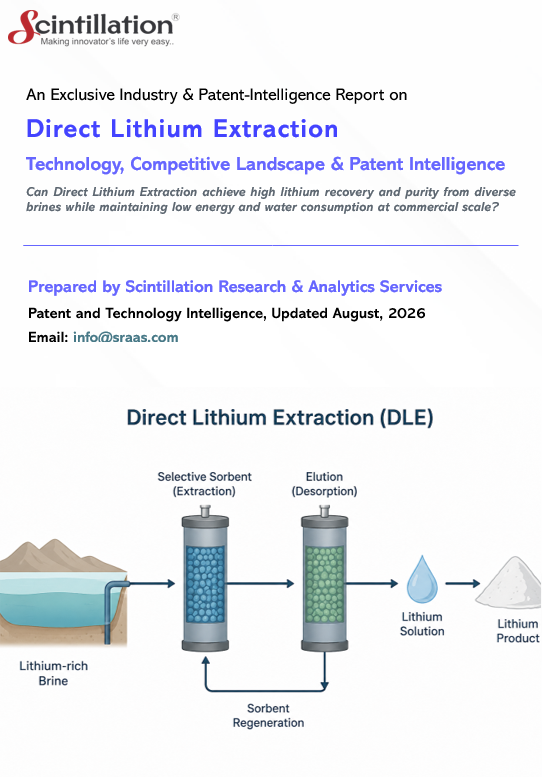
Much of the world's lithium has long come from evaporating brine in large ponds, a slow process that uses significant land and water and depends on weather. Direct Lithium Extraction replaces that step with engineered materials and processes that pull lithium directly out of brine, then return the remaining liquid. If DLE can do this selectively, at low cost, and at scale, it could shorten production times, raise recovery, and open resources that evaporation cannot economically reach, such as geothermal brines and oilfield water.

Report structure

Table of contents

Ten chapters, from DLE fundamentals to patent landscape intelligence. Click any chapter to expand.

—Key findings on DLE technology, leading filers, trends, and strategic implications
—Who Will Benefit from This Report
3.1Challenges in Traditional Direct Lithium Extraction
4.1Key Features
4.2Problems Addressed
4.3Potential Applications
—Technology maturity, scale-up barriers, and the path to commercial deployment
6.1Methodology & Scope
6.2Who Is Filing
6.3Filing Activity Over Time
6.4Jurisdiction Coverage
6.5Technology Segmentation
6.6Whitespace & Strategic Opportunities
—Stakeholder-specific takeaways for miners, developers, battery makers, investors, IP teams, and policymakers
—Synthesis of the technical trajectory, IP dynamics, and strategic implications
—Overview of Scintillation Research and its patent and technology intelligence services
—Legal disclaimer covering information accuracy, IP ownership, and terms of use
Key features

The main DLE technology approaches

Different ways of separating lithium from the other salts in brine.

Adsorption
Selective sorbents capture lithium, which is then released and the sorbent reused.
Ion exchange
Resins and materials that swap lithium ions out of the brine stream.
Solvent extraction
Selective solvents that pull lithium into a separate liquid phase.
Membrane-based separation
Membranes that preferentially let lithium pass while holding back other ions.
Electrochemical extraction
Electrically driven capture and release of lithium with potentially low chemical use.
Hybrid processes
Combinations of methods designed to balance selectivity, energy use, and cost.
Problems addressed

What DLE aims to solve, and what still stands in the way

The promise is clear. These are the barriers to proving it at scale.

01
Slow, land- and water-intensive evaporation
Pond-based production takes long, uses large areas, and depends on climate. DLE targets faster, more compact recovery
02
Selectivity and recovery
Separating lithium from magnesium, sodium, and other ions at high recovery remains a core technical challenge
03
Cost and scalability
Moving from pilots to large, continuous operations at competitive cost is the main commercial hurdle
04
Energy, reagents, and sustainability
Low-energy regeneration, durable materials, and closed-loop water and chemical use are key to environmental performance
Potential applications

Where DLE can create value

Lithium resources that conventional methods struggle to use economically.

Battery-grade lithium for EVs
Conventional lithium brines
Geothermal brines
Oilfield produced water
Energy storage supply chains
Domestic and diversified supply
Patent landscape study

Who is filing, where, and in which areas

The study covers methodology and scope, who is filing, filing activity over time, jurisdiction coverage, technology segmentation across adsorption, ion exchange, solvent extraction, membranes, electrochemical, and hybrid processes, and the whitespace and strategic opportunities for new filings and licensing.
Request Your Sample Report Now!

    For a quick demo, schedule a meeting now!

    Shopping Cart (0 items)

    Subscribe to our newsletter

    Sign up to receive latest news, updates, promotions, and special offers delivered directly to your inbox.
    No, thanks