DNA Digital Data Storage

  • Home
  • DNA Digital Data Storage
Market & Innovation Landscape Analysis  ·  Data Storage Series

Storing the World's Data in a Molecule: How DNA Digital Data Storage Is Redefining Archival Storage

A data-grounded look at who is investing, where technology and commercial activity are concentrated, and what it means for research, product development, and strategic positioning.

SynthesisWriting data to DNA
SequencingReading data back
EncodingError correction
PatentLandscape & whitespace

Report details

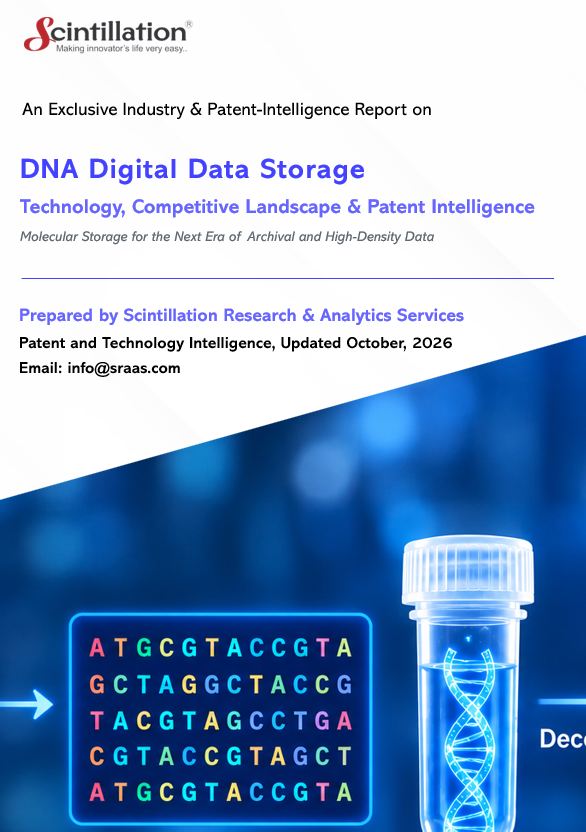
DNA Digital Data Storage — Market & Innovation Landscape Analysis Report

PublisherScintillation Research
TechnologyDNA Digital Data Storage
Focus areaArchival and high-density data storage
Key segmentsSynthesis, Sequencing, Encoding, Retrieval
Coverage8-part landscape study
AudienceStrategy, Investment, IT, IP
Purpose of the report

A next-generation archival and high-density data storage platform

This report examines the emergence of DNA digital data storage as a next-generation archival and high-density data storage platform. It reviews the technology's scientific and engineering foundations, encoding and retrieval pathways, competitive and applications landscape, and the broader market and innovation trends shaping the sector, providing insight into who is investing, where technology and commercial activity are concentrated, and what these trends mean for future research, product development, and strategic positioning.

The report covers core DNA data storage technologies (synthesis, sequencing, encoding, and retrieval), leading companies and research institutions, market and investment trends, technology evolution, applications across archival, enterprise, and specialty use cases, competitive dynamics, whitespace opportunities, and the future outlook for DNA-based data storage.

The report also evaluates the key technical challenges, scalability constraints, cost considerations, and infrastructure requirements that may influence the transition of DNA data storage from experimental research toward practical deployment.

Finally, it highlights emerging innovations, commercialization pathways, and potential future opportunities to help stakeholders identify promising technology areas, investment priorities, and strategic directions within the evolving DNA data storage ecosystem.

Who will benefit from this report

Built for everyone shaping the future of data storage

Each audience gets a clear view of the landscape and what to do with it.

01
Corporate Strategy & Business Development Teams
A structured overview of the DNA data storage landscape, including leading synthesis, sequencing, and encoding technology providers, supporting partnership, investment, and market-entry decisions.
02
Investors & Market Analysts
An evidence-based view of market sizing, cost-reduction trends, commercialization progress, and leading companies within the rapidly evolving DNA data storage sector.
03
Data Center Operators, Cloud Providers & Enterprise IT Teams
Insight into archival storage economics, retrieval-time trade-offs, and technology readiness for long-term "cold data" storage use cases.
04
IP Professionals & Technology Licensing Teams
A landscape view of innovation activity and leading patent holders across DNA synthesis, sequencing, encoding/error-correction, and storage-hardware technologies, supporting freedom-to-operate and licensing assessments.
05
Genomics, Synthetic Biology & Semiconductor Companies
Competitive intelligence on DNA synthesis chemistry, sequencing platforms, and chip-integrated storage hardware to support strategic planning and technology-licensing decisions.
06
Policymakers, Standards Bodies & Regulatory Agencies
Context on how data-security, biosecurity, and industry-standardization efforts (including the DNA Data Storage Alliance and SNIA) are shaping investment and technology deployment in the DNA data storage sector.
Introduction

When the world's data outgrows the media that holds it

The volume of data the world creates keeps growing, and much of it must be kept for decades or longer, even though it is rarely accessed. Conventional archival media such as magnetic tape and hard disks take up large amounts of space, consume power and cooling, degrade over time, and must be periodically migrated to newer formats. DNA digital data storage encodes digital information into synthetic DNA sequences and reads it back through sequencing, offering extremely high density and the potential for very long-lived storage with little energy to maintain. The approach is promising but not without limits: writing and reading DNA is still slow and costly compared with conventional media, random access and retrieval times are constrained, and the technology needs scalable hardware, robust error correction, and common standards before it can move from research toward practical deployment.

Report structure

Table of contents

Twelve chapters, from DNA data storage fundamentals to market and innovation landscape intelligence. Click any chapter to expand.

—Key findings on DNA digital data storage, leading players, investment trends, and strategic implications
—Who Will Benefit from This Report
3.1Limitations of Conventional Archival Storage Media
—Core Components of DNA Data Storage Systems
4.1Challenges Addressed by DNA Digital Data Storage
4.2Key Features of DNA Digital Data Storage
4.3Applications of DNA Digital Data Storage
—How DNA storage has progressed from early laboratory demonstrations toward scalable, commercially oriented systems
—The technical, commercial, and innovation signals that make the field strategically important
—Commercialization pathways, open challenges, and future directions
8.1Methodology & Scope
8.2Interesting Strategic Insights
8.3Assignee Picture
8.4Market and Investment Growth Over Time
8.5Jurisdiction Coverage
8.6Technology Segmentation
8.7Representative Technologies and Research Programs Across the Field
8.8Whitespace & Strategic Opportunities
—Stakeholder-specific takeaways for strategy teams, data center and cloud operators, investors, IP teams, and policymakers
—Synthesis of the technical trajectory, market dynamics, and strategic implications
—Overview of Scintillation Research and its patent and technology intelligence services
—Legal disclaimer covering information accuracy, IP ownership, and terms of use
Key features

Core capabilities of DNA digital data storage

The properties that make DNA an attractive medium for long-term data.

Extreme storage density
Very large amounts of data held in a tiny physical volume compared with tape or disk.
Long-term durability
DNA can remain stable for very long periods when stored properly, reducing refresh cycles.
Low energy to retain data
Stored samples need little power or cooling once written, unlike spinning or powered media.
Encoding and error correction
Algorithms that map bits to bases and recover data despite synthesis and sequencing errors.
Parallel synthesis and sequencing
Writing and reading many molecules at once to raise throughput and lower cost.
Selective data retrieval
Addressing and extracting specific files from a pool without reading everything.
Challenges addressed

Why conventional archival storage is struggling, and what stays hard

What DNA digital data storage aims to address, and where the limits are.

01
Explosive growth in data
Data creation is outpacing the capacity and affordability of conventional archival media
02
Space, power, and cooling costs
Large archives need big facilities and continuous energy. DNA offers a far denser, lower-energy alternative
03
Media degradation and repeated migration
Tapes and disks age and need periodic copying to new media, adding cost and risk of loss
04
Cost, speed, and standardization limits
Writing and reading remain slow and expensive, random access is limited, and common standards are still emerging
Applications

Where DNA digital data storage creates value

Use cases where long-term, dense, low-maintenance storage is a competitive edge.

Cold data and long-term archives
Cloud and enterprise backup
Cultural heritage preservation
Scientific and genomic datasets
Media and entertainment archives
Government and compliance records
Specialty and secure storage
Patent landscape study

Who is investing, where, and in which areas

The study covers methodology and scope, strategic insights, the assignee picture, market and investment growth over time, jurisdiction coverage, technology segmentation across DNA synthesis, sequencing, encoding and error correction, and storage hardware, representative technologies and research programs, and the whitespace and strategic opportunities for new filings and licensing.
Request Your Sample Report Now!

    For a quick demo, schedule a meeting now!

    Shopping Cart (0 items)

    Subscribe to our newsletter

    Sign up to receive latest news, updates, promotions, and special offers delivered directly to your inbox.
    No, thanks