Epitranscriptomic Therapeutics

  • Home
  • Epitranscriptomic Therapeutics
Patent & Innovation Landscape Analysis  ·  RNA Medicine Series

Beyond the Genetic Code: How Epitranscriptomic Therapeutics Are Transforming the Future of Medicine

A data-grounded look at who is filing, where innovation is concentrated, and why modulating RNA modifications is emerging as a new frontier for precision therapeutics.

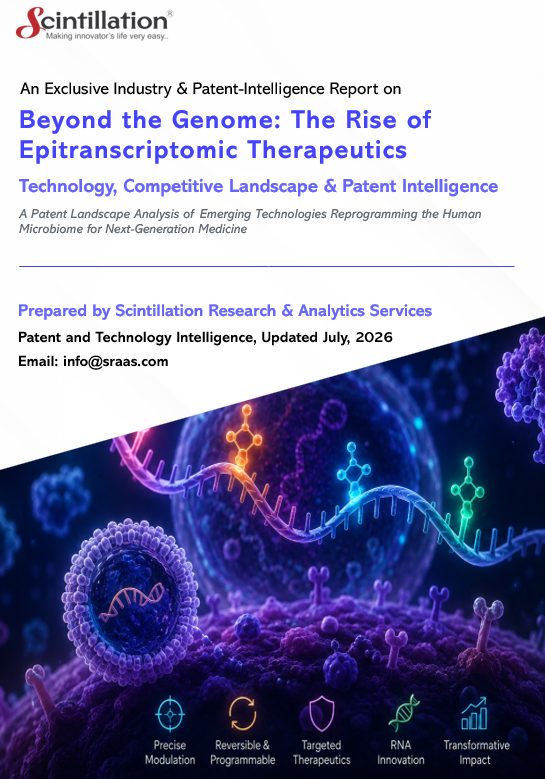
A technology and patent intelligence analysis of epitranscriptomic therapeutics — examining RNA methylation modulators, RNA editing technologies, epitranscriptomic biomarkers, RNA-modifying enzyme therapeutics, AI-enabled RNA drug discovery, and precision RNA medicines that regulate gene expression through reversible RNA modifications.

RNAModification modulators
EditingProgrammable RNA editing
AIRNA drug discovery
PatentLandscape & whitespace

Report details

Epitranscriptomic Therapeutics — Patent & Innovation Landscape Analysis Report

PublisherScintillation Research
TechnologyEpitranscriptomic Therapeutics
Focus areaRNA modification-based medicine
Key segmentsMethylation, Editing, Biomarkers, AI
IP coverage8-part patent landscape
ApplicationsOncology, Neurology, Metabolic, Rare Disease
AudienceIP, R&D, BD, Investment
RNAModification-level control
ReversibleGene expression modulation
PrecisionTargeted RNA medicines
IP8-part patent analysis
Purpose of the report

Mapping a new therapeutic platform built on RNA modifications

This report examines epitranscriptomic therapeutics as an emerging platform aimed at modulating RNA modifications to regulate gene expression for the prevention, diagnosis, and treatment of disease.

Therapeutic development has traditionally targeted DNA, proteins, or unmodified RNA. Advances in epitranscriptomics, RNA biology, RNA-modifying enzymes, RNA editing, precision medicine, and computational biology are now opening highly targeted and reversible ways to modulate cellular function.

The report analyzes the technological foundations, patent landscape, key innovators, filing trends, jurisdictional distribution, and evolving innovation themes in the field. It also explores major technology segments, strategic opportunities, competitive dynamics, commercialization pathways, and future directions for intellectual property development.

Who will benefit from this report

Built for everyone shaping the RNA therapeutics ecosystem

From patent professionals and licensing teams to biopharma leaders and investors, the report turns a complex scientific field into decisions each audience can act on.

01
Patent Attorneys, Agents & IP Analysts
A structured view of assignees, filing trends, jurisdictions, and technology segments to support prosecution, FTO, invalidity, landscape, and portfolio work.
02
Licensing & Business Development
Insight into foundational and emerging portfolios to identify licensing opportunities, collaboration targets, and commercially significant technology owners.
03
In-house IP & R&D Leaders
Competitive intelligence on RNA modification technologies, drug platforms, RNA-targeting small molecules, and programmable editing systems for planning and technology scouting.
04
Investors & Market Analysts
An evidence-based view of innovation activity, commercialization trends, leading assignees, and emerging opportunities in RNA medicine.
05
Pharma, Biotech & RNA Therapeutics Companies
Insight into methylation modulators, editing platforms, biomarkers, enzyme inhibitors, AI-assisted discovery, and enabling technologies for next-generation RNA therapeutics.
06
Academic & Research Organizations
Benchmarking on leading innovators, emerging research directions, commercialization pathways, and collaboration opportunities.
07
Healthcare & Biopharma Strategists
Strategic insight into how precise regulation of RNA function could reshape disease management across oncology, neurological, metabolic, inflammatory, cardiovascular, and rare genetic diseases.
Introduction

When the next layer of gene regulation becomes a drug target

Epitranscriptomics studies the chemical modifications on RNA — such as methylation — that influence how RNA is processed, stabilized, translated, and degraded, adding a dynamic layer of control on top of the genetic code.

Because many of these modifications are written, read, and erased by dedicated enzymes, they offer tractable points of intervention. Epitranscriptomic therapeutics seek to tune those enzymes, edit modification sites, or exploit modification patterns as biomarkers, enabling targeted and potentially reversible control of gene expression without altering the underlying DNA sequence.

Report structure

Table of contents

Twelve chapters connecting the science of epitranscriptomic therapeutics to patent landscape intelligence and commercialization strategy. Click any chapter to expand.

—Condensed findings on epitranscriptomic therapeutics, leading assignees, filing trends, and strategic implications
—Who Will Benefit from This Report — IP professionals, licensing teams, R&D leaders, investors, biopharma companies, academic institutions, and healthcare strategists
—Background on RNA modifications and the emergence of epitranscriptomic therapeutics
—Key Technology Platforms in Epitranscriptomic Therapeutics
4.1Challenges Addressed by Epitranscriptomic Therapeutics
4.2Key Features of Epitranscriptomic Therapeutics
4.3Applications of Epitranscriptomic Therapeutics
—How the field has progressed from RNA modification discovery to therapeutic platforms
—The scientific, clinical, and commercial signals that make the field strategically important
—Commercialization pathways, development milestones, and future directions
8.1Methodology & Scope
8.2Interesting Strategic Insights
8.3Assignee Picture
8.4Filing Activity Over Time
8.5Jurisdiction Coverage
8.6Technology Segmentation
8.7Representative Publications Across the Field
8.8Whitespace & Strategic Opportunities
—Stakeholder-specific takeaways for IP teams, licensing professionals, R&D leaders, investors, and biopharma strategists
—Synthesis of the technical trajectory, IP dynamics, and strategic implications
—Overview of Scintillation Research and its patent and technology intelligence services
—Legal disclaimer covering information accuracy, IP ownership, and terms of use
Key technology platforms

Core platforms in epitranscriptomic therapeutics

The field spans enzymes that write, read, and erase RNA modifications, tools that edit RNA, and the computational and diagnostic layers that make them clinically usable.

RNA methylation modulators
Small molecules and biologics that tune the writers, readers, and erasers of RNA methylation to adjust gene expression.
RNA editing technologies
Programmable systems that make precise, reversible changes to RNA sequences or modifications without altering DNA.
Epitranscriptomic biomarkers
RNA modification signatures used for disease detection, patient stratification, and treatment monitoring.
RNA-modifying enzyme therapeutics
Inhibitors, activators, and enzyme-directed agents aimed at the proteins that install and remove RNA modifications.
AI-enabled RNA drug discovery
Machine learning to predict modification sites, model RNA structure, and identify RNA-targeting compounds faster.
Precision RNA medicines
Personalized therapies that use an individual patient's RNA modification profile to guide targeted treatment.
Challenges addressed

Where conventional modalities fall short

Epitranscriptomic approaches target gaps that DNA-, protein-, and conventional RNA-directed therapies struggle to close, while facing their own scientific and translational hurdles.

01
Undruggable or hard-to-reach targets
Many disease drivers are difficult to address through proteins or DNA. RNA modification pathways open a new class of tractable targets
New targets
02
Permanent versus reversible intervention
Genome-level changes are permanent. RNA-level modulation offers tunable, reversible control with a different safety profile
Reversibility
03
Limited precision in gene expression control
Fine-tuning expression in specific cells and contexts remains difficult. Modification-level control adds a precise regulatory layer
Precision
04
Translational and delivery barriers
Selectivity, off-target effects, delivery, and biomarker validation remain open challenges on the path to the clinic
Translation
Applications

Therapeutic areas with the most potential

Because RNA modifications influence nearly every cellular process, the platform may apply across a broad range of diseases.

Oncology
Tumor-driving RNA modification pathways
Neurological disorders
Regulation of neuronal gene expression
Metabolic diseases
Control of metabolic pathways
Inflammatory diseases
Modulating immune responses
Cardiovascular diseases
Cardiac and vascular gene regulation
Rare genetic diseases
Targeted RNA-level correction
Patent landscape study

Who is filing, where, and in which technology areas

The landscape study maps innovation activity to reveal competitive positioning, maturing technology clusters, and whitespace for new IP.

Scope & players
  • Methodology and scope: database coverage, search strategy, and classification framework
  • Strategic insights drawn from the filing data
  • Assignee picture: leading companies, institutions, and organization types
Landscape analytics
  • Filing activity over time and IP maturity signals
  • Jurisdiction coverage across major patent offices
  • Technology segmentation and representative publications
  • Whitespace and strategic opportunities for new filings and licensing
Request Your Sample Report Now!

    For a quick demo, schedule a meeting now!

    Shopping Cart (0 items)

    Subscribe to our newsletter

    Sign up to receive latest news, updates, promotions, and special offers delivered directly to your inbox.
    No, thanks