
A Virtual Twin for Every Pack: How EV Battery Digital Twins Are Turning Battery Data Into Strategic Intelligence
A data-grounded look at who owns the IP, where innovation is concentrated, and which less-crowded areas offer room for defensible new portfolios.
Report details
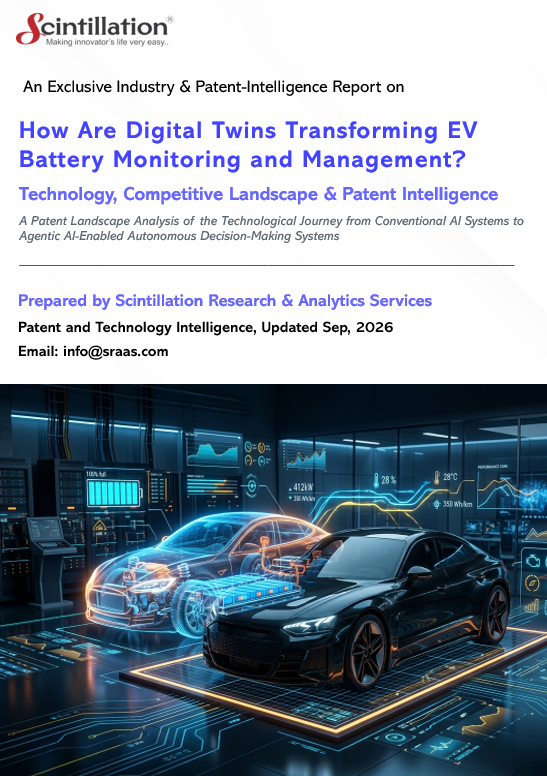
EV Battery Digital Twin — Patent & Innovation Landscape Analysis Report
Strategic evolution, competition, and commercial opportunity
This IP and technology landscape report evaluates the strategic evolution, competitive landscape, and commercial opportunities in EV battery digital twin technologies. By analyzing assignee profiles, patent filing trends, and technology concentrations, it maps established domains such as cell-level electrochemical modeling, thermal behavior simulation, cloud-edge architectures, and machine-learning-driven State of Health (SOH) and State of Charge (SOC) estimation, and tracks the shift from foundational physics-based models toward deployment-focused implementations, including real-time IoT sensor streaming, predictive thermal runaway detection, adaptive fast-charging protocols, over-the-air (OTA) control loops, and fleet management integration.
It also assesses commercialization drivers such as fleet electrification, warranty risk reduction, vehicle-to-grid (V2G) integration, and second-life energy storage, and highlights less crowded whitespace such as solid-state battery twins, physics-informed neural networks (PINNs), battery passport data protocols, and automated recycling optimization, giving OEMs, battery manufacturers, and technology firms the intelligence to build defensible portfolios, guide R&D, and differentiate in cloud-connected battery intelligence.
Built for everyone in the EV battery intelligence ecosystem
Each audience gets a clear view of the landscape and what to do with it.
A living virtual model of each battery
An EV battery digital twin is a virtual model of a specific battery cell, pack, or fleet that is kept up to date with real data from the vehicle. It combines electrochemical and thermal models with machine learning to estimate state of health and state of charge, anticipate degradation and safety risks, and test charging or control strategies virtually before applying them. With cloud-edge architectures and over-the-air links, the twin can close the loop, informing the battery management system, supporting warranty and fleet decisions, and eventually helping place a battery in second-life use or recycling.
Table of contents
Twelve chapters, from EV battery digital twin fundamentals to patent landscape intelligence. Click any chapter to expand.
What an EV battery digital twin is made of
From cell-level physics to fleet-level decisions.
Limits of conventional battery monitoring, and what stays hard
What battery digital twins aim to address, and where the hurdles are.
Where EV battery digital twins create value
Commercial drivers across the battery life cycle.
Who is filing, where, and in which areas
The study covers methodology and scope, strategic insights, the assignee picture, filing activity over time, jurisdiction coverage, technology segmentation across modeling, thermal simulation, SOH/SOC estimation, and cloud-edge control, representative publications, and the whitespace and strategic opportunities, including solid-state battery twins, physics-informed neural networks, battery passport protocols, and recycling optimization.
Request Your Sample Report Now!
