Exosome Drug Delivery

  • Home
  • Exosome Drug Delivery
Patent & Innovation Landscape Analysis  ·  Advanced Therapeutics Series

Nature's Own Delivery Vehicles: How Exosome Drug Delivery Is Shaping Next-Generation Targeted Therapeutics

A data-grounded look at who is innovating, where IP activity is concentrated, and what it means for development, commercialization, and freedom to operate.

ExosomesNatural vesicle carriers
CargoDrugs, RNA, and proteins
TargetingEngineered delivery
PatentLandscape & whitespace

Report details

Exosome Drug Delivery — Patent & Innovation Landscape Analysis Report

PublisherScintillation Research
TechnologyExosome Drug Delivery
Focus areaExtracellular-vesicle therapeutics
Key segmentsIsolation, Loading, Targeting, Manufacturing
IP coverage7-part patent landscape
AudienceIP, R&D, Biopharma, Investment
Purpose of the report

A technical, innovation, and IP assessment of exosome delivery

This report provides a comprehensive technical, innovation, and patent landscape assessment of exosome drug delivery, an emerging approach that uses naturally occurring extracellular vesicles to carry therapeutic payloads, including small-molecule drugs, proteins, mRNA, siRNA, miRNA, and other nucleic acids, to target cells and tissues. It examines the technology stack from exosome isolation and purification, cargo loading, and surface engineering to targeting, characterization, formulation and stabilization, controlled release, and in-vivo delivery.

It also analyzes the global patent landscape, including filing trends, leading innovators, geographic distribution, technology clusters, foundational inventions, and whitespace. Together, the technical and IP views give pharma and biotech companies, developers, researchers, IP professionals, investors, and healthcare stakeholders a framework to find opportunities, assess competitive position, evaluate freedom to operate, and support development and investment decisions.

Who will benefit from this report

Built for everyone shaping exosome-based therapeutics

Each audience gets a clear view of the landscape and what to do with it.

01
Patent Attorneys, Agents & IP Analysts
Verified assignee, patent family, and jurisdiction data plus whitespace analysis for prosecution, portfolio work, FTO, and competitive intelligence.
02
Licensing & Monetization Professionals
An early view of where licensable IP is concentrating across engineered exosomes, encapsulation, nucleic-acid delivery, targeting, manufacturing, and formulations.
03
In-house IP & R&D Leaders
Competitive positioning on engineered exosomes, targeted delivery, cargo loading, manufacturing, and next-generation vesicle platforms.
04
Investors & Market Analysts
A data-driven view of commercialization readiness, maturity, clinical translation, patent strength, and innovation signals.
05
Pharma, Biotech, Delivery, CDMO & Healthcare Players
Pharmaceutical and biotech companies, delivery developers, research institutions, CDMOs, platform providers, and healthcare organizations gain insight into isolation, loading, targeting, release, and scalable manufacturing.
Introduction

Using the body's own messengers to carry medicine

Exosomes are tiny vesicles that cells naturally release to carry proteins and RNA to other cells. Drug delivery researchers aim to borrow that ability: load an exosome with a therapeutic, adjust its surface so it homes in on the right cells, and let it deliver its cargo. Because exosomes come from natural membranes, they may be better tolerated than some synthetic carriers and may cross biological barriers more readily. Turning that promise into products depends on solving isolation, loading, targeting, characterization, and, above all, consistent manufacturing at scale.

Report structure

Table of contents

Nine chapters, from exosome delivery fundamentals to patent landscape intelligence. Click any chapter to expand.

—Key findings on exosome drug delivery, leading assignees, filing trends, and strategic implications
—Who Will Benefit from This Report
3.1Challenges in Exosome Drug Delivery
4.1Key Features of Exosome Drug Delivery Technology
4.2Problems Exosome Drug Delivery Technology Aims to Solve
4.3Potential Applications of Exosome Drug Delivery Technology
—Technology maturity, clinical translation, manufacturing scale-up, and commercialization pathways
6.1Revised Assignee Picture
6.2Notable Assignee Profiles
6.3Filing Activity Over Time
6.4Jurisdiction Coverage
6.5Technology Segmentation
6.6Representative Publications Across the Field
6.7Whitespace & Strategic Opportunities
—Stakeholder-specific takeaways for IP teams, licensing professionals, R&D leaders, investors, and biopharma companies
—Synthesis of the technical trajectory, IP dynamics, and strategic implications
—Legal disclaimer covering information accuracy, IP ownership, and terms of use
Key features

The building blocks of exosome drug delivery

From producing and purifying vesicles to loading and targeting them.

Isolation & purification
Producing and separating exosomes from source cells at the required purity.
Therapeutic cargo loading
Encapsulating small molecules, proteins, mRNA, siRNA, miRNA, and other nucleic acids.
Surface engineering & targeting
Modifying the vesicle surface with ligands so it reaches the intended cells and tissues.
Characterization
Measuring size, content, and quality to ensure consistent, well-defined products.
Formulation & controlled release
Stabilizing exosomes and controlling how and when the payload is delivered.
Scalable manufacturing
Production platforms and donor-cell strategies that support commercial volumes.
Problems addressed

What exosome delivery aims to solve, and what stays hard

The promise of better delivery, and the barriers to turning it into products.

01
Reaching the right cells and tissues
Many drugs spread widely or fail to reach their target. Engineered targeting aims to concentrate them where needed
02
Delivering fragile or large payloads
Nucleic acids and proteins are hard to deliver intact, and vesicle carriers may help protect and transport them
03
Tolerability of synthetic carriers
Natural-membrane vesicles may offer different immune and safety profiles than some synthetic delivery systems
04
Manufacturing, consistency, and standardization
Scalable production, purification, loading efficiency, and reliable characterization remain the main hurdles to commercialization
Potential applications

Where exosome delivery could create value

Therapeutic areas that depend on targeted delivery of sensitive payloads.

Targeted drug delivery
Nucleic-acid delivery
Gene therapy
Cancer therapeutics
Regenerative medicine
Immunotherapy
Personalized medicine
Patent landscape study

Who is filing, where, and in which areas

The study covers the revised assignee picture and notable profiles, filing activity over time, jurisdiction coverage, technology segmentation across engineered exosomes, cargo loading, targeting, production and purification, and formulations, representative publications, and the whitespace and strategic opportunities for new filings and licensing.
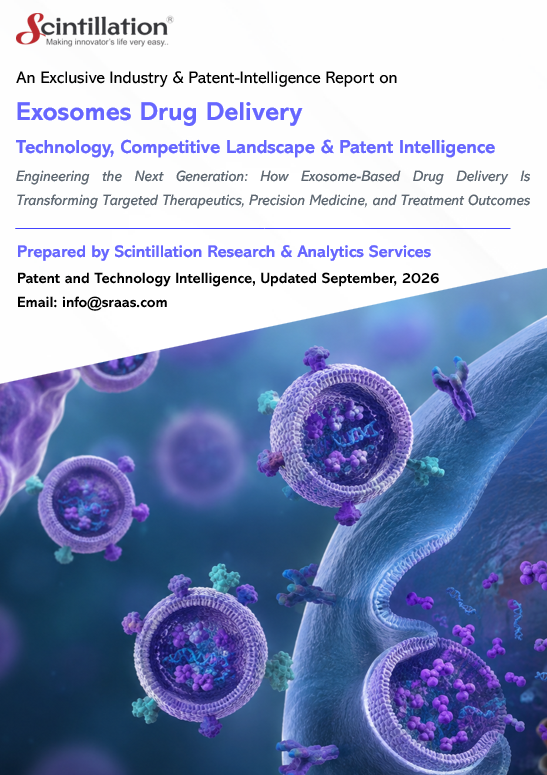
Request Your Sample Report Now!

    For a quick demo, schedule a meeting now!

    Shopping Cart (0 items)

    Subscribe to our newsletter

    Sign up to receive latest news, updates, promotions, and special offers delivered directly to your inbox.
    No, thanks