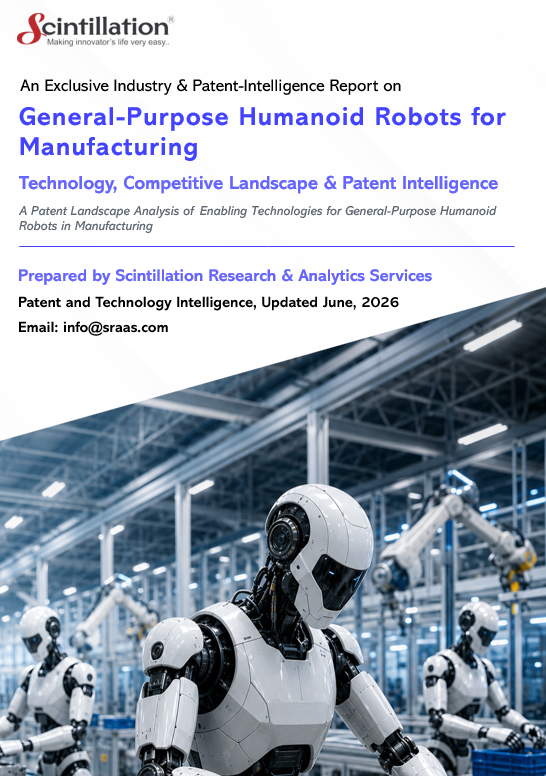
General Purpose Humanoid Robots for Manufacturing

  • Home
  • General Purpose Humanoid Robots for Manufacturing
Patent & Innovation Landscape Analysis  ·  Industrial Automation Series

Robots Built for Human Workplaces: How General-Purpose Humanoid Robots Are Emerging as a Next-Generation Automation Platform for Manufacturing

A data-grounded look at who is innovating, where IP activity is concentrated, and what it means for automation, commercialization, and IP strategy.

BipedalLocomotion
DexterousManipulation
AI controlPerception and decisions
PatentLandscape & whitespace

Report details

General-Purpose Humanoid Robots for Manufacturing — Patent & Innovation Landscape Analysis Report

PublisherScintillation Research
TechnologyGeneral-Purpose Humanoid Robots
Focus areaManufacturing and industrial automation
Key segmentsLocomotion, Manipulation, Vision, AI Control
IP coverage8-part patent landscape
AudienceIP, R&D, Robotics, Investment
Purpose of the report

A next-generation automation platform and its IP landscape

This report explores the emergence of general-purpose humanoid robots as a next-generation automation platform for manufacturing. It examines the foundations, industrial applications, and evolving patent landscape, showing who is innovating, where IP activity is concentrated, and what these trends mean for future automation, commercialization, and IP strategy.

It covers key humanoid-robot technologies, leading assignees, filing trends, technology evolution, manufacturing applications, competitive dynamics, whitespace, and the outlook for general-purpose humanoid robots in industrial environments.

Who will benefit from this report

Built for everyone shaping humanoid robotics in industry

Each audience gets a clear view of the landscape and what to do with it.

01
Patent Attorneys, Agents & IP Analysts
Assignees, filing trends, jurisdictions, and segments to support prosecution, FTO, invalidity, and portfolio work.
02
Licensing & Business Development
Foundational and emerging portfolios, with licensing opportunities, collaboration targets, and key technology owners.
03
In-house IP & R&D Leaders
Competitive intelligence on humanoid platforms, manipulation, perception, mobility, AI control, and manufacturing automation.
04
Investors & Market Analysts
An evidence-based view of innovation activity, commercialization trends, and emerging opportunities in humanoid robotics.
05
Robotics, Automotive, Electronics & Manufacturing Companies
Insight into bipedal locomotion, dexterous manipulation, machine vision, human-robot interaction, AI decision-making, and task automation.
06
Academia & Robotics Research Organizations
Benchmarking on leading groups, emerging technologies, commercialization pathways, and partnerships.
Introduction

One robot form, many tasks

Most industrial robots are built and programmed for one task in one place. General-purpose humanoid robots aim for a different model: a human-shaped machine that can walk, reach, grasp, and use tools in spaces designed for people, and that can be directed to many tasks rather than one. Advances in AI-based control, perception, and actuation are making that idea more realistic, and manufacturers, robotics companies, and investors are all watching how fast it can mature into reliable, safe, and cost-effective production use.

Report structure

Table of contents

Twelve chapters, from humanoid robot fundamentals to patent landscape intelligence. Click any chapter to expand.

—Key findings on general-purpose humanoid robots for manufacturing, leading assignees, filing trends, and strategic implications
—Who Will Benefit from This Report
3.1Limitations of Conventional Industrial Automation
—Core Components of General-Purpose Humanoid Robots for Manufacturing
4.1Challenges Addressed by General-Purpose Humanoid Robots for Manufacturing
4.2Key Features of General-Purpose Humanoid Robots for Manufacturing
4.3Applications of General-Purpose Humanoid Robots for Manufacturing
—How humanoid robots have progressed from research platforms toward industrial deployment
—The technical, commercial, and IP signals that make the field strategically important
—Commercialization pathways, open challenges, and future directions in industrial environments
8.1Methodology & Scope
8.2Interesting Strategic Insights
8.3Assignee Picture
8.4Filing Activity Over Time
8.5Jurisdiction Coverage
8.6Technology Segmentation
8.7Representative Publications Across the Field
8.8Whitespace & Strategic Opportunities
—Stakeholder-specific takeaways for IP teams, licensing professionals, R&D leaders, investors, and manufacturers
—Synthesis of the technical trajectory, IP dynamics, and strategic implications
—Overview of Scintillation Research and its patent and technology intelligence services
—Legal disclaimer covering information accuracy, IP ownership, and terms of use
Core components & key features

What a general-purpose humanoid robot is made of

The hardware and intelligence that let a human-form robot work in a factory.

Bipedal locomotion & mobility
Walking, balancing, and moving through spaces designed for people.
Dexterous manipulation
Hands and arms that grasp and handle varied parts and tools.
Perception & machine vision
Sensing the environment to find objects, read scenes, and guide actions.
AI-based control & decision-making
Learning-driven planning that adapts the robot to new tasks and conditions.
Human-robot interaction & safety
Instruction, collaboration, and safe operation around people.
Actuation, sensing & power
The joints, sensors, and energy systems that determine strength, precision, and endurance.
Challenges addressed

Limits of conventional automation, and barriers to humanoids

What general-purpose humanoids aim to address, and what they still have to prove.

01
Single-task, fixed automation
Conventional robots are built and programmed for specific tasks, and they are costly to redeploy when products or processes change
02
Workplaces designed for people
Many factory tasks involve stairs, shelves, hand tools, and tight spaces that a human-form robot may handle more naturally
03
Repetitive, strenuous, and hazardous work
Humanoids could take on tasks that are tedious, physically demanding, or unsafe for workers
04
Reliability, safety, cost, and endurance
Dexterity, battery life, safe operation near people, and cost per task remain the main barriers to industrial adoption
Applications

Where humanoid robots could create value in manufacturing

Tasks that benefit from a flexible, human-form machine.

Assembly and kitting
Material handling and logistics
Machine tending
Inspection and quality checks
Automotive manufacturing
Electronics manufacturing
Hazardous and repetitive tasks
Patent landscape study

Who is filing, where, and in which areas

The study covers methodology and scope, strategic insights, the assignee picture, filing activity over time, jurisdiction coverage, technology segmentation across locomotion, manipulation, vision, AI control, and interaction, representative publications, and the whitespace and strategic opportunities for new filings and licensing.
Request Your Sample Report Now!

    For a quick demo, schedule a meeting now!

    Shopping Cart (0 items)

    Subscribe to our newsletter

    Sign up to receive latest news, updates, promotions, and special offers delivered directly to your inbox.
    No, thanks