
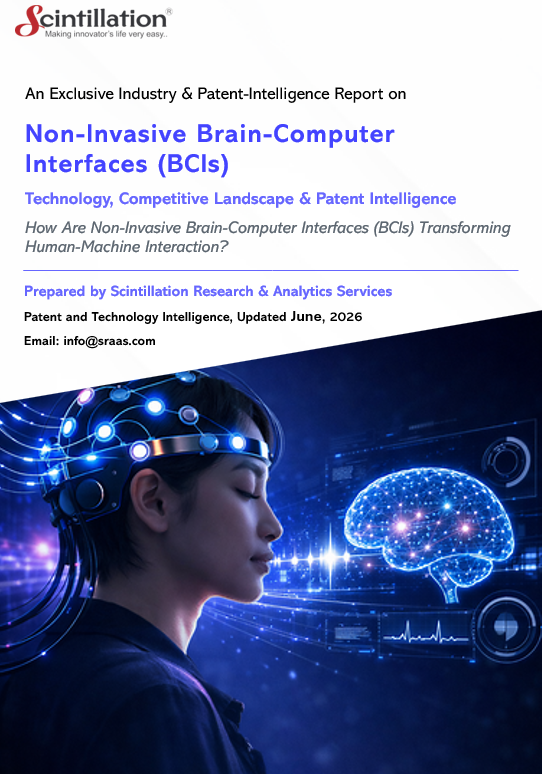
How Are Non-Invasive Brain-Computer Interfaces (BCIs) Transforming Human–Machine Interaction?
A data-grounded look at who is filing patents, where neurotechnology innovation is concentrated, and why non-invasive BCIs are becoming critical infrastructure for healthcare, consumer electronics, and next-generation human–machine interaction.
A comprehensive technology and patent intelligence analysis of non-invasive BCIs — examining EEG-based neural signal acquisition, brain-signal decoding algorithms, AI-driven neural interpretation, wearable neurotechnology platforms, neurofeedback systems, cognitive monitoring solutions, motor imagery and SSVEP paradigms, brain-controlled applications, and the evolving IP landscape across medical device companies, consumer technology firms, research institutions, and defence organisations.
Report details
Non-Invasive Brain-Computer Interfaces (BCIs) — Technology & Patent Intelligence Report
When physical interfaces can no longer meet the accessibility, speed, and immersion demands of the next generation of human–machine interaction
The global Non-Invasive BCI industry is rapidly evolving as healthcare providers, technology companies, research institutions, and governments increase investments in neurotechnology, digital health, assistive communication, and next-generation human–machine interaction systems. Sectors including healthcare, consumer electronics, gaming, education, defence, and industrial operations are seeking more intuitive and accessible ways for humans to interact with digital devices and intelligent systems.
To address these challenges, organisations worldwide are actively developing advanced Non-Invasive BCI technologies as key enablers of direct brain-to-device communication. These technologies utilise neural signal acquisition systems, electroencephalography (EEG), wearable neurotechnology, artificial intelligence, and brain-signal decoding algorithms to interpret neural activity and convert it into actionable commands. Unlike traditional human–computer interfaces that rely on physical interaction, Non-Invasive BCIs enable communication and device control directly through brain signals — creating new possibilities for accessibility, productivity, and immersive digital experiences without the surgical risk of implanted BCI systems.
One of the most significant advantages of Non-Invasive BCI technologies is their ability to enhance accessibility, improve communication capabilities, enable hands-free device control, support cognitive monitoring, and facilitate neurorehabilitation — all without requiring surgical intervention. Advances in miniaturised dry electrode arrays, AI-powered signal decoding, noise rejection algorithms, and consumer-grade wearable form factors are progressively closing the signal quality gap between non-invasive and implanted BCI systems, making broad deployment across clinical and consumer applications increasingly viable.
These technologies are highly suitable for applications in assistive healthcare, consumer electronics, gaming, virtual and augmented reality systems, education, workforce monitoring, defence operations, and other sectors seeking advanced human–machine interaction solutions. This report explores the technological foundations of Non-Invasive BCIs, the key challenges they address, recent innovations, commercialisation developments, emerging applications, and the future market potential of these technologies within the global neurotechnology and human–machine interface landscape.
Table of contents
Ten chapters connecting non-invasive BCI technology foundations to patent landscape intelligence and commercialisation strategy. Click any chapter to expand.
Components & key features of non-invasive BCIs
Non-invasive BCI systems combine neural signal acquisition hardware, signal processing pipelines, AI-powered decoding algorithms, and application interfaces into a complete brain-to-device communication architecture — enabling direct control and communication through brain activity without electrodes penetrating the scalp or skull.
Why conventional input methods cannot meet the accessibility, speed, and monitoring requirements that non-invasive BCIs uniquely address
Non-invasive BCI technologies directly target five structural limitations of conventional human–computer interfaces that prevent accessible, hands-free, and neural-state-aware interaction for users across healthcare, consumer, and enterprise contexts.
Request Your Sample Report Now!
