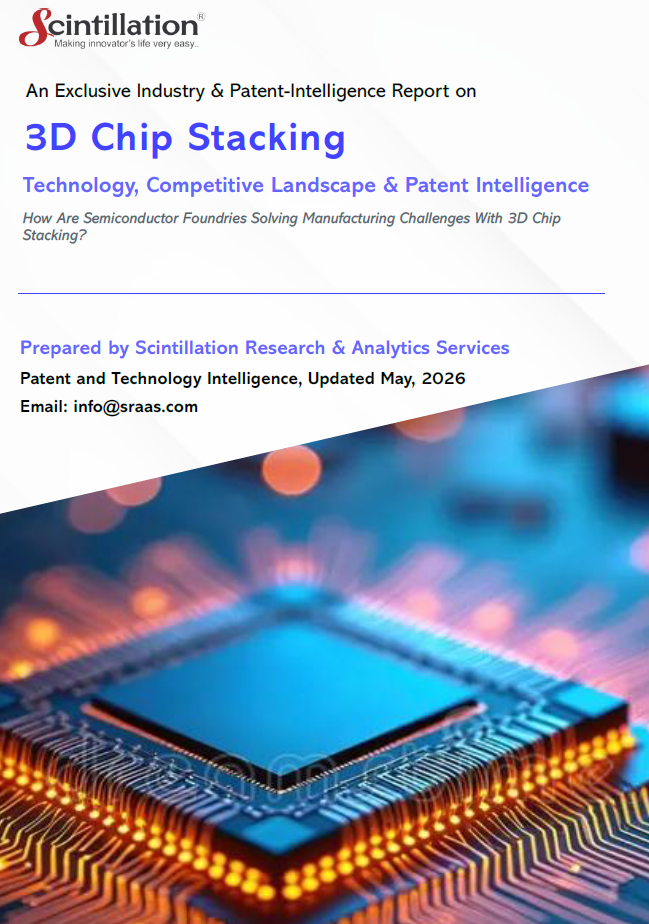
How Are Semiconductor Foundries Solving Manufacturing Challenges With 3D Chip Stacking?

  • Home
  • How Are Semiconductor Foundries Solving Manufacturing Challenges With 3D Chip Stacking?
3D Chip Stacking: How Semiconductor Foundries Are Solving Manufacturing Challenges | Scintillation Research
Patent Intelligence Report  ·  Advanced Semiconductor Packaging Series

How Are Semiconductor Foundries Solving Manufacturing Challenges With 3D Chip Stacking?

A data-grounded look at who is filing, where innovation is concentrated, and why it matters now.

A comprehensive technology and patent intelligence analysis of 3D chip stacking — examining TSV, hybrid bonding, wafer-to-wafer bonding, chiplet integration, thermal management innovations, and the evolving IP landscape across AI, HPC, advanced telecommunications, and next-generation semiconductor architectures.

TSVThrough-silicon via interconnect
Hybrid bondingNext-gen die integration
ChipletsHeterogeneous integration
7-partPatent landscape analysis

Report details

3D Chip Stacking in Semiconductor Foundries — Technology & Patent Intelligence

Publisher Scintillation Research
Technology 3D Chip Stacking
Core technologies TSV, hybrid bonding, chiplets, W2W bonding
IP focus Thermal mgmt, testing, hybrid bonding
IP coverage 7-part patent landscape
Applications AI, HPC, 5G/6G, data centers, autonomous
Audience IP, R&D, Foundry, Investment
3D Vertical die integration
TSV Through-silicon via
Hybrid Bonding technology
IP 7-part patent analysis
360° Ecosystem coverage
Introduction

When 2D scaling hits its limits, the only way forward is up

The semiconductor foundry industry is undergoing a major technological transition driven by the growing demand for high-performance computing, artificial intelligence, data centers, autonomous systems, and next-generation communication networks such as 5G and 6G.

As chipmakers continue to push beyond conventional scaling limits, traditional two-dimensional chip architectures are increasingly facing challenges: power efficiency constraints, thermal management difficulties, interconnect bandwidth limitations, and manufacturing complexity. These challenges have accelerated the adoption of advanced packaging and integration technologies, with 3D chip stacking emerging as one of the most significant innovations transforming the semiconductor ecosystem.

3D chip stacking enables multiple semiconductor dies to be vertically integrated within a single package, allowing higher transistor density, improved bandwidth, reduced latency, and enhanced overall system performance. Technologies such as Through-Silicon Via (TSV), hybrid bonding, wafer-to-wafer bonding, and chiplet integration are becoming increasingly important in enabling these next-generation semiconductor architectures.

Despite its advantages, 3D chip stacking introduces several technical and manufacturing challenges — thermal management and heat dissipation, design verification complexity, testing methodology, yield optimization, wafer alignment precision, bonding defect control, and hybrid bonding integration. Companies across the semiconductor value chain are heavily investing in research, development, and intellectual property generation to address these evolving challenges, making the patent landscape a critical window into where the technology is heading.

Report structure

Table of contents

Ten chapters connecting 3D chip stacking's technical foundations to patent landscape intelligence, manufacturing reality analysis, and commercialization strategy. Click any chapter to expand.

Condensed findings on 3D chip stacking technology, top patent assignees, filing trends, manufacturing challenges, and strategic implications for semiconductor manufacturers and IP professionals
2.1 Who Will Benefit from This Report — semiconductor engineers, foundry strategists, IP counsel, packaging specialists, EDA vendors, AI hardware teams, and technology investors
3.1 Challenges in Traditional Semiconductor Architectures Addressed by 3D Chip Stacking — power efficiency limits, thermal constraints, interconnect bandwidth, and manufacturing complexity at advanced nodes
4.1 Problems 3D Chip Stacking Aims to Solve — thermal management, design and testing complexity, yield optimization, bonding precision, and the manufacturing reality of large-scale 3D integration
4.2 Potential Applications — AI accelerators, HPC processors, advanced memory (HBM), 5G/6G RF systems, autonomous vehicles, data center infrastructure, and mobile SoCs
Hybrid bonding adoption timeline, chiplet ecosystem maturity, heterogeneous integration roadmap, foundry capacity investment, and near-term commercial deployment across AI and HPC markets
6.1 Methodology & Scope — patent database coverage, search strategy, classification framework, and analytical approach for 3D chip stacking IP
6.2 Assignee Picture with notable assignee profiles — leading filers across semiconductor foundries, IDMs, packaging specialists, equipment makers, and research institutions
6.3 Filing Activity Over Time — trend analysis identifying R&D acceleration and IP maturity signals in 3D stacking technology domains
6.4 Jurisdiction Coverage — USPTO, CNIPA, KIPO, JPO, EPO, WIPO, and TIPO distributions across the 3D chip stacking patent landscape
6.5 Technology Segmentation — patents mapped to TSV, hybrid bonding, W2W bonding, chiplet integration, thermal management, testing, yield optimization, and system packaging
6.6 Foundational Anchor Patents — core IP defining the 3D chip stacking landscape and their strategic competitive significance across the semiconductor value chain
Stakeholder-specific takeaways for semiconductor engineers, foundry strategy teams, IP counsel, equipment suppliers, EDA vendors, AI hardware developers, and technology investors
Synthesis of 3D chip stacking's technical trajectory, IP landscape dynamics, and strategic implications for next-generation semiconductor manufacturing
Publisher profile, research methodology, and service overview — patent analytics, technology scouting, competitive intelligence, and strategic research
Full legal disclaimer covering information accuracy, IP ownership, and terms of use for this intelligence report
Inside 3D Chip Stacking Technologies

Core stacking technologies & integration innovations

3D chip stacking encompasses a family of vertical integration technologies — each solving different aspects of the bandwidth, density, power, and manufacturing challenges that 2D architectures cannot address.

Through-Silicon Via (TSV)
Vertical electrical connections etched through semiconductor dies — enabling high-bandwidth, low-latency inter-die communication and the foundational interconnect technology for 3D integration.
Hybrid bonding
Direct copper-to-copper bonding at the die interface — eliminating conventional bump interconnects and enabling pitch scaling below 10μm for the highest interconnect density in 3D integration, now deployed in HBM and advanced image sensors.
Wafer-to-wafer (W2W) bonding
Direct bonding of complete wafers before dicing — enabling the highest throughput for matched-die products and the most precise alignment for stacked image sensors and memory stacks.
Chiplet integration
Heterogeneous integration of separately manufactured functional tiles — enabling mix-and-match of different process nodes, IP blocks, and vendors within a single package for optimal performance-per-watt and die yield.
High Bandwidth Memory (HBM)
DRAM dies vertically stacked using TSV and connected to a logic die via silicon interposer — delivering terabytes-per-second memory bandwidth for AI training accelerators and HPC processors.
Thermal management innovations
Microfluidic cooling, thermal TSV arrays, phase-change materials, and advanced heat spreader architectures addressing the increased power density within vertically stacked 3D semiconductor structures.
Known-Good-Die (KGD) testing
Pre-bond testing methodologies ensuring only validated dies enter the stacking process — critical for achieving acceptable compound yield in 3D-stacked structures where a single bad die destroys the entire stack.
Silicon interposer & 2.5D packaging
High-density silicon interposers providing the routing substrate for side-by-side chiplet integration — an intermediate step between 2D and full 3D stacking now widely deployed in GPU and AI accelerator packaging.

Key bonding & integration technologies covered in the report

Interconnect
Micro-bump / C4 bump
Conventional solder-based die-to-substrate interconnects; pitch >40μm
Advanced
Hybrid bonding (Cu-Cu)
Direct metal bonding; pitch <10μm; highest density interconnect
Vertical
Through-Silicon Via (TSV)
Vertical electrical feed-through; enables HBM and 3D NAND stacking
Integration
Chiplet / UCIe
Standardized die-to-die interface for heterogeneous chiplet integration
Substrate
Silicon interposer (2.5D)
High-density routing substrate enabling side-by-side die integration
Thermal
Microfluidic cooling
On-chip liquid cooling channels for high-power-density 3D stacks
Challenges addressed

Why traditional 2D semiconductor architectures are reaching their limits

3D chip stacking directly targets four compounding challenges that prevent conventional planar chip architectures from meeting the performance, power, and bandwidth requirements of next-generation AI and HPC workloads.
01
Interconnect bandwidth bottleneck
Off-package memory bandwidth has not scaled with processor performance — creating a "memory wall" that limits AI training throughput and HPC performance. 3D stacking via TSV and hybrid bonding shortens interconnects from millimeters to micrometers, delivering 10–100× bandwidth improvements through HBM and stacked memory architectures
Bandwidth
02
Power efficiency & thermal management
Higher transistor density in 3D stacks concentrates power dissipation, creating thermal hotspots that degrade performance and reliability. Innovations in thermal TSV arrays, microfluidic cooling, phase-change materials, and advanced heat spreaders are addressing the heat dissipation challenge unique to vertically integrated structures
Thermal
03
Design complexity & testing challenges
3D-stacked designs require new EDA toolflows for 3D floorplanning, thermal simulation, and signal integrity analysis. Testing complexity grows exponentially — Known-Good-Die (KGD) strategies, boundary scan, and built-in self-test are critical to preventing compound yield losses in multi-die stacks where one bad die scraps the entire assembly
Testing
04
Manufacturing precision & yield at scale
Hybrid bonding requires sub-micron wafer alignment, atomic-level surface cleanliness, and defect-free bonding interfaces at commercial production volumes. Wafer-to-wafer overlay error, bonding void detection, and process yield optimization represent the core manufacturing challenges limiting large-scale 3D stacking commercialization
Manufacturing

Download Your Sample Report Now:

    Application areas

    Where 3D chip stacking creates the greatest impact

    3D stacking's combination of higher bandwidth, lower latency, improved power efficiency, and greater transistor density directly benefits the most demanding semiconductor applications.

    AI Training & Inference Accelerators
    HBM-stacked GPUs and AI ASICs requiring terabytes-per-second memory bandwidth
    High-Performance Computing
    Scientific simulation processors, supercomputing nodes, and HPC memory subsystems
    Advanced Memory (HBM, 3D NAND)
    Stacked DRAM and NAND architectures for AI data centers and enterprise storage
    5G / 6G RF & Baseband
    Compact RF front-ends and baseband processors using 3D integration for next-gen wireless
    Data Center Infrastructure
    High-bandwidth network switching ASICs, SmartNICs, and DPU packages
    Autonomous Vehicles & ADAS
    Compact, high-performance sensor fusion and perception processors for automotive AI
    Mobile & Consumer SoCs
    Flagship smartphone processors with stacked DRAM for performance-per-watt leadership
    Image Sensors & Imaging
    Stacked CMOS image sensors with dedicated image signal processing dies for mobile and industrial cameras
    Patent intelligence

    The 3D chip stacking patent landscape — a 7-part analysis

    The patent landscape chapter delivers data-grounded IP intelligence across the 3D chip stacking ecosystem — from assignee profiling and filing trends to technology segmentation, foundational anchor patents, and strategic positioning insights.

    Assignee & filing intelligence
    • Methodology and scope defining the patent search universe for 3D chip stacking and advanced semiconductor packaging
    • Assignee picture with notable profiles — foundries, IDMs, packaging specialists, equipment makers, and research institutions
    • Filing activity over time — trend analysis identifying R&D acceleration and IP maturity signals
    • Jurisdiction coverage — USPTO, CNIPA, KIPO, JPO, EPO, WIPO, and TIPO distributions
    Technology & strategic analysis
    • Technology segmentation — TSV, hybrid bonding, W2W bonding, chiplets, thermal management, KGD testing, interposer packaging
    • Foundational anchor patents — core IP defining the 3D chip stacking landscape and competitive strategic significance
    • Technology positioning and innovation intensity across the semiconductor value chain
    • Licensing opportunities, collaboration potential, and competitive whitespace identification
    Who will benefit

    Who should read this report

    Semiconductor Engineers & Packaging Specialists
    Technical teams working on TSV processes, hybrid bonding development, chiplet integration, thermal management solutions, and advanced packaging design for 3D semiconductor architectures.
    IP Counsel & Patent Teams
    Attorneys and patent professionals assessing 3D stacking portfolio positioning, whitespace, freedom-to-operate, and filing strategy across TSV, hybrid bonding, and heterogeneous integration technologies.
    Foundry & IDM Strategy Teams
    TSMC, Samsung, Intel, and OSAT strategy teams evaluating 3D stacking technology roadmaps, hybrid bonding commercialization timelines, and competitive IP positioning in advanced packaging.
    Technology Investors
    Investment professionals tracking the 3D chip stacking ecosystem, competitive dynamics, and emerging companies in advanced packaging, bonding equipment, thermal management, and chiplet integration.
    AI Hardware & HPC Teams
    Engineers and strategists at AI accelerator companies, cloud providers, and HPC vendors evaluating 3D stacking integration for next-generation AI training and inference hardware.
    R&D Strategists & Industry Analysts
    Researchers and consultants mapping the competitive 3D stacking landscape across semiconductor foundries, packaging OSATs, equipment makers, EDA vendors, and materials suppliers.
    Technology & Patent Intelligence · Scintillation Research

    Understand who is winning the 3D chip stacking race

    Get the complete technology and patent intelligence report on 3D chip stacking — from TSV and hybrid bonding innovations to the patent landscape revealing who is filing, where manufacturing breakthroughs are concentrated, and what it means for semiconductor strategy now.

    Scintillation Research · 3D Chip Stacking · Patent Intelligence Series

    For a quick demo, schedule a meeting now!

    Service Demo Booking
    About

    About Scintillation Research

    Scintillation Research & Analytics Services is a specialized intellectual property and technology intelligence firm delivering patent analytics, technology scouting, competitive intelligence, and strategic research services.

    Through comprehensive patent and technology intelligence reports, we help organizations understand emerging innovations, identify market opportunities, monitor competitors, and make data-driven decisions across rapidly evolving technology domains. Our reports are designed for professionals at the intersection of technology strategy, IP management, and competitive intelligence.

    Shopping Cart (0 items)

    Subscribe to our newsletter

    Sign up to receive latest news, updates, promotions, and special offers delivered directly to your inbox.
    No, thanks
    Select your currency