How Artificial General Intelligence (AGI) Could Transform Industries Worldwide

  • Home
  • How Artificial General Intelligence (AGI) Could Transform Industries Worldwide
Artificial General Intelligence (AGI): How AGI Could Transform Industries Worldwide | Scintillation Research
Patent Intelligence Report  ·  Frontier AI Technology Series

How Artificial General Intelligence (AGI) Could Transform Industries Worldwide

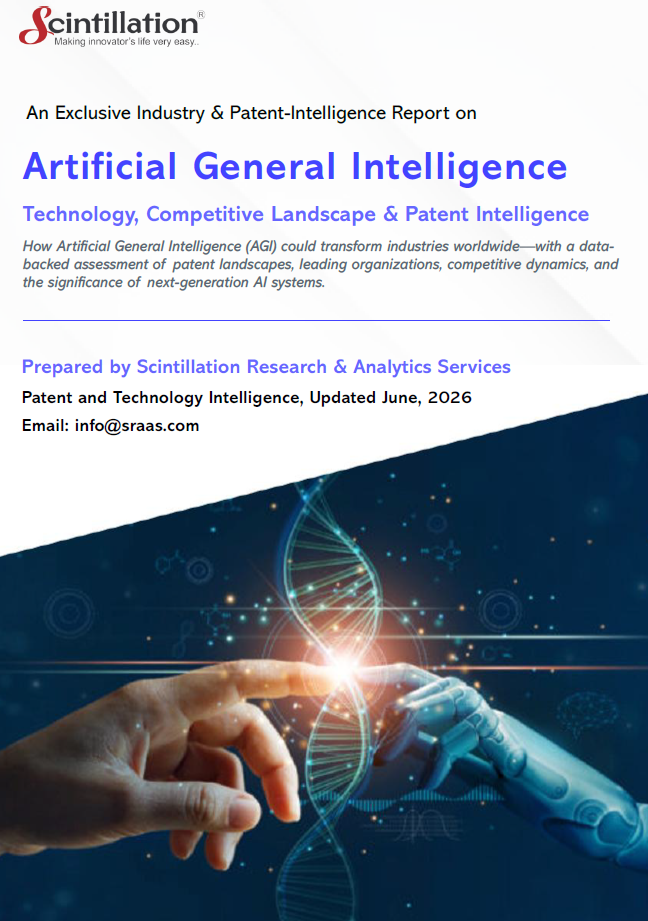
A data-backed assessment of patent landscapes, leading organizations, competitive dynamics, and the significance of next-generation AI systems.

A comprehensive technology and patent intelligence analysis of AGI — examining foundation models, multimodal architectures, autonomous agents, reasoning and memory systems, AI safety and alignment, and the evolving IP landscape across enterprise software, healthcare, scientific discovery, robotics, and financial services.

FoundationModels & multimodal AI
AutonomousAgents & planning systems
SafetyAI alignment & governance
8-partPatent landscape analysis

Report details

Artificial General Intelligence (AGI) — Technology & Patent Intelligence Report

Publisher Scintillation Research
Technology Artificial General Intelligence
Core technologies Foundation models, agents, multimodal AI, reasoning
IP coverage 8-part patent landscape
Key verticals Enterprise, healthcare, robotics, science, finance
Chapters 10 structured chapters
Audience IP, R&D, Strategy, Investment
AGI General-purpose AI
Foundation Model architectures
Autonomous Agents & planning
IP 8-part patent analysis
360° Competitive ecosystem
Introduction

The path from generative AI toward genuinely general intelligence

The global artificial intelligence industry is advancing rapidly as demand grows for increasingly capable AI systems across enterprise operations, scientific research, communications networks, intelligent devices, and digital infrastructure.

Recent advances in foundation models, multimodal AI, and autonomous agents have significantly expanded the capabilities of AI systems, enabling more sophisticated reasoning, decision-making, and task execution. However, challenges remain in areas such as generalization, long-term memory, autonomous planning, continual learning, and reliable operation across complex real-world environments.

To address these challenges, the AI ecosystem is exploring technologies that may contribute to the long-term development of Artificial General Intelligence (AGI). Development efforts are focused on foundation models, multimodal architectures, AI agents, reasoning systems, large-scale compute infrastructure, and AI-native platforms — advanced by leading technology companies, research institutions, and industry collaborations as the industry investigates pathways toward increasingly general-purpose and autonomous AI systems.

This report connects that technical landscape to the intellectual-property and innovation activity surrounding AGI-enabling technologies — enabling readers to move from "how the technology works" to "who is innovating, who is filing, and what it means for IP and technology strategy."

Report structure

Table of contents

Ten chapters connecting AGI's technical foundations to patent landscape intelligence, industry transformation analysis, and commercialization strategy. Click any chapter to expand.

Condensed findings on AGI technology, top patent assignees, filing trends, competitive dynamics, and strategic implications for AI development and IP strategy
2.1 Who Will Benefit from This Report — AI researchers, technology strategists, IP counsel, enterprise technology teams, investors, policymakers, and innovation leaders across high-value sectors
3.1 Challenges in Current AI Technologies and the Path Toward AGI — limitations in generalization, long-term memory, autonomous planning, continual learning, and cross-domain problem-solving
Structural components of AGI — foundation models, multimodal architectures, reasoning engines, autonomous agents, memory systems, continual learning, and AI safety frameworks
4.1 Key Features — cross-domain generalization, autonomous planning, self-improvement, long-term memory, multimodal perception, and causal reasoning capabilities
4.2 Problems AGI Aims to Solve — narrow AI task-specificity, knowledge transfer failure, the development reality and scaling pathway from generative AI toward general-purpose systems
4.3 Potential Applications — enterprise software, healthcare, scientific discovery, robotics, advanced manufacturing, financial services, education, and other high-value sectors
Development timeline from generative AI toward AGI, compute infrastructure scaling, enterprise adoption pathways, regulatory landscape, and long-term commercial impact analysis
6.1 Methodology & Scope — patent database coverage, search strategy, classification framework, and analytical approach for AGI-enabling technology IP
6.2 Top Assignees with notable assignee profiles — leading filers across AI labs, technology companies, research institutions, and enterprise software providers
6.3 Filing Activity Over Time — trend analysis identifying R&D acceleration and IP maturity signals in AGI-enabling technology domains
6.4 Jurisdiction Coverage — USPTO, CNIPA, EPO, KIPO, JPO, WIPO, and regional patent office distributions across the AGI IP landscape
6.5 Legal Status Snapshot — granted, pending, expired, and lapsed portfolio breakdown by technology domain and assignee
6.6 Technology Segmentation — patents mapped to foundation models, multimodal AI, autonomous agents, reasoning systems, memory architectures, continual learning, and AI safety
6.7 Foundational Anchor Patents — core IP defining the AGI-enabling technology landscape and their strategic competitive significance
6.8 Whitespace & Strategic Opportunities — unprotected technology domains and emerging filing opportunities across the AGI IP ecosystem
Stakeholder-specific takeaways for AI researchers, IP counsel, enterprise technology leaders, investors, policymakers, healthcare innovators, and scientific discovery teams
Synthesis of AGI's technical trajectory, competitive IP dynamics, and strategic implications for the future of intelligent computing and industry transformation
Publisher profile, research methodology, and service overview — patent analytics, technology scouting, competitive intelligence, and strategic research
Full legal disclaimer covering information accuracy, IP ownership, and terms of use for this intelligence report
Inside AGI Technology

Structural components & key features

AGI-enabling technologies build on current AI foundations — extending generative AI capabilities toward reasoning, planning, autonomy, and knowledge generalization that approaches human-level cross-domain problem-solving.

Foundation models
Large-scale pre-trained models serving as general-purpose AI backbones — enabling broad capability transfer across tasks through fine-tuning, prompting, and in-context learning without task-specific retraining.
Multimodal AI architectures
Vision-language-audio-code unified models processing and generating across multiple data modalities simultaneously — enabling human-like perception and cross-modal reasoning essential for general intelligence.
Autonomous AI agents
Goal-directed AI systems capable of decomposing complex tasks, planning multi-step action sequences, using tools, browsing information, executing code, and iterating toward objectives without human intervention.
Reasoning & planning systems
Chain-of-thought, tree-of-thought, and formal reasoning architectures enabling step-by-step logical inference, causal reasoning, and long-horizon planning across complex, novel problem domains.
Long-term memory & knowledge systems
Episodic memory, semantic knowledge retrieval, and persistent context architectures enabling AI systems to accumulate, organize, and retrieve relevant experience across interactions and time horizons.
Continual & self-improving learning
Architectures enabling AI systems to learn from new experiences without forgetting prior knowledge — a critical requirement for AGI's ability to adapt and improve across an expanding range of environments.
AI safety & alignment
Constitutional AI, RLHF, interpretability research, and value alignment frameworks ensuring increasingly capable AI systems remain aligned with human intentions, values, and safety constraints as capabilities scale.
Large-scale compute infrastructure
Custom AI accelerators, distributed training frameworks, and AI-native data center architectures providing the computational substrate required for training and serving frontier AGI-scale models.
Challenges addressed

Where current AI systems fall short of general intelligence

AGI research directly targets five fundamental limitations that prevent current narrow AI systems from operating with the flexibility, adaptability, and autonomy required for genuinely general-purpose intelligence.
01
Narrow task-specificity and failure to generalize
Current AI systems excel within their training distribution but fail at tasks outside their specific training scope. AGI-enabling technologies — particularly foundation models and transfer learning architectures — aim to enable robust performance across novel domains without task-specific retraining
Generalization
02
Absence of autonomous planning and multi-step reasoning
Current AI systems respond to individual prompts but cannot autonomously decompose complex long-horizon goals, plan multi-step strategies, and adapt when initial approaches fail. AGI-oriented agent architectures and reasoning systems are targeting this gap
Reasoning
03
Catastrophic forgetting in continual learning
Neural networks trained on new tasks typically lose prior knowledge — preventing accumulation of experience across time. Continual learning architectures, episodic memory systems, and neural plasticity mechanisms are addressing this fundamental barrier to AGI development
Memory
04
Unreliability in complex real-world environments
Current AI systems fail unpredictably when encountering out-of-distribution inputs, adversarial conditions, or novel real-world complexity. AI safety, alignment, and robustness research are working to make AGI-scale systems reliably safe and predictable across open-world environments
Reliability
05
Knowledge transfer across domains
Human intelligence seamlessly applies knowledge from one domain to solve problems in another — a capability current AI systems lack. Cross-domain knowledge transfer, causal reasoning, and abstract concept learning are core research priorities on the path toward AGI
Transfer

Download Your Sample Report Now:

    Potential applications

    How AGI-level capabilities could transform industries

    As AI systems advance toward greater generalization and autonomy, the industries expected to benefit most are those where complex cross-domain reasoning, autonomous decision-making, and continuous adaptation create the greatest value.

    Enterprise Software
    Autonomous enterprise AI agents
    AGI-capable systems autonomously executing complex multi-step business workflows — financial analysis, contract review, supply chain optimization, and customer service — without task-specific programming or human supervision.
    Healthcare & Life Sciences
    Autonomous scientific reasoning for medicine
    AGI-level systems synthesizing medical literature, patient data, genomics, and clinical trial results to generate novel drug candidates, treatment protocols, and diagnostic insights beyond current AI's narrow analytical capabilities.
    Scientific Discovery
    Cross-domain research acceleration
    General-purpose AI systems capable of autonomous hypothesis generation, experimental design, result interpretation, and cross-disciplinary synthesis — dramatically accelerating fundamental research across physics, chemistry, biology, and materials science.
    Robotics & Automation
    General-purpose physical AI
    AGI-enabled robot systems adapting to novel environments and tasks without reprogramming — unlocking flexible automation in unstructured manufacturing, healthcare assistance, construction, and household applications.
    Financial Services
    Autonomous financial reasoning
    AGI-capable systems performing complex financial analysis, regulatory compliance, fraud detection, and portfolio management across heterogeneous data sources with continuous adaptation to market regime changes.
    Education & Knowledge Work
    Personalized intelligent tutoring
    General AI tutors adapting dynamically to individual learner knowledge, learning style, and misconceptions across any subject domain — potentially democratizing access to expert-level personalized education at scale.
    Industry verticals analyzed

    Where AGI creates transformative value

    The report examines AGI deployment opportunities, development pathways, and IP implications across sectors where general-purpose AI capabilities create the greatest strategic advantage.

    Enterprise Software & Automation
    Autonomous business process agents, workflow intelligence, decision support
    Healthcare & Drug Discovery
    Medical reasoning AI, autonomous drug candidate generation, clinical intelligence
    Scientific Research
    Hypothesis generation, experimental design, cross-disciplinary discovery acceleration
    Robotics & Advanced Manufacturing
    General-purpose physical AI, flexible factory automation, unstructured environment navigation
    Financial Services
    Autonomous financial analysis, compliance intelligence, adaptive trading systems
    Defense & National Security
    Autonomous decision support, intelligence synthesis, strategic planning assistance
    Education & Knowledge Services
    Personalized AI tutoring, autonomous knowledge synthesis, expert system replacement
    Software Engineering
    Autonomous code generation, debugging, system design, and software development at scale
    Patent intelligence

    The AGI patent landscape — an 8-part analysis

    The patent landscape chapter delivers data-grounded IP intelligence across the AGI-enabling technology ecosystem — from top assignee profiling and filing trends to legal status, technology segmentation, foundational anchor patents, and whitespace identification.

    Assignee & filing intelligence
    • Methodology and scope defining the patent search universe for AGI-enabling technologies
    • Top assignees with notable profiles — AI labs, technology companies, research institutions, and enterprise AI providers
    • Filing activity over time — trend analysis identifying R&D acceleration and IP maturity signals
    • Jurisdiction coverage — USPTO, CNIPA, EPO, KIPO, JPO, WIPO, and regional patent office distributions
    Technology & strategic analysis
    • Legal status snapshot — granted, pending, expired, and lapsed portfolio breakdown by domain
    • Technology segmentation — foundation models, multimodal AI, agents, reasoning, memory, continual learning, AI safety
    • Foundational anchor patents — core IP defining the AGI-enabling technology landscape and competitive significance
    • Whitespace & strategic opportunities — unprotected domains and emerging filing opportunities in AGI IP
    Who will benefit

    Who should read this report

    AI Researchers & Engineers
    Scientists and engineers working on foundation models, autonomous agents, reasoning systems, continual learning, AI safety, and the technical pathways toward increasingly general-purpose AI systems.
    IP Counsel & Patent Teams
    Attorneys and patent professionals assessing AGI-enabling technology portfolio positioning, whitespace, freedom-to-operate, and filing strategy across foundation models, agents, and reasoning systems.
    Technology Investors
    Investment professionals tracking the AGI ecosystem, competitive IP landscape, and emerging companies across foundation model providers, AI hardware, autonomous agent platforms, and AI safety startups.
    Enterprise Technology Leaders
    CTOs, CDOs, and technology strategy teams evaluating AGI-enabling AI adoption, competitive implications, and long-term enterprise transformation opportunities across their industries.
    Policymakers & Regulators
    Government and regulatory professionals assessing AGI's strategic significance for national AI competitiveness, safety governance frameworks, and long-term AI policy development.
    R&D Strategists & Industry Analysts
    Researchers and consultants mapping the competitive landscape across AI labs, technology companies, academic institutions, and the broader ecosystem of organizations advancing AGI-enabling capabilities.
    Technology & Patent Intelligence · Scintillation Research

    Understand who is shaping the future of general-purpose AI

    Get the complete technology and patent intelligence report on Artificial General Intelligence — from foundation model architectures and autonomous agents to the patent landscape revealing who is filing, where innovation is concentrated, and why it matters now.

    Scintillation Research · Artificial General Intelligence (AGI) · Patent Intelligence Series

    For a quick demo, schedule a meeting now!

    Service Demo Booking
    About

    About Scintillation Research

    Scintillation Research & Analytics Services is a specialized intellectual property and technology intelligence firm delivering patent analytics, technology scouting, competitive intelligence, and strategic research services.

    Through comprehensive patent and technology intelligence reports, we help organizations understand emerging innovations, identify market opportunities, monitor competitors, and make data-driven decisions across rapidly evolving technology domains. Our reports are designed for professionals at the intersection of technology strategy, IP management, and competitive intelligence.

    Shopping Cart (0 items)

    Subscribe to our newsletter

    Sign up to receive latest news, updates, promotions, and special offers delivered directly to your inbox.
    No, thanks
    Select your currency