How Electronic Skin Technology Aims to Give Machines a Human-Like Sense of Touch

  • Home
  • How Electronic Skin Technology Aims to Give Machines a Human-Like Sense of Touch
Electronic Skin: How E-Skin Technology Gives Machines a Human-Like Sense of Touch | Scintillation Research
Patent Intelligence Report  ·  Advanced Materials & Sensing Series

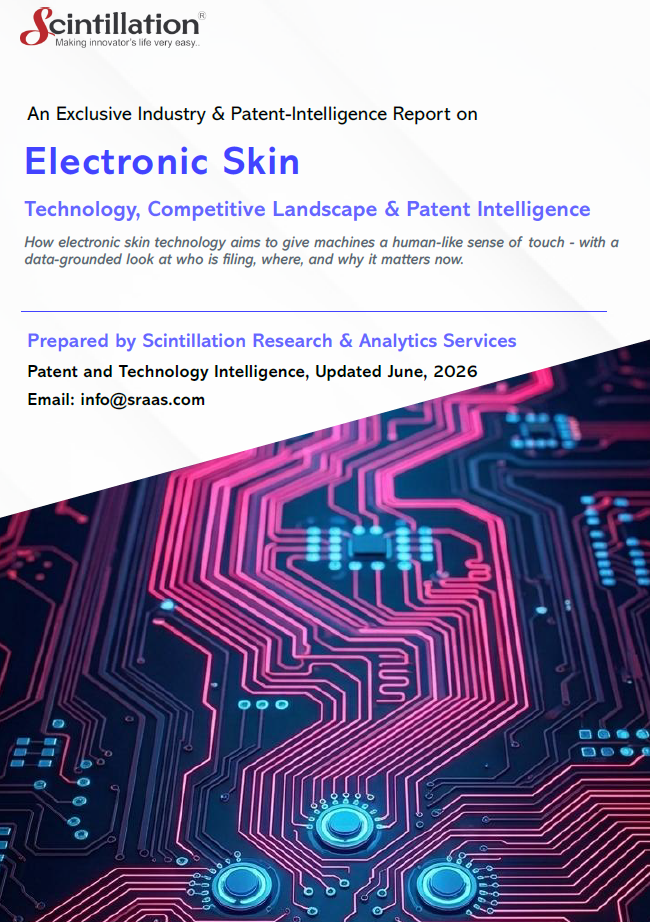
How Electronic Skin Technology Aims to Give Machines a Human-Like Sense of Touch

A data-grounded look at who is filing, where, and why it matters now.

A comprehensive technology and patent intelligence analysis of e-skin — examining flexible material architectures, multi-modal tactile sensing, 3-axis force detection, and the evolving IP landscape across robotics, prosthetics, healthcare wearables, and next-generation human-machine interfaces.

Multi-modalPressure, strain, temperature, texture
3-axisForce-direction detection
FlexibleConformable form factor
10-partPatent landscape analysis

Report details

Electronic Skin — Technology & Patent Intelligence Report

Publisher Scintillation Research
Technology Electronic Skin (E-Skin)
Sensing modalities Pressure, strain, temp, texture, 3-axis force
Top assignee Shenzhen Yuejiang Technology
IP coverage 10-part patent landscape
Applications Robotics, prosthetics, healthcare, automotive
Audience IP, R&D, Strategy, Investment
E-Skin Next-gen sensing
5+ Sensing modalities
3-Axis Force direction detection
IP 10-part patent analysis
360° Ecosystem coverage
Introduction

The race to give machines a sense of touch

The global electronic skin and tactile sensing industry is evolving rapidly as demand grows for robots, prosthetics, wearable devices, and intelligent systems capable of perceiving and interacting with their environments through touch.

Humanoid robots, industrial automation systems, healthcare wearables, and next-generation human-machine interfaces all require flexible, conformable, and highly sensitive sensing solutions capable of detecting pressure, strain, texture, temperature, and multi-directional forces. Conventional rigid sensors continue to face limitations in coverage, adaptability, durability, and the ability to replicate the complex sensing functions of human skin.

To address these challenges, the industry is developing electronic skin technologies that combine flexible materials, distributed sensor arrays, and multi-modal tactile sensing architectures. Unlike traditional point-based sensors, e-skin systems provide large-area, skin-like sensing capabilities that enable real-time force detection, object recognition, and environmental awareness.

The patent landscape is led by Shenzhen Yuejiang Technology, followed by BOE Technology Group, Wootzano, South China University of Technology, and Kent Displays. Strong contributions also come from Beijing Tashan Technology, Zhejiang University, Zhejiang University of Science & Technology, Tongji University, and the University of Electronic Science & Technology of China — highlighting the growing role of both industry and academia in advancing next-generation tactile perception technologies.

Report structure

Table of contents

Ten chapters connecting e-skin's technical foundations to a data-grounded patent landscape and commercialization strategy. Click any chapter to expand its sections.

Condensed findings on e-skin technology, top patent assignees, filing trends, and strategic implications for tactile sensing and flexible electronics
2.1 Who Will Benefit from This Report — robotics engineers, materials scientists, IP counsel, prosthetics developers, wearable health investors, and human-machine interface strategists
3.1 Challenges in Designing Electronic Skin — rigid form factors, limited multi-modal sensing, poor conformability, restricted force-direction detection, and inadequate real-time environmental awareness
Structural components — substrate materials, electrode architectures, sensing layers, encapsulation systems, and signal processing integration
4.1 Key Features — multi-modal sensing, conformable substrates, 3-axis force detection, distributed sensor arrays, and skin-like mechanical properties
4.2 Problems Aims to Solve — rigid sensor limitations, limited tactile coverage, poor object recognition, inadequate force directionality, and real-time feedback constraints
4.3 Potential Applications — humanoid robotics, advanced prosthetics, healthcare wearables, surgical robotics, automotive systems, and industrial human-machine interfaces
Technology readiness levels, manufacturing scale-up, cost reduction pathways, ecosystem partnerships, and near-term commercial deployment opportunities across verticals
6.1 Methodology & Scope — patent database coverage, search strategy, classification framework, and analytical approach for e-skin IP
6.2 Scope Corrections — refinements to the search universe addressing classification overlap between flexible electronics, wearables, and tactile sensing domains
6.3 Revised Assignee Picture — detailed profiles of leading filers: Shenzhen Yuejiang Technology, BOE Technology, Wootzano, South China University of Technology, Kent Displays, and others
6.5 Filing Activity Over Time — trend analysis identifying R&D acceleration and IP maturity signals across e-skin technology domains
6.6 Jurisdiction Coverage — CNIPA, USPTO, EPO, KIPO, JPO, WIPO, and regional patent office distributions across the e-skin landscape
6.7 Technology Segmentation — patents mapped to substrate materials, pressure sensing, strain sensing, temperature sensing, 3-axis force, signal processing, and system integration
6.8 Foundational Anchor Patents — core IP defining the e-skin landscape and their strategic competitive significance
6.9 Representative Publications Across the Field — key academic and industry publications shaping e-skin research direction and commercialization
6.10 Whitespace & Strategic Opportunities — unprotected technology domains and emerging filing opportunities across the e-skin IP ecosystem
Stakeholder-specific takeaways for robotics engineers, IP counsel, prosthetics developers, healthcare wearable investors, automotive systems teams, and materials science strategists
Synthesis of e-skin's technical trajectory, IP landscape dynamics, and strategic implications for tactile sensing and human-machine interaction
Publisher profile, research methodology, and service overview — patent analytics, technology scouting, competitive intelligence, and strategic research
Full legal disclaimer covering information accuracy, IP ownership, and terms of use for this intelligence report
Inside E-Skin Design

Key features & structural innovations

Electronic skin systems combine flexible substrates, distributed sensor arrays, and multi-modal transduction mechanisms to replicate and exceed the tactile sensing capabilities of human skin across large surface areas.

Multi-modal tactile sensing
Simultaneous detection of pressure, strain, shear force, texture, vibration, and temperature within a single conformable sensor array — replicating the multi-sensory capability of human skin.
Flexible & conformable substrates
Elastomeric polymers, silicone, polyimide, and hydrogel substrates enabling e-skin to conform to curved, irregular surfaces — from robot finger joints to prosthetic limb contours.
3-axis force direction detection
Triaxial force sensing capable of decomposing normal and tangential force components — enabling robots and prosthetics to detect slip, grasp stability, and directional loading during object manipulation.
Distributed sensor arrays
High-density arrays of taxel (tactile pixel) elements providing spatial tactile resolution across large skin-area coverage — enabling object shape recognition and texture discrimination.
Piezoresistive & piezoelectric transduction
Carbon nanotube, graphene, and PVDF-based transduction layers converting mechanical deformation into electrical signals with high sensitivity and fast dynamic response for real-time tactile feedback.
Temperature & thermal sensing
Integrated thermistor and thermoelectric elements enabling simultaneous thermal perception alongside mechanical sensing — critical for safe human-robot collaboration and prosthetic sensation restoration.
Self-healing materials
Autonomously repairing elastomers and conductive composites that restore structural integrity and electrical conductivity after damage — extending e-skin operational lifetime in demanding robotic and wearable deployments.
Integrated signal processing
On-skin or near-skin electronics for signal amplification, multiplexing, and wireless transmission — enabling real-time tactile data streaming to robot controllers, prosthetic feedback systems, and healthcare monitoring platforms.
Challenges addressed

Why conventional sensors cannot replicate human touch

E-skin technology directly targets five structural limitations that prevent conventional rigid and point-based sensors from delivering the tactile sensing capabilities required by advanced robotics, prosthetics, and wearable systems.
01
Rigid form factors and poor conformability
Conventional sensors are rigid and point-based, unable to conform to curved surfaces or cover large areas. E-skin's flexible substrates and stretchable interconnects allow full-surface coverage of robot hands, prosthetic limbs, and wearable device contours
Flexibility
02
Limited tactile perception & sensing modalities
Traditional sensors detect one physical parameter. E-skin integrates multi-modal sensing — pressure, strain, temperature, texture, and force direction — within a single platform, enabling comprehensive environmental perception analogous to biological skin
Sensing
03
Restricted force-direction detection
Most sensors detect only normal (perpendicular) force. 3-axis tactile sensing in e-skin captures shear and tangential forces — essential for detecting slip, grasping stability, and directional contact forces during robot manipulation and prosthetic dexterity tasks
Force
04
Inadequate real-time environmental awareness
Conventional sensors lack the spatial resolution and response speed needed for real-time tactile interpretation. E-skin's distributed taxel arrays and integrated signal processing enable millisecond-resolution tactile feedback for closed-loop robotic control and prosthetic sensation
Real-time
05
Durability and mechanical reliability
Flexible electronic systems historically suffered from delamination, fatigue failure, and conductor cracking under repeated mechanical deformation. Self-healing materials, stretchable conductor architectures, and advanced encapsulation are addressing this barrier to long-lifetime e-skin deployment
Durability
Patent landscape preview

Leading patent assignees in e-skin

The e-skin IP landscape reflects a strong concentration of industrial and academic activity in China, alongside emerging contributions from UK-based innovators and Western research institutions.

Top assignees by filing activity

#1 · Industry
Shenzhen Yuejiang Technology
Robotics company · China
#2 · Industry
BOE Technology Group
Display & flexible electronics · China
#3 · Industry
Wootzano
E-skin specialist · United Kingdom
#4 · Academia
South China University of Technology
Research university · China
#5 · Industry
Kent Displays
Flexible display & sensing · USA
#6 · Academia
Zhejiang University
Research university · China
#7 · Industry
Beijing Tashan Technology
Sensing technology · China
#8 · Academia
Tongji University
Research university · China

Download Your Sample Report Now:

    Application areas

    Target deployment verticals

    E-skin's combination of conformability, multi-modal sensing, and large-area coverage unlocks tactile perception capabilities across sectors where conventional rigid sensors cannot operate effectively.

    Humanoid & Service Robotics
    Full-hand and full-body tactile sensing for dexterous manipulation and safe human-robot collaboration
    Advanced Prosthetics
    Sensory feedback restoration for bionic limbs — enabling amputees to feel pressure, texture, and temperature
    Healthcare Wearables
    Continuous skin-contact health monitoring for vital signs, wound care, and patient movement tracking
    Surgical Robotics
    Tactile feedback for minimally invasive surgical instruments — improving tissue differentiation and force control
    Industrial Automation
    Gripper tactile sensing for delicate assembly tasks, quality inspection, and collaborative robot safety
    Automotive Systems
    Seat and steering wheel occupant sensing, interior interaction surfaces, and driver biometric monitoring
    Extended Reality (XR) & Haptics
    Tactile gloves and body suits for immersive VR/AR environments and remote physical interaction
    Consumer Electronics
    Next-generation touch interfaces, flexible displays, and wearable computing form factors
    Patent intelligence

    The e-skin patent landscape — a 10-part analysis

    The patent landscape chapter delivers data-grounded IP intelligence across the e-skin ecosystem — from scope corrections and revised assignee profiling to foundational anchor patents, representative publications, and whitespace identification.

    Assignee & filing intelligence
    • Methodology, scope, and scope corrections addressing classification overlap in the e-skin patent search universe
    • Revised assignee picture with detailed profiles of Shenzhen Yuejiang, BOE, Wootzano, and leading academic filers
    • Filing activity over time — trend analysis identifying acceleration and maturity signals in e-skin IP
    • Jurisdiction coverage — CNIPA, USPTO, EPO, KIPO, JPO, WIPO, and regional patent office distributions
    Technology & strategic analysis
    • Technology segmentation — substrate materials, pressure sensing, strain, temperature, 3-axis force, signal processing, system integration
    • Foundational anchor patents — core IP defining the e-skin landscape and competitive significance
    • Representative publications — key academic and industry papers shaping e-skin research and commercialization
    • Whitespace & strategic opportunities — unprotected technology domains and emerging filing opportunities
    Who will benefit

    Who should read this report

    Robotics Engineers & Materials Scientists
    Technical teams developing e-skin architectures, flexible substrate materials, distributed sensor arrays, and tactile feedback systems for humanoid and industrial robots.
    IP Counsel & Patent Teams
    Attorneys and patent professionals assessing e-skin portfolio positioning, whitespace opportunities, freedom-to-operate, and filing strategy across tactile sensing and flexible electronics.
    Prosthetics & Medical Device Developers
    Engineers and clinical teams developing tactile-sensing prosthetic limbs and wearable medical devices requiring skin-like sensing for sensory restoration and health monitoring.
    Technology Investors
    Investment professionals tracking the e-skin ecosystem, competitive IP landscape, and emerging companies in flexible tactile sensing, wearable healthcare, and humanoid robotics.
    Automotive & Industrial Automation Teams
    Engineering and strategy teams evaluating e-skin integration for collaborative robot safety, dexterous gripper design, occupant sensing, and smart surface interfaces.
    R&D Strategists & Industry Analysts
    Researchers and consultants mapping the competitive landscape across flexible electronics companies, materials suppliers, robotics OEMs, and academic research programs in tactile sensing.
    Technology & Patent Intelligence · Scintillation Research

    Understand who owns the future of machine touch

    Get the complete technology and patent intelligence report on electronic skin — from flexible sensor architectures and multi-modal tactile sensing to the data-grounded patent landscape defining who is filing, where, and why it matters now.

    Scintillation Research · Electronic Skin (E-Skin) · Patent Intelligence Series

    For a quick demo, schedule a meeting now!

    Service Demo Booking
    About

    About Scintillation Research

    Scintillation Research & Analytics Services is a specialized intellectual property and technology intelligence firm delivering patent analytics, technology scouting, competitive intelligence, and strategic research services.

    Through comprehensive patent and technology intelligence reports, we help organizations understand emerging innovations, identify market opportunities, monitor competitors, and make data-driven decisions across rapidly evolving technology domains. Our reports are designed for professionals at the intersection of technology strategy, IP management, and competitive intelligence.

    Shopping Cart (0 items)

    Subscribe to our newsletter

    Sign up to receive latest news, updates, promotions, and special offers delivered directly to your inbox.
    No, thanks
    Select your currency