
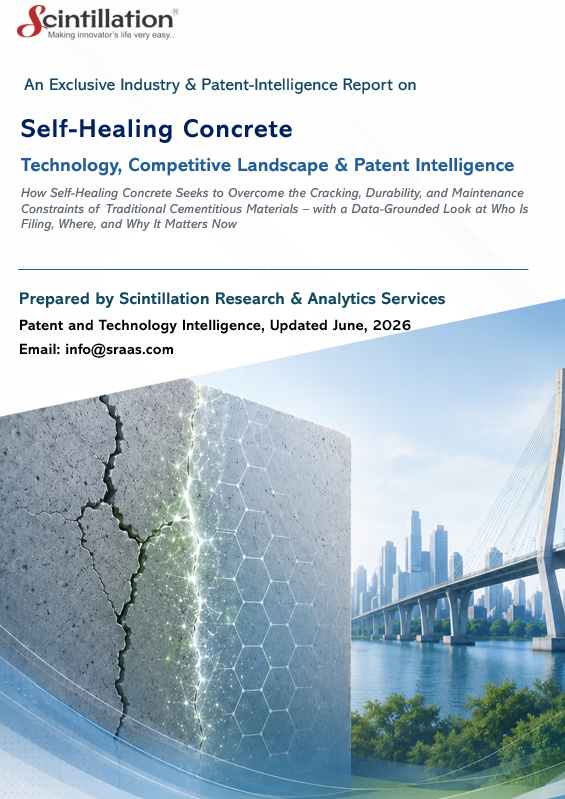
How Self-Healing Concrete Seeks to Overcome the Cracking, Durability, and Maintenance Constraints of Traditional Cementitious Materials
A data-grounded look at who is filing, where innovation is concentrated, and why self-healing concrete is becoming strategically important for resilient, sustainable infrastructure.
A comprehensive technology and patent intelligence analysis of Self-Healing Concrete — examining biological self-healing systems, bacteria-based concrete, encapsulated healing agents, vascular healing networks, microcapsule technologies, crystalline admixtures, autonomous crack-detection mechanisms, nanomaterial-enhanced healing approaches, and smart construction materials enabling the next generation of durable and low-maintenance infrastructure.
Report details
Self-Healing Concrete — Technology & Patent Intelligence Report
When conventional concrete can no longer meet the durability and maintenance demands of modern infrastructure
The global construction industry is undergoing a significant transformation as urbanization, aging infrastructure, and sustainability goals drive demand for more durable and cost-effective building materials. Conventional concrete is prone to cracking due to environmental exposure, mechanical stress, and aging, leading to costly repairs and reduced structural lifespan.
As infrastructure owners and governments seek solutions to improve durability and reduce maintenance costs, Self-Healing Concrete has emerged as a promising innovation in advanced construction materials.
Self-Healing Concrete incorporates autonomous repair mechanisms that enable cracks to be sealed without significant human intervention. Technologies such as bacteria-based healing systems, encapsulated healing agents, crystalline admixtures, and nanomaterial-enhanced formulations help restore structural integrity, prevent water ingress, and extend service life.
As investments in sustainable construction and resilient infrastructure continue to grow, Self-Healing Concrete is expected to play an increasingly important role in the development of next-generation buildings, bridges, tunnels, and other critical infrastructure systems.
Table of contents
Ten chapters connecting self-healing concrete's technical foundations to patent landscape intelligence and commercialization strategy. Click any chapter to expand.
Structural composition & key features
Self-healing concrete embeds autonomous repair mechanisms directly into the cementitious matrix — enabling cracks to be detected and sealed without manual intervention, restoring structural integrity and extending service life well beyond conventional concrete.
Leading self-healing concrete patent assignees
The self-healing concrete IP landscape reflects engagement across the full construction-materials value chain — cement producers protecting admixture formulations, biotechnology firms advancing bacteria-based healing agents, and research institutions establishing foundational science ahead of broader commercial deployment.
Top assignees by filing activity
Why traditional cementitious materials cannot meet modern durability demands
Self-healing concrete directly targets five structural constraints that prevent conventional cementitious materials from meeting the durability, longevity, and maintenance-cost requirements of modern infrastructure.
Download Your Sample Report Now:
Error: Contact form not found.
Where self-healing concrete creates critical infrastructure impact
Self-healing concrete's durability and maintenance-cost advantages are most compelling in applications where crack-driven degradation, repair accessibility, and structural lifespan requirements push conventional concrete beyond its practical limits.
The self-healing concrete patent landscape — a 10-part analysis
The patent landscape chapter delivers data-grounded IP intelligence — from scope corrections and revised assignee profiling to filing trends, technology segmentation, anchor patents, representative publications, and whitespace identification across the full self-healing concrete ecosystem.
- Methodology, scope, and scope corrections addressing classification overlap between self-healing concrete, conventional admixtures, and general construction-material patent domains
- Revised assignee picture and notable profiles — cement producers, construction-materials companies, biotechnology firms, and research institutions shaping the self-healing concrete IP landscape
- Filing activity over time — trend analysis identifying R&D acceleration points and IP maturity signals across self-healing concrete technology segments
- Jurisdiction coverage — USPTO, CNIPA, KIPO, JPO, EPO, and WIPO distributions across the self-healing concrete patent corpus
- Technology segmentation — bacteria-based healing, encapsulated agents, vascular networks, crystalline admixtures, crack-detection mechanisms, and nanomaterial-enhanced approaches
- Foundational anchor patents — core IP defining the self-healing concrete landscape and their strategic competitive significance
- Representative publications — key academic and industry papers shaping self-healing concrete research direction and commercialization roadmap
- Whitespace & strategic opportunities — underprotected technology domains and emerging self-healing concrete filing and licensing opportunities
Who should read this report
Understand who is building the IP foundation for self-healing concrete
Get the complete technology and patent intelligence report on Self-Healing Concrete — from bacteria-based healing agents and crystalline admixtures to the patent landscape revealing who is filing, where innovation is concentrated, and why self-healing concrete is becoming strategically critical for resilient, sustainable infrastructure.
For a quick demo, schedule a meeting now!
About Scintillation Research
Scintillation Research & Analytics Services is a specialized intellectual property and technology intelligence firm delivering patent analytics, technology scouting, competitive intelligence, and strategic research services.
Through comprehensive patent and technology intelligence reports, we help organizations understand emerging innovations, identify market opportunities, monitor competitors, and make data-driven decisions across rapidly evolving technology domains. Our reports are designed for professionals at the intersection of technology strategy, IP management, and competitive intelligence.
