
Perceiving a World in Motion: How Integrated 4D Sensor Fusion Is Redefining Spatial Intelligence
A data-grounded look at who is innovating, where intellectual-property activity is concentrated, and what it means for autonomous systems, Physical AI, commercialization, and IP strategy.
Report details
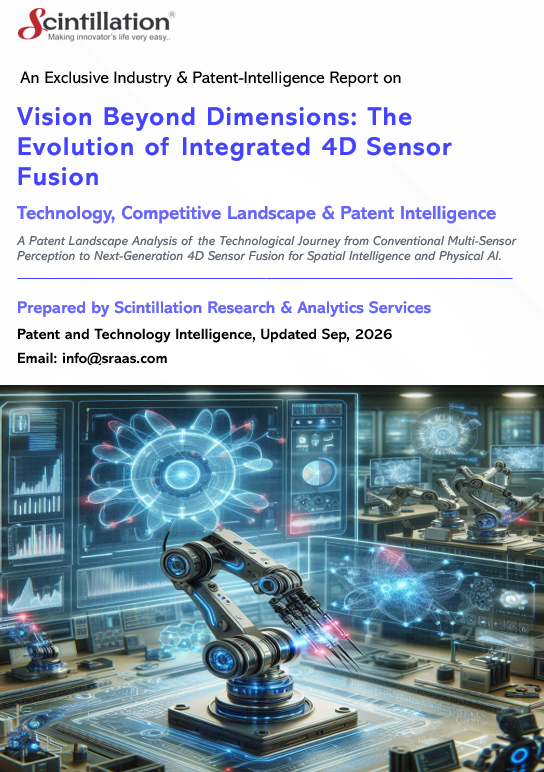
Integrated 4D Sensor Fusion — Patent Landscape Study Report
A next-generation perception technology for dynamic environments
This report explores the emergence of Integrated 4D Sensor Fusion as a next-generation perception technology for enabling real-time, multimodal, and intelligent understanding of dynamic physical environments. It examines the technological foundations, applications, and evolving patent landscape, providing insight into who is innovating, where intellectual-property activity is concentrated, and what these trends mean for future autonomous systems, Physical AI, commercialization, and IP strategy.
The report covers key technologies including 4D sensing, coherent vision, multimodal sensor fusion, RGB/depth sensing, LiDAR and radar integration, IMU-assisted perception, spatial and temporal synchronization, sensor calibration, AI-based scene understanding, custom perception silicon, edge processing, 3D/4D mapping, and dynamic world modeling. It also analyzes leading assignees, patent-filing trends, jurisdictions, technology evolution, application areas, competitive dynamics, whitespace opportunities, and the future outlook for intelligent spatial perception.
Built for everyone shaping the future of machine perception
Each audience gets a clear view of the landscape and what to do with it.
When machines must understand motion, not just snapshots
Autonomous vehicles, robots, and industrial systems need to understand not only where objects are, but how they move, in real time and under varied conditions. Conventional multi-sensor perception typically processes cameras, LiDAR, radar, and inertial sensors in separate pipelines, then merges results late, which can lose information, introduce latency, and struggle with timing mismatches, calibration drift, and sensor failure in poor weather or lighting. Integrated 4D sensor fusion brings multimodal data together tightly in both space and time, combining RGB and depth sensing, LiDAR and radar, and IMU-assisted perception with precise synchronization and calibration, and often supported by custom perception silicon and edge processing, to build a continuously updated model of the dynamic world. The approach is promising but not without limits: it demands accurate calibration and synchronization, high computational throughput within tight power and cost budgets, robust behavior in edge cases, and standards and validation methods that regulators and customers can trust.
Table of contents
Twelve chapters, from integrated 4D sensor fusion fundamentals to patent landscape intelligence. Click any chapter to expand.
Core capabilities of integrated 4D sensor fusion
The capabilities that turn many sensors into one coherent, time-aware view of the world.
Why conventional multi-sensor perception falls short, and what stays hard
What integrated 4D sensor fusion aims to address, and where the limits are.
Where integrated 4D sensor fusion creates value
Use cases where real-time, robust understanding of moving environments is a competitive edge.
Who is innovating, where, and in which areas
The study covers methodology and scope, strategic insights, the assignee picture, filing activity over time, jurisdiction coverage, technology segmentation across 4D sensing, multimodal fusion, calibration and synchronization, AI-based scene understanding, custom perception silicon, and world modeling, representative publications across the field, and the whitespace and strategic opportunities for new filings and licensing.
Request Your Sample Report Now!
