Next Generation Carbon Negative Construction Materials for Buildings and Infrastructure

  • Home
  • Next Generation Carbon Negative Construction Materials for Buildings and Infrastructure
Patent & Innovation Landscape Analysis  ·  Sustainable Construction Series

Buildings That Store Carbon: How Next-Generation Carbon-Negative Construction Materials Are Changing Buildings and Infrastructure

A data-grounded look at who is patenting, where innovation is concentrated, and where whitespace remains in materials that store more carbon than they emit.

CO₂ mineralizationPermanent carbon storage
Net-negativeBeyond low-carbon
PerformanceStrength and durability
PatentLandscape & whitespace

Report details

Next-Generation Carbon-Negative Construction Materials for Buildings & Infrastructure — Patent & Innovation Landscape Analysis Report

PublisherScintillation Research
TechnologyCarbon-Negative Construction Materials
Focus areaPermanent carbon storage in construction
Key segmentsMineralization, Binders, Bio-based, Aggregates
IP coverage8-part patent landscape
AudienceConstruction, IP, Policy, Investment
Purpose of the report

From lower-carbon materials to permanent carbon storage

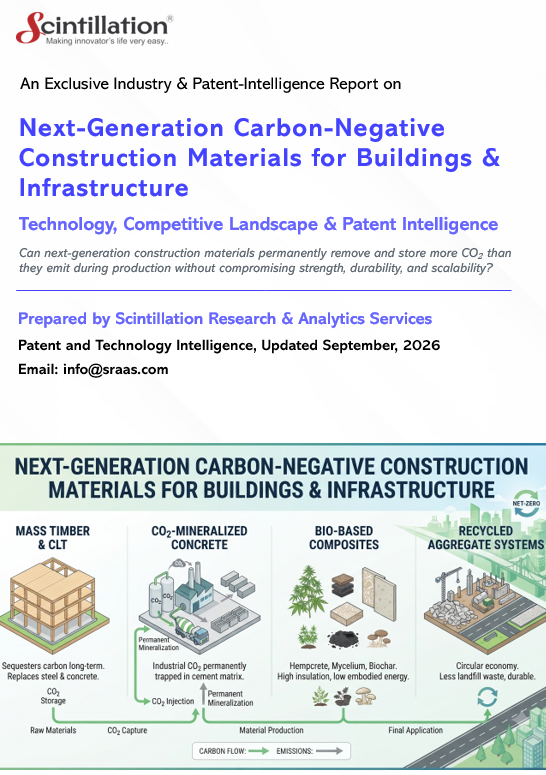
This report analyzes the patent landscape and technological development of next-generation carbon-negative construction materials for buildings and infrastructure. It identifies key innovations in CO₂ mineralization, carbon-storing concrete and aggregates, carbon-negative binders, bio-based materials, biochar, and waste-derived materials, and evaluates how the field is moving from conventional low-carbon materials that reduce embodied carbon toward materials that deliver net carbon removal or long-term storage while keeping the strength, durability, scalability, and performance construction requires, including developments in cement replacement, mineral carbonation, CO₂ curing, and carbon-negative composites.

It also maps technology trends, leading assignees and research organizations, filing activity, geographic distribution, and emerging applications across concrete structures, precast products, bricks and blocks, insulation, pavements, roads, and bridges, and it identifies whitespace around permanent storage, durability, scalable manufacturing, cost reduction, carbon verification, feedstock availability, and compatibility with existing construction processes.

Who will benefit from this report

Built for everyone shaping low- and negative-carbon construction

Each audience gets a clear view of the landscape and what to do with it.

01
Construction Material Manufacturers
Identify emerging carbon-negative technologies, competitors, and product development opportunities.
02
Cement & Concrete Companies
Understand CO₂ mineralization, carbon curing, alternative binders, and carbon-storing concrete.
03
Building & Infrastructure Developers
Find advanced materials for lower-carbon and carbon-negative projects.
04
Engineering & Construction Companies
Evaluate materials for integration into buildings, roads, bridges, and other infrastructure.
05
Technology & Material Startups
Spot technology gaps, opportunities, and whitespace for innovation.
06
Research Institutions & Universities
Follow research trends in carbon capture, mineralization, bio-based materials, and carbon storage.
07
Investors & VC Firms
Identify emerging companies, technology areas, and innovation trends.
08
Government & Policy Organizations
Understand technologies that may support construction decarbonization and carbon-removal initiatives.
09
Architects & Building Designers
Explore materials that lower embodied carbon and support sustainable design.
10
Infrastructure Owners & Operators
Assess materials for long-life assets such as bridges, roads, tunnels, and public facilities.
11
Patent & IP Professionals
Identify key patent holders, technology trends, IP opportunities, and areas of activity.
12
Sustainability & ESG Teams
Understand technologies that contribute to embodied-carbon reduction and long-term storage targets.
13
Raw-Material & Waste-Management Companies
Find ways to convert industrial waste, mineral residues, and biomass into carbon-storing materials.
14
Carbon-Capture & Carbon-Removal Companies
Identify downstream uses for captured CO₂ in construction materials.
15
Standards & Certification Organizations
Understand emerging materials and the need for standards on carbon permanence, durability, and carbon accounting.
Introduction

Turning construction from a carbon source into a carbon store

Construction materials, especially cement and concrete, carry a large embodied-carbon footprint. Most progress so far has focused on reducing that footprint. Carbon-negative materials go further: they use captured or biogenic carbon, through mineralization, CO₂ curing, carbon-storing aggregates, biochar, bio-based components, and carbon-negative binders, so that a product locks away more carbon than was emitted to make it. The challenge is to achieve that permanently, at scale and at competitive cost, without compromising strength, durability, or compatibility with how buildings and infrastructure are actually built.

Report structure

Table of contents

Twelve chapters, from carbon-negative materials fundamentals to patent landscape intelligence. Click any chapter to expand.

—Key findings on carbon-negative construction materials, leading assignees, filing trends, and strategic implications
—Who Will Benefit from This Report
3.1Limitations of Conventional Construction Materials for Buildings & Infrastructure
—Core Components of Carbon-Negative Construction Materials
4.1Challenges Addressed by Carbon-Negative Construction Materials
4.2Key Features of Carbon-Negative Construction Materials
4.3Applications of Carbon-Negative Construction Materials
—How construction materials have progressed from reducing embodied carbon to achieving net-negative impact
—The technical, commercial, and policy signals that make the field strategically important
—Scale-up pathways, standards, and future directions
8.1Methodology & Scope
8.2Interesting Strategic Insights
8.3Assignee Picture
8.4Filing Activity Over Time
8.5Jurisdiction Coverage
8.6Technology Segmentation
8.7Representative Publications Across the Field
8.8Whitespace & Strategic Opportunities
—Stakeholder-specific takeaways for manufacturers, developers, designers, owners, investors, IP teams, and policymakers
—Synthesis of the technical trajectory, IP dynamics, and strategic implications
—Overview of Scintillation Research and its patent and technology intelligence services
—Legal disclaimer covering information accuracy, IP ownership, and terms of use
Core components & key features

The main routes to carbon-negative construction materials

Different ways of locking carbon into the materials buildings are made from.

CO₂ mineralization & carbon curing
Converting CO₂ into stable minerals within materials, or curing products with CO₂, for permanent storage.
Carbon-storing concrete & aggregates
Concrete and aggregates engineered to hold carbon within their structure.
Carbon-negative binders & cement replacement
Alternative binders that cut cement use and can store more carbon than they emit.
Bio-based materials & biochar
Plant-derived materials and biochar that carry biogenic carbon into products.
Waste-derived materials
Industrial waste, mineral residues, and biomass turned into carbon-storing construction inputs.
Verification & carbon accounting
Methods to measure, prove, and certify permanence of stored carbon.
Challenges addressed

Limits of conventional materials, and what stays hard

What carbon-negative materials aim to address, and the barriers still to clear.

01
High embodied carbon in conventional materials
Cement and concrete carry large emissions from production, which makes construction a major carbon source
02
Low-carbon is not the same as carbon-negative
Reducing emissions still leaves a net positive footprint. Carbon-negative materials aim for net removal or long-term storage
03
Keeping strength, durability, and performance
New materials must meet construction standards and last for the life of the building or infrastructure
04
Scale, cost, feedstock, and verification
Scalable manufacturing, affordability, feedstock supply, compatibility with existing processes, and proof of permanence remain the main hurdles
Applications

Where carbon-negative materials could create value

Building and infrastructure components that can hold carbon.

Concrete structures
Precast products
Bricks and blocks
Insulation
Pavements and roads
Bridges
Other construction components
Patent landscape study

Who is filing, where, and in which areas

The study covers methodology and scope, strategic insights, the assignee picture, filing activity over time, jurisdiction coverage, technology segmentation across mineralization, binders, aggregates, bio-based and waste-derived materials, representative publications, and the whitespace and strategic opportunities for new filings and licensing.
Request Your Sample Report Now!

    For a quick demo, schedule a meeting now!

    Shopping Cart (0 items)

    Subscribe to our newsletter

    Sign up to receive latest news, updates, promotions, and special offers delivered directly to your inbox.
    No, thanks