Passive Radiative Cooling Materials

  • Home
  • Passive Radiative Cooling Materials
Patent & Innovation Landscape Analysis  ·  Advanced Materials Series

Cooling Without Power: How Passive Radiative Cooling Materials Are Turning the Sky Into a Heat Sink

A data-grounded look at who is patenting, where innovation is concentrating, and what stands between laboratory performance and widespread real-world adoption.

ReflectSolar radiation
EmitHeat to the sky
ZeroActive energy input
PatentLandscape & whitespace

Report details

Passive Radiative Cooling Materials — Patent & Innovation Landscape Analysis Report

PublisherScintillation Research
TechnologyPassive Radiative Cooling Materials
Focus areaEnergy-free cooling coatings and surfaces
Key segmentsCoatings, Polymers, Photonics, Nanostructures
IP coverage6-part patent landscape
AudienceIP, R&D, Materials, Investment
Purpose of the report

Assessing development, patenting, and commercial readiness

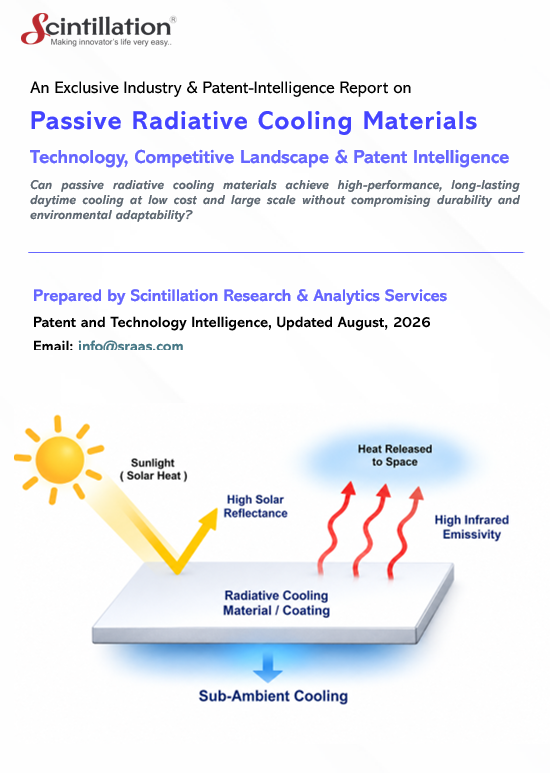
This report assesses the technological development, patenting activity, commercialization status, and future potential of passive radiative cooling materials: advanced materials and coatings that achieve energy-free cooling by reflecting solar radiation and emitting thermal energy to the sky. It evaluates maturity and readiness, with emphasis on what prevents wide adoption: cooling performance under varying conditions, long-term durability and optical stability, cost-effective large-area manufacturing, and resistance to weathering, dust, humidity, and UV.

It also analyzes patenting trends, key developers, geographic filing activity, emerging material approaches, and application areas, highlighting technology gaps and white spaces in durable cooling coatings, scalable manufacturing, self-cleaning materials, building envelopes, photovoltaic cooling, electronics thermal management, and industrial heat management.

Who will benefit from this report

Built for everyone shaping passive cooling

Each audience gets a clear view of the landscape and what to do with it.

01
Advanced Materials & Coating Manufacturers
Identify emerging material architectures, performance requirements, and routes to durable, scalable cooling products.
02
Building & Construction Companies
Learn how radiative cooling coatings and surfaces can lower building temperatures and cooling-energy demand.
03
Renewable Energy & Solar Companies
Explore radiative cooling to reduce PV operating temperatures and potentially improve performance and reliability.
04
Electronics & Thermal Management Companies
Find opportunities for heat dissipation in electronics, data centers, and telecom equipment without extra electrical energy.
05
Research Institutions & Universities
Understand developments and gaps in solar reflectance, infrared emissivity, durability, stability, and scalable manufacturing.
06
Patent Professionals & IP Teams
Identify key patent holders, filing trends, technology clusters, and white spaces for future R&D and IP generation.
07
Investors & VC Firms
Assess maturity, commercialization status, competition, and growth opportunities.
08
Technology Strategy & Innovation Teams
Evaluate opportunities, monitor competitors, and identify partnership or acquisition targets.
Introduction

A cooling effect that needs no electricity

Passive radiative cooling materials do two things at once: they reflect almost all incoming sunlight, and they emit heat as infrared radiation through the atmosphere's transparent window out to cold space. A surface that does both can stay cooler than the surrounding air, even in daylight, with no electricity or refrigerant. That makes it attractive for cutting cooling loads in buildings, solar panels, electronics, and industry, provided the materials can be made durable, affordable, and manufacturable at scale.

Report structure

Table of contents

Ten chapters, from radiative cooling fundamentals to patent landscape intelligence. Click any chapter to expand.

—Key findings on passive radiative cooling materials, leading filers, trends, and strategic implications
—Who Will Benefit from This Report
3.1Challenges in Traditional Cooling and Passive Radiative Cooling Materials
4.1Key Features
4.2Problems Addressed
4.3Potential Applications
—Technology maturity, manufacturing scale-up, and the path to widespread adoption
6.1Methodology & Scope
6.2Who Is Filing
6.3Filing Activity Over Time
6.4Jurisdiction Coverage
6.5Technology Segmentation
6.6Whitespace & Strategic Opportunities
—Stakeholder-specific takeaways for materials makers, builders, energy and electronics companies, IP teams, and investors
—Synthesis of the technical trajectory, IP dynamics, and strategic implications
—Overview of Scintillation Research and its patent and technology intelligence services
—Legal disclaimer covering information accuracy, IP ownership, and terms of use
Key features

Core properties and technologies

What lets a surface cool itself under direct sun.

High solar reflectance
Reflects most incoming sunlight so the surface absorbs very little heat.
High infrared emissivity
Radiates heat efficiently through the atmospheric window to cold space.
Polymers, ceramics & photonic structures
Material families engineered to control how light and heat are reflected and emitted.
Nanostructured surfaces
Fine-scale structures that tune optical properties across the solar and infrared range.
Durable, weather-resistant coatings
Stability against UV, humidity, dust, and weathering over long service lives.
Scalable & self-cleaning designs
Large-area manufacturing and surfaces that keep their performance as they age.
Problems addressed

What passive radiative cooling aims to solve

The need is clear. The remaining question is how fast the materials can mature.

01
Energy demand for active cooling
Air conditioning and refrigeration consume large amounts of electricity. Passive surfaces cut that load without added energy
02
Heat buildup in buildings, panels, and equipment
Excess heat lowers comfort, efficiency, and equipment life. Radiative surfaces keep temperatures down
03
Durability and performance in real conditions
Weathering, dust, humidity, and UV degrade optical properties, and performance shifts with climate and sky conditions
04
Cost and large-area manufacturing
Affordable, scalable production remains a key barrier between lab results and widespread adoption
Potential applications

Where passive radiative cooling creates value

Anywhere heat needs to be shed without spending energy.

Building envelopes and roofing
Photovoltaic cooling
Electronics and data centers
Telecom equipment
Industrial heat management
Durable cooling coatings
Patent landscape study

Who is filing, where, and in which areas

The study covers methodology and scope, who is filing, filing activity over time, jurisdiction coverage, technology segmentation across coatings, polymers, photonic and nanostructured materials, and manufacturing, and the whitespace and strategic opportunities for new filings and licensing.
Request Your Sample Report Now!

    For a quick demo, schedule a meeting now!

    Shopping Cart (0 items)

    Subscribe to our newsletter

    Sign up to receive latest news, updates, promotions, and special offers delivered directly to your inbox.
    No, thanks