Per- and Polyfluoroalkyl Substances (PFAS) Destruction

  • Home
  • Per- and Polyfluoroalkyl Substances (PFAS) Destruction
Patent & Innovation Landscape Analysis  ·  Environmental Technology Series

Breaking the Strongest Bond in Organic Chemistry: How PFAS Destruction Technologies Are Moving Beyond Containment

A data-grounded look at who is patenting, where innovation is concentrated, and how the field is shifting from removing PFAS to permanently destroying and defluorinating it.

DestroyNot just remove or contain
DefluorinationBreaking C–F bonds
ScalableReal-world treatment
PatentLandscape & whitespace

Report details

Per- and Polyfluoroalkyl Substances (PFAS) Destruction — Patent & Innovation Landscape Analysis Report

PublisherScintillation Research
TechnologyPFAS Destruction
Focus areaPermanent destruction and defluorination
Key segmentsCatalysts, Electrodes, Reactors, Materials
IP coverage8-part patent landscape
AudienceIP, R&D, Water, Industry, Investment
Purpose of the report

A strategic view of the PFAS destruction ecosystem

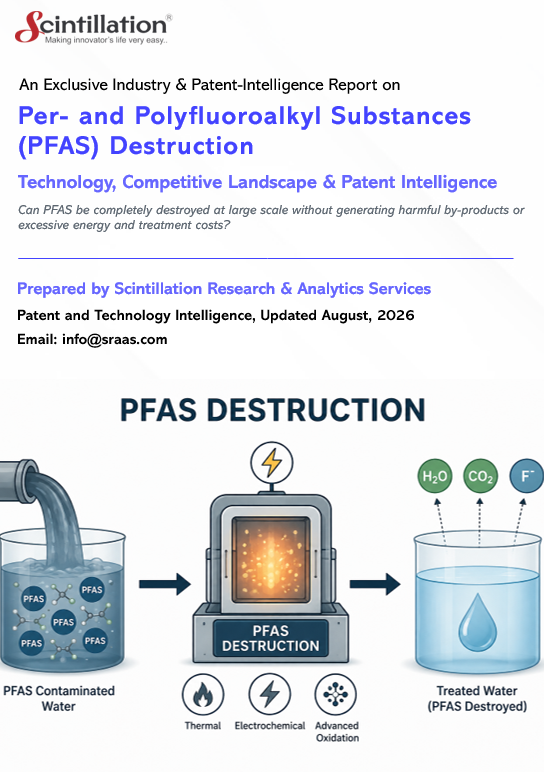
This report provides a comprehensive overview of the patent and technology landscape for PFAS destruction, focusing on key technological developments, major players, emerging approaches, and areas of innovation. It evaluates how the field is progressing from conventional PFAS removal and containment toward permanent destruction and defluorination of PFAS compounds.

Overall, it gives a strategic view of the ecosystem, showing where innovation is concentrated today and where opportunities may exist for next-generation destruction technologies.

Who will benefit from this report

Built for everyone facing the PFAS challenge

Each audience gets a clear view of the landscape and what to do with it.

01
Environmental Technology Companies
Identify emerging destruction technologies, competitive developments, and ways to differentiate.
02
Water & Wastewater Treatment Companies
Evaluate approaches to permanently destroy PFAS in drinking water, industrial wastewater, landfill leachate, and other streams.
03
Chemical & Materials Companies
Find opportunities in catalysts, electrodes, membranes, reactive materials, and other system components.
04
Technology Developers & Start-ups
Spot patent whitespace, technology gaps, and commercialization opportunities.
05
Universities & Research Institutions
Understand the state of research, avoid duplication, and find promising areas for R&D.
06
Patent Holders & IP Teams
Benchmark competitors, monitor emerging portfolios, and identify licensing opportunities.
07
Investors & VC Firms
Assess technology maturity, competition, and commercialization potential.
08
Industrial Manufacturers & PFAS-Generating Industries
Chemical, semiconductor, textile, and other industries seeking effective options for PFAS-containing waste streams.
09
Environmental Consultants & Engineering Firms
Evaluate available technologies and suitable pathways for remediation and treatment projects.
10
Government Agencies & Regulators
Understand technological progress and the availability of scalable solutions.
11
Corporate Strategy & Business Development
Identify partnerships, acquisitions, licensing, and market-entry opportunities.
Introduction

From concentrating PFAS to ending it

PFAS are a large family of fluorinated chemicals prized for resisting heat, water, and oil, and for that same reason they persist in the environment. Most treatment today removes PFAS from water and moves it somewhere else, for example onto spent carbon or into concentrated waste, which still has to be managed. PFAS destruction aims to break the carbon–fluorine bonds so that the compounds are permanently converted, closing the loop rather than just relocating the problem.

Report structure

Table of contents

Twelve chapters, from PFAS destruction fundamentals to patent landscape intelligence. Click any chapter to expand.

—Key findings on PFAS destruction technology, leading assignees, filing trends, and strategic implications
—Who Will Benefit from This Report
3.1Limitations of Conventional PFAS Destruction Technologies
—Core Components of PFAS Destruction
4.1Challenges Addressed by PFAS Destruction
4.2Key Features of PFAS Destruction
4.3Applications of Per- and Polyfluoroalkyl Substances (PFAS) Destruction
—How the field has progressed from removal and containment toward permanent destruction
—The technical, regulatory, and commercial signals that make the field strategically important
—Commercialization pathways, scale-up needs, and future directions
8.1Methodology & Scope
8.2Interesting Strategic Insights
8.3Assignee Picture
8.4Filing Activity Over Time
8.5Jurisdiction Coverage
8.6Technology Segmentation
8.7Representative Publications Across the Field
8.8Whitespace & Strategic Opportunities
—Stakeholder-specific takeaways for technology companies, treatment providers, industry, IP teams, and investors
—Synthesis of the technical trajectory, IP dynamics, and strategic implications
—Overview of Scintillation Research and its patent and technology intelligence services
—Legal disclaimer covering information accuracy, IP ownership, and terms of use
Core components & key features

The main approaches to destroying PFAS

Different ways of breaking the carbon–fluorine bond, each with its own strengths and trade-offs.

High-temperature thermal destruction
Heat-driven breakdown of PFAS, with attention to complete conversion and emissions control.
Supercritical water oxidation
Water at extreme temperature and pressure that oxidizes PFAS and other persistent organics.
Electrochemical oxidation
Electrodes that drive reactions breaking down PFAS in water, enabled by advanced electrode materials.
Plasma-based treatment
Reactive species generated in plasma that attack and defluorinate PFAS molecules.
Photochemical & photocatalytic
Light-activated reactions, often with catalysts, that degrade PFAS.
Mechanochemical & sonochemical
Mechanical or acoustic energy used to break PFAS bonds, including in solid and concentrated streams.
Challenges addressed

Why removal alone is not enough

The limits of conventional approaches, and the barriers destruction still has to clear.

01
Extreme chemical persistence
The carbon–fluorine bond is among the strongest in organic chemistry, so PFAS resists natural breakdown
02
Removal that only moves the problem
Capture methods leave spent media or concentrated waste that still contains PFAS and needs further management
03
Incomplete destruction and by-products
Partial breakdown can leave shorter-chain PFAS or other by-products, so verified, complete defluorination matters
04
Energy, cost, and scale
Treating diverse, dilute, and complex streams at an affordable cost and large scale remains the central commercial hurdle
Applications

Where PFAS destruction creates value

Any stream where PFAS needs to be permanently eliminated.

Drinking water
Industrial wastewater
Landfill leachate
Spent sorbents and concentrates
Semiconductor and chemical manufacturing waste
Textile industry waste streams
Remediation projects
Patent landscape study

Who is filing, where, and in which areas

The study covers methodology and scope, strategic insights, the assignee picture, filing activity over time, jurisdiction coverage, technology segmentation across thermal, electrochemical, plasma, photochemical, and other destruction routes, representative publications, and the whitespace and strategic opportunities for new filings and licensing.
Request Your Sample Report Now!

    For a quick demo, schedule a meeting now!

    Shopping Cart (0 items)

    Subscribe to our newsletter

    Sign up to receive latest news, updates, promotions, and special offers delivered directly to your inbox.
    No, thanks