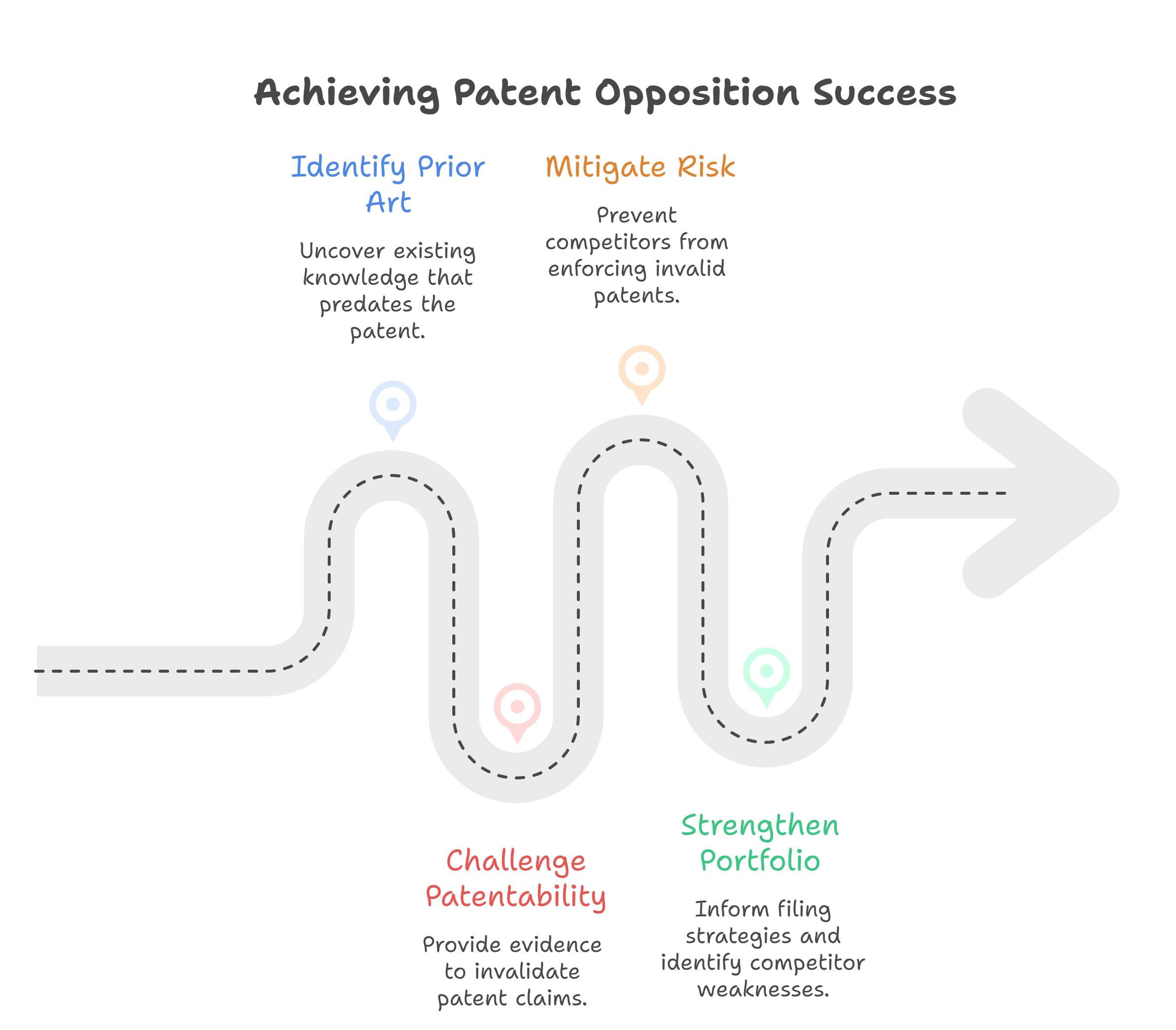
An opposition search looks for prior art that can be used to challenge a patent during an opposition proceeding at a patent office. The search covers patent databases, scientific literature, and other relevant sources, and the documents found are assessed for their bearing on validity. Companies and their advisers commission it when a granted or published patent blocks a product or a filing.
Who it is for: Companies facing a competitor patent that blocks a product, attorneys preparing an opposition or a defence against one, and patent holders testing the strength of a rival filing.
Scintillation Research & Analytics offers specialised Opposition Search Services, designed to provide a robust defence against potentially invalid patents and to strengthen your own intellectual property portfolio. Our mission is to empower clients by delivering comprehensive, data-driven insights that inform strategic decision-making throughout the patent lifecycle.
Scintillation Research's Expertise in Opposition Search
Leveraging over 14 years of experience in patent and innovation consulting, Scintillation Research & Analytics provides meticulous and strategic opposition search services. Our team of technology enthusiasts and engineers, armed with strong educational backgrounds and extensive experience in analysing patents and scientific research papers, are adept at navigating complex patent landscapes.
Deep Dive Analysis: We go beyond superficial searches, conducting thorough investigations into patent databases, scientific literature, and other relevant sources to uncover the most pertinent prior art.
Strategic Insight: Our analysis is not just about finding documents; it's about understanding their relevance and potential impact on the validity of a patent. We provide actionable intelligence to support your opposition strategy.
Tailored Solutions: We recognise that each case is unique. Our services are customised to meet your specific requirements, ensuring that the search is focused on the most critical aspects of the patent under challenge.
Competitive Advantage: By identifying weaknesses in competitor patents, our opposition search services help you maintain a competitive edge, reduce legal costs, and protect your market share.
Choosing Scintillation Research means partnering with a firm committed to professionalism, precision, and client success. We offer a modular approach, ensuring client engagement throughout the process, and adhere to fixed timelines to meet project deadlines.
Frequently Asked Questions: Opposition Search Services
What is an Opposition Search?
▼
An opposition search is a crucial step in intellectual property (IP) protection, particularly for trade marks. It involves a thorough investigation to identify any existing earlier trade marks or rights that could conflict with a new trade mark application.
This process helps to determine if a trade mark application is likely to be opposed by a third party on either absolute or relative grounds.
Why is Opposition Search Important for My Business?
▼
Mitigate Risk: It helps identify potential conflicts before a trade mark is published, saving significant time and expense associated with formal opposition proceedings.
Strengthen Application: Understanding potential objections allows for strategic adjustments to the application, increasing the likelihood of successful registration.
Competitive Intelligence: It provides insights into competitors' existing IP portfolios and their potential grounds for objection.
Avoid Infringement: By identifying conflicting marks, businesses can avoid inadvertently infringing on existing rights.
What are the Grounds for Opposition?
▼
Absolute Grounds: These relate to defects in the trade mark itself, such as being descriptive of the goods/services, generic, or non-distinctive. The mark must be capable of distinguishing the applicant's goods or services from those of others.
Relative Grounds: These arise when the applicant's trade mark conflicts with an earlier trade mark or right owned by an opponent. This often involves a likelihood of confusion among consumers.
Who Can Oppose a Trade Mark Application?
▼
Absolute Grounds: Generally, anyone can oppose a trade mark application on absolute grounds.
Relative Grounds: Only the proprietor of an earlier trade mark or earlier right can oppose on relative grounds.
What is the Typical Timeline for Opposition?
▼
An initial opposition period usually begins immediately after the publication of a trade mark application in an official journal. This period is typically two months.
This period can sometimes be extended, for example, by filing a "Notice of Threatened Opposition" within the initial two months, which may extend it to three months.
How Can Scintillation Research Assist with Opposition Searches?
▼
Expert Analysis: Our team conducts comprehensive searches using advanced methodologies and databases.
Strategic Insights: We provide detailed analysis of potential conflicts and likelihood of opposition.
Tailored Solutions: Customized strategies based on your objectives.
Proactive Defence: Identify risks early and take preventive actions.
Market Intelligence: Gain insights into patents and competitive positioning.
What Information Do You Need to Conduct an Opposition Search?
▼
The trade mark in question (word mark, logo, etc.).
The specific goods and/or services for which registration is sought.
Any known earlier marks or rights that may be relevant.
The jurisdiction(s) where protection is sought.
How Does Scintillation Research's Service Differ from a Standard Search?
▼
We go beyond basic searches by:
Identifying subtle conflicts missed by automated tools.
Assessing the strength and validity of opposing marks.
Providing actionable recommendations.
Offering a holistic IP strategy based on innovation expertise.
What Are the Next Steps After an Opposition Search?
▼
Based on our findings, you can:
Proceed with confidence if no conflicts exist.
Amend your application to avoid conflicts.
Engage in discussions with existing rights holders.
Prepare a defence strategy if opposition is likely.
We guide you through every step of the process.
What you receive
The most pertinent prior art found across patent databases, scientific literature and other relevant sources
An assessment of each document’s relevance and its potential impact on the validity of the patent
Actionable intelligence to support the opposition strategy, focused on the critical aspects of the patent under challenge
A search scope customised to the specific requirements of the case
An opposition search is a prior art search carried out to challenge the validity of a patent through an opposition proceeding. Scintillation conducts thorough investigations across patent databases, scientific literature, and other relevant sources to uncover the most pertinent prior art. The work does not stop at finding documents. Each one is assessed for its relevance and its potential impact on validity, so the result supports a strategy rather than simply listing references.
Both look for prior art that undermines a patent, and the searching overlaps heavily. The difference is the forum and the timing. An opposition search supports a challenge filed at a patent office within the opposition window that follows grant or publication. An invalidity search usually supports a challenge in litigation or a post-grant review, often years later. The evidence standard and the way documents are argued differ with the forum, so scope is set case by case.
Patent databases, scientific literature, and other relevant sources are searched. Patent documents matter because they are dated and public, and scientific papers often disclose a technique before anyone files on it. Non-patent material such as conference proceedings, standards documents, manuals, and product literature can also carry a disclosure date. Searching beyond the obvious databases is the point: superficial searching tends to find the same references the examiner already considered.
The patent number is the minimum, along with the claims of most concern. It helps to say why the patent matters to you, whether it reads on a product, blocks a filing, or sits in a portfolio you are assessing. Any prior art already known, including references cited during examination, saves repeated ground. Deadlines matter too, because opposition windows are fixed. The search is then customised to the most critical aspects of the patent under challenge.