The Revival of QNED Displays
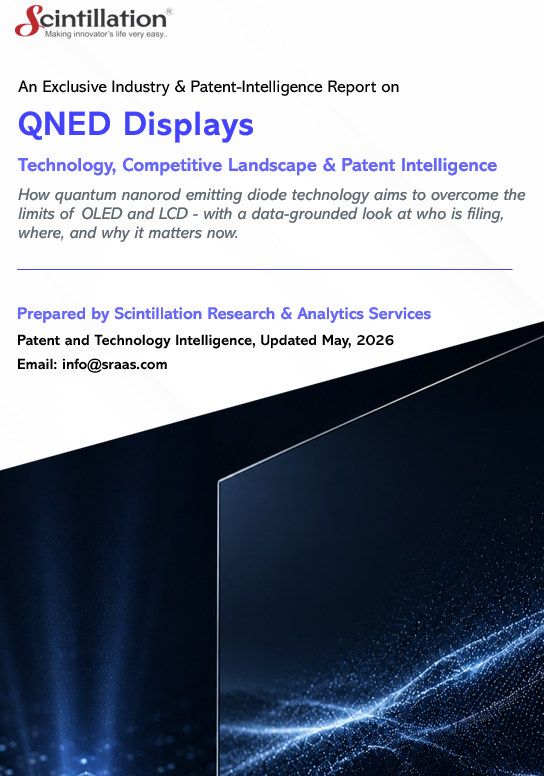
Quantum Nanorod Emitting Diode (QNED) technology has long been considered one of the most promising candidates for next-generation self-emissive displays. By combining inorganic nanorod LEDs with quantum-dot color conversion, QNED offers the potential to overcome key limitations associated with OLED technology, including burn-in, brightness constraints, and material degradation.
After a period of intense research activity followed by a noticeable slowdown, QNED is once again attracting industry attention. Recent developments in nanorod alignment and manufacturing processes have renewed interest in the technology, prompting display manufacturers and innovators to revisit its commercialization potential.
This report aims to provide a comprehensive view of the evolving QNED landscape, examining the technology’s development trajectory, patent activity, competitive dynamics, and future opportunities. Through detailed patent intelligence and technology analysis, the report helps stakeholders understand who is driving innovation, where critical intellectual property is concentrated, and how the technology may shape the future of premium displays.
Why QNED Matters?
The display industry continues to seek technologies capable of delivering higher brightness, improved energy efficiency, longer operational lifetimes, and greater reliability. While OLED remains the leading premium display technology, concerns surrounding burn-in, organic material degradation, and brightness limitations continue to encourage the search for alternatives.
QNED addresses these challenges through the use of inorganic gallium nitride (GaN) nanorod emitters combined with quantum-dot color conversion layers. This architecture offers the potential for enhanced thermal stability, improved durability, superior HDR performance, and reduced image retention while preserving the benefits of self-emissive displays.
Insights from the QNED Patent Landscape?
Our analysis reveals that QNED innovation remains concentrated among a relatively small group of industry leaders.
Key findings include:
- Samsung Display holds the strongest intellectual property position, supported by a broad portfolio covering nanorod alignment, ink formulations, pixel structures, and manufacturing techniques.
- South Korea leads global QNED innovation activity and accounts for the majority of priority patent filings.
- Aledia has emerged as the most significant non-Korean participant through its nanowire-based display technologies.
- LG Group maintains a stronger patent position than commonly recognized, particularly in nanorod assembly and alignment technologies.
- Significant opportunities remain in areas such as encapsulation, yield improvement, repair technologies, and display compensation methods.
Download Your Sample Report Now:
What this report covers?
This report provides a comprehensive examination of:
- QNED technology architecture and operating principles
- Technical challenges and advantages compared with OLED and LCD technologies
- Commercialization prospects and future application opportunities
- Patent filing trends and geographic distribution
- Leading assignees and competitive positioning
- Foundational patents and technology segmentation
- Emerging whitespace opportunities and innovation gaps
- Licensing, investment, and freedom-to-operate considerations
- +1. Introduction to Wi-Fi 6
- 1.1 Wi-Fi 6
- 1.2 Key Features of Wi-Fi 6 Technologies
- +2. Methodology for Patent Extraction
- 2.1 Thorough Research and Documentation
- 2.2 Synonym Extraction & Taxonomy Preparation
- 2.3 Database Query & Filtering
- 2.4 Categorization
- +3. Wi-Fi 6 Patent Analysis
- 3.1 Top Assignees for Wi-Fi 6 Patents
- 3.2 Filing Trend of Wi-Fi 6 Patents
- 3.3 Technology Distribution of Wi-Fi 6 Patents
- 3.4 Priority Countries
- +4. Essentiality Analysis
- 4.1 Assignee Distribution of Wi-Fi 6 Essential Patents
- 4.2 Technology Distribution of Wi-Fi 6 Patents
- +4. Conclusion
Although IEEE maintains a database of LoAs submitted by patent holders, these declarations do not fully reflect the actual landscape of a particular technology. Therefore, we recognised the need to create a patent landscape relevant to the Wi-Fi 6 standard. We employed a four-phase approach to conduct this detailed study.
In Phase 1, we focused on building a comprehensive dataset of active, granted worldwide patents covering the newly added features of the Wi-Fi 6 standard. Based on several publicly available reports and research papers, we identified the following features as new additions in 802.11ax compared to the previous standard, 802.11ac:
- Orthogonal Frequency Division Multiple Access (OFDMA)
- Multi-User Multiple Input Multiple Output (MU-MIMO)
- Target Wake Time (TWT)
- Beamforming
- Basic Service Set (BSS) Colouring
- 1024 QAM
- 160 MHz
- Spatial Streams
We followed a four-step approach during Phase 1 to create a comprehensive patent dataset.
Step 1: Extract all patents listed under LoAs declared to 802.11ax or 802.11 2020.
Step 2: Extract patents listed in the list published by Sisvel as of March 21, 2025.
Step 3:
Step 4: Identify patent families using combinations of keywords, CPCs, assignees, and citations, with a focus on the newly added features. We restricted our key strings to a priority date of 'on or before Feb 2021' to match the approval date of 802.11ax.
After combining all results from Steps 1-3, we compiled a list of over 3,000 patent families.
We recognise the terminology similarities between 5G and Wi-Fi 6 technologies; therefore, we expected a substantial number of telecom patents to be captured in Step 3.
In Phase 2, we focused on identifying patents unrelated to the Wi-Fi 6 technology domain. We analysed the title, abstract, and claims to identify patents with limitations related to telecom terminologies or concepts, such as LTE, UMTS, PDCCH, PDSCH, and similar. Such patents were removed from our list. However, patents written with broad terminology or concepts applicable to both telecom and Wi-Fi 6 technologies were considered for further analysis.
Additionally, we identified several patent families related to coordinated beamforming, 320 MHz, EHT, MLO, and similar concepts, which are also associated with the WiFi-7 standard, and were excluded from the list.
After removing irrelevant patents, the refined list comprised 2,011 patent families, including over 35 patent families declared to ETSI under various telecom specifications.
In Phase 3, we categorised all 2,011 patents based on newly added features, including Beamforming, MU-MIMO, spatial streams, OFDMA, and 160 MHz, among others.
In Phase 4, we performed a detailed analysis of each patent family in the list without utilising any AI algorithm to determine the essentiality of the claims with respect to 802.11-2020 or 802.11ax. Our team reviewed each patent family in detail and assessed its essentiality, providing rationale and excerpts from the relevant standards to support their findings. When our team identifies evidence in the standard for each claim limitation, we mark the family as essential and proceed to the next one. In a situation, if our team found a particular independent claim to be non-essential to the standard due to certain limitations, we reviewed the following independent claim for analysis purposes. Further, if no independent claim of that patent was found to be essential, we reviewed the other granted family member for essentiality purposes. We have marked a particular patent family as non-essential only after reviewing all granted family members.
Please note that our team has not conducted a prior art or invalidity search to determine the validity of the essential patents.
We have done an extensive study on Wi-Fi 6 technology and prepared a comprehensive report. Our team has carried out a manual assessment on each of 2000+ patent families to determine the essentiality of patent claims with 802.11 2020 or 802.11 ax standard. The following insights were derived from the report.
- 1000+ active granted patent families are essential to the WiFi-6 standard.
- Huawei has the most significant number of essential patents.
- 85% of the essential patents have at least one US family member.
- 54 unique assignees are having at least one essential patent.
- 11 patent families were found to be essential to WiFi-6 that are declared to ETSI as well.
We have prepared a comprehensive interactive dashboard to give a holistic overview of all essential patents in the Wi-Fi 6 technology domain.

- +1. Introduction to Wi-Fi 6
- 1.1 Wi-Fi 6
- 1.2 Key Features of Wi-Fi 6 Technologies
- +2. Methodology for Patent Extraction
- 2.1 Thorough Research and Documentation
- 2.2 Synonym Extraction & Taxonomy Preparation
- 2.3 Database Query & Filtering
- 2.4 Categorization
- +3. Wi-Fi 6 Patent Analysis
- 3.1 Top Assignees for Wi-Fi 6 Patents
- 3.2 Filing Trend of Wi-Fi 6 Patents
- 3.3 Technology Distribution of Wi-Fi 6 Patents
- 3.4 Priority Countries
- +4. Essentiality Analysis
- 4.1 Assignee Distribution of Wi-Fi 6 Essential Patents
- 4.2 Technology Distribution of Wi-Fi 6 Patents
- +4. Conclusion
Although IEEE maintains a database of LoAs submitted by patent holders, these declarations do not fully reflect the actual landscape of a particular technology. Therefore, we recognised the need to create a patent landscape relevant to the Wi-Fi 6 standard. We employed a four-phase approach to conduct this detailed study.
In Phase 1, we focused on building a comprehensive dataset of active, granted worldwide patents covering the newly added features of the Wi-Fi 6 standard. Based on several publicly available reports and research papers, we identified the following features as new additions in 802.11ax compared to the previous standard, 802.11ac:
- Orthogonal Frequency Division Multiple Access (OFDMA)
- Multi-User Multiple Input Multiple Output (MU-MIMO)
- Target Wake Time (TWT)
- Beamforming
- Basic Service Set (BSS) Colouring
- 1024 QAM
- 160 MHz
- Spatial Streams
We followed a three-step approach during Phase 1 to create a comprehensive patent dataset.
Step 1: Extract all patents listed under LoAs declared to 802.11ax or 802.11 2020.
Step 2: Extract patents listed in the list published by Sisvel as of March 21, 2025.
Step 3: Identify patent families using combinations of keywords, CPCs, assignees, and citations, with a focus on the newly added features. We restricted our key strings to a priority date of 'on or before Feb 2021' to match the approval date of 802.11ax.
After combining all results from Steps 1-3, we compiled a list of over 3,000 patent families.
We recognise the terminology similarities between 5G and Wi-Fi 6 technologies; therefore, we expected a substantial number of telecom patents to be captured in Step 3.
In Phase 2, we focused on identifying patents unrelated to the Wi-Fi 6 technology domain. We analysed the title, abstract, and claims to identify patents with limitations related to telecom terminologies or concepts, such as LTE, UMTS, PDCCH, PDSCH, and similar. Such patents were removed from our list. However, patents written with broad terminology or concepts applicable to both telecom and Wi-Fi 6 technologies were considered for further analysis.
Additionally, we identified several patent families related to coordinated beamforming, 320 MHz, EHT, MLO, and similar concepts, which are also associated with the WiFi-7 standard, and were excluded from the list.
After removing irrelevant patents, the refined list comprised 2,011 patent families, including over 35 patent families declared to ETSI under various telecom specifications.
In Phase 3, we categorised all 2,011 patents based on newly added features, including Beamforming, MU-MIMO, spatial streams, OFDMA, and 160 MHz, among others.
In Phase 4, we performed a detailed analysis of each patent family in the list without utilising any AI algorithm to determine the essentiality of the claims with respect to 802.11-2020 or 802.11ax. Our team reviewed each patent family in detail and assessed its essentiality, providing rationale and excerpts from the relevant standards to support their findings. When our team identifies evidence in the standard for each claim limitation, we mark the family as essential and proceed to the next one. In a situation, if our team found a particular independent claim to be non-essential to the standard due to certain limitations, we reviewed the following independent claim for analysis purposes. Further, if no independent claim of that patent was found to be essential, we reviewed the other granted family member for essentiality purposes. We have marked a particular patent family as non-essential only after reviewing all granted family members.
Please note that our team has not conducted a prior art or invalidity search to determine the validity of the essential patents.
We have created an interactive dashboard for Wi-Fi 6 patent landscape

