Vehicle-to-Grid (V2G) and Smart Charging

  • Home
  • Vehicle-to-Grid (V2G) and Smart Charging
Vehicle-to-Grid (V2G) and Smart Charging | Scintillation Research
Patent Intelligence Report  ·  Energy & Mobility Series

How Vehicle-to-Grid (V2G) and Smart Charging Are Transforming EVs into Intelligent Energy Assets

A data-grounded look at who is filing, where grid-interactive EV innovation is concentrated, and why V2G and smart charging are becoming critical infrastructure for the intelligent energy ecosystem.

A comprehensive technology and patent intelligence analysis of Vehicle-to-Grid and Smart Charging systems — examining bidirectional power electronics, intelligent charge management algorithms, grid communication protocols, demand response integration, renewable energy coordination, battery management systems, aggregation platforms, and the evolving IP landscape across utilities, automotive OEMs, charging infrastructure providers, and energy management software companies.

V2GBidirectional energy flow
SmartIntelligent charge management
GridDemand response & balancing
9-partPatent landscape analysis

Report details

Vehicle-to-Grid (V2G) and Smart Charging — Technology & Patent Intelligence Report

Publisher Scintillation Research
Technology V2G & Smart Charging
Focus area Grid-Interactive EV Systems
Key segments Bidirectional Charging, Demand Response, BEMS
IP coverage 9-part patent landscape
Applications Utilities, Fleet, Residential, Commercial
Audience IP, R&D, Strategy, Investment
V2G Bidirectional grid flow
Smart Intelligent charge scheduling
DR Demand response integration
IP 9-part patent analysis
360° Ecosystem coverage
Introduction

When the electricity grid was not designed for millions of mobile batteries — and EV charging becomes a grid management problem

The rapid growth of electric vehicles is transforming the global transportation sector and accelerating the transition toward sustainable mobility. As EV adoption continues to increase, the demand for efficient charging infrastructure and intelligent energy management solutions has become increasingly important. Traditional electricity grids were not designed to accommodate large-scale EV charging loads, creating challenges related to peak electricity demand, grid stability, renewable energy integration, and infrastructure expansion.

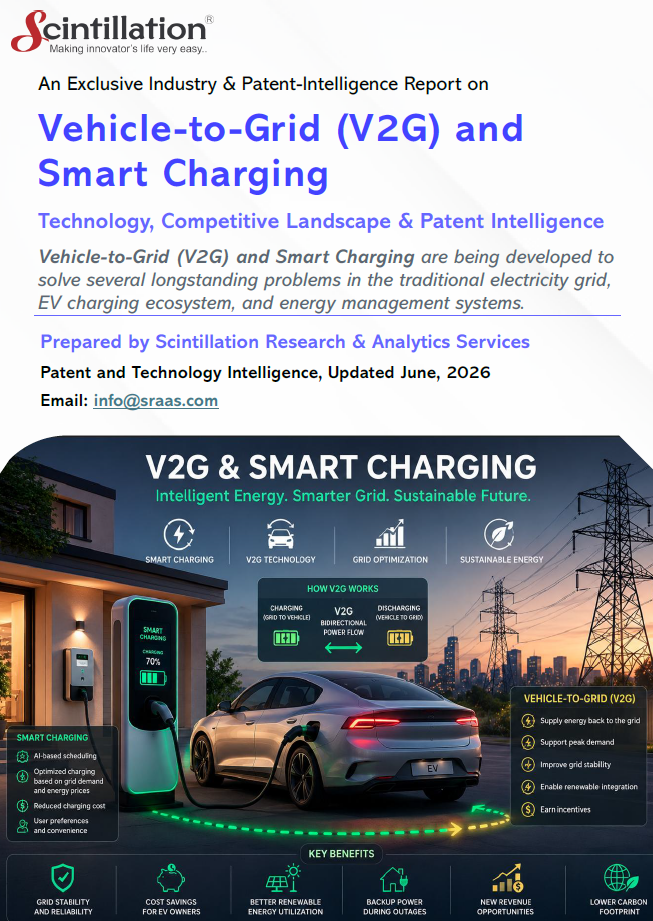
Smart Charging refers to the intelligent management of EV charging processes based on electricity demand, grid conditions, renewable energy availability, electricity pricing, and user preferences. By optimising charging schedules, Smart Charging helps reduce peak load demand, improve grid efficiency, lower charging costs, and maximise the utilisation of renewable energy sources — transforming a grid burden into a grid management tool.

Vehicle-to-Grid technology extends Smart Charging by enabling bidirectional energy flow between electric vehicles and the power grid. In addition to consuming electricity for charging, EVs equipped with V2G functionality can store energy and supply it back to the grid when needed — transforming electric vehicles into distributed energy storage resources capable of supporting grid operations, balancing supply and demand, and enhancing overall energy system flexibility.

As a result, V2G and Smart Charging are increasingly recognised as key enabling technologies for the future intelligent energy ecosystem — supporting the development of sustainable, connected, and energy-efficient transportation and energy networks. This report examines the technology, patent landscape, competitive ecosystem, regulatory landscape, and strategic implications of V2G and Smart Charging for the energy, automotive, and infrastructure sectors.

Report structure

Table of contents

Ten chapters connecting V2G and Smart Charging technology foundations to patent landscape intelligence and commercialisation strategy. Click any chapter to expand.

Condensed findings on V2G and Smart Charging technology, top patent assignees, filing trends, competitive dynamics, and strategic implications for the EV, utility, and energy management sectors
Who Will Benefit from This Report — EV charging infrastructure developers, utility grid strategists, automotive OEM technology teams, IP counsel, energy storage investors, fleet operators, and policymakers shaping EV and grid integration frameworks
3.1 Challenges in Traditional V2G and Smart Charging — uncontrolled charging peak loads, grid infrastructure strain, interoperability and standards fragmentation, battery degradation from bidirectional cycling, regulatory and utility market access barriers, and consumer adoption friction
Structural components — bidirectional on-board chargers, AC/DC power conversion units, EV communication controllers, EVSE hardware, aggregation platforms, grid communication interfaces, and energy management software
4.1 Key Features — bidirectional power flow, dynamic load management, real-time grid signal response, renewable energy time-shifting, V2H and V2B capability, price-responsive charging, and fleet aggregation for grid services
4.2 Problems Addressed — grid congestion, peak demand surges, renewable energy curtailment, distributed storage scarcity, uncoordinated charging load growth, and EV charging cost inefficiency for consumers and fleet operators
4.3 Potential Applications — residential V2H and community microgrids, commercial building energy management, fleet depot smart charging, utility demand response programs, ancillary grid services, and renewable energy firming
V2G and Smart Charging commercialisation roadmap, OEM V2G rollout timelines, utility program development, regulatory evolution across key markets, standard protocol adoption (ISO 15118, OCPP, OpenADR), and near-term market opportunity across fleet and residential segments
6.1 Methodology & Scope — patent database coverage, search strategy, classification framework, and analytical approach for V2G, bidirectional charging, smart charging, and grid-interactive EV system IP
6.2 Who Is Filing — leading assignees across automotive OEMs, charging infrastructure providers, utilities and grid operators, power electronics companies, energy management software vendors, and research institutions
6.3 Filing Activity Over Time — trend analysis identifying R&D acceleration points, EV adoption-driven filing surges, and IP maturity signals across V2G and smart charging technology domains
6.4 Jurisdiction Coverage — USPTO, CNIPA, EPO, KIPO, JPO, WIPO, and national office distributions reflecting key EV and V2G deployment markets and protection strategies
6.5 Technology Segmentation — patents mapped to bidirectional power electronics, charge scheduling algorithms, grid communication protocols, battery state estimation, aggregation platforms, demand response systems, and V2H/V2B architectures
6.6 Whitespace & Strategic Opportunities — underprotected technology domains and emerging filing, licensing, and partnership opportunities across the V2G and Smart Charging IP ecosystem
Stakeholder-specific takeaways for automotive OEM technology teams, EVSE hardware developers, utility grid strategists, fleet operators, IP counsel, energy storage investors, and policy professionals shaping V2G regulatory frameworks
Synthesis of V2G and Smart Charging technology trajectory, IP landscape dynamics, and strategic implications for the future intelligent energy ecosystem, sustainable mobility, and grid flexibility infrastructure
Publisher profile, research methodology, and service overview — patent analytics, technology scouting, competitive intelligence, and strategic research across energy, mobility, and grid technology domains
Full legal disclaimer covering information accuracy, IP ownership, and terms of use for this intelligence report
Inside the Technology

Structural components & key features

V2G and Smart Charging systems integrate power electronics, communication protocols, energy management software, and grid services interfaces to transform passive EV charging points into active, grid-responsive distributed energy resources capable of providing value in both directions of the electricity network.

Bidirectional on-board charger (OBC)
Power electronics hardware integrated into the EV that enables both AC charging from the grid and discharge back to the grid or building — the core hardware enabler of V2G that must manage high-frequency AC/DC conversion in both directions with high efficiency and low harmonic distortion.
EV supply equipment (EVSE) & DC fast charging
The physical charging station hardware — from AC Level 2 home chargers to DC fast-charging units — that communicates with the vehicle, the energy management system, and the grid operator to coordinate smart and bidirectional charging sessions in real time.
Smart charge scheduling algorithms
Software algorithms that optimise EV charging start time, rate, and duration based on grid signals, electricity tariffs, renewable energy availability, user departure requirements, and battery state of health — shifting load away from peaks and toward periods of high renewable generation without compromising driver range.
Grid communication protocols
Standardised communication interfaces — including ISO 15118 (Plug & Charge and V2G communication), OCPP (Open Charge Point Protocol), OpenADR, and IEEE 2030.5 — that enable interoperable, vendor-neutral exchange of energy and grid signals between vehicles, chargers, aggregators, and utility systems.
Aggregation & virtual power plant platforms
Software platforms that aggregate the charge and discharge capacity of multiple EVs into a coordinated distributed energy resource — enabling fleet operators and utilities to participate in wholesale electricity markets, frequency regulation, demand response programs, and capacity market auctions with pooled EV battery storage.
Vehicle-to-Home (V2H) & Vehicle-to-Building (V2B)
Bidirectional energy flow from the EV battery to power a home or commercial building — enabling EVs to serve as backup power during outages, reduce peak demand charges for commercial buildings, and self-consume solar generation rather than exporting it to the grid at low export tariff rates.
Battery state estimation & health management
Advanced battery management system (BMS) algorithms that accurately estimate state of charge (SOC), state of health (SOH), and remaining useful life — enabling smart charging systems to optimise charge profiles, avoid harmful cycling patterns, and preserve battery longevity while maximising the energy services provided to the grid.
Demand response & grid ancillary services
Integration with utility demand response programs and wholesale electricity market ancillary services — including frequency regulation, spinning reserve, voltage support, and peak shaving — that monetise aggregated EV battery capacity as a grid flexibility resource and create revenue streams for EV owners and fleet operators.
Challenges addressed

Why traditional grid and charging approaches cannot accommodate the scale of EV adoption

V2G and Smart Charging technologies directly target five structural problems that unmanaged EV charging creates for electricity grids, energy systems, and consumers — and that conventional grid infrastructure alone cannot resolve at the scale and speed of EV adoption now underway.
01
Grid congestion and peak demand amplification
Unmanaged EV charging at residential and commercial locations coincides with existing evening demand peaks — amplifying peak loads on distribution transformers and feeders that were sized for pre-EV load profiles. Smart charging shifts EV load to off-peak periods through dynamic scheduling, price signals, and direct utility control, reducing peak demand growth without requiring costly grid infrastructure reinforcement on accelerated timelines
Grid Peak
02
Renewable energy curtailment and integration
Solar and wind generation frequently exceeds grid demand during midday and overnight periods — leading to curtailment where clean energy is wasted rather than stored. Smart charging and V2G enable EVs to absorb renewable energy when it is abundant and cheap, and return it to the grid when generation falls and demand rises — acting as a flexible distributed storage buffer that improves renewable energy utilisation without requiring dedicated stationary battery storage investments
Renewables
03
Distributed energy storage scarcity
Grid-scale battery storage remains expensive relative to the storage capacity embedded in the global EV fleet — which collectively represents tens of gigawatt-hours of battery capacity parked and connected to the grid for the majority of each day. V2G unlocks this latent distributed storage resource for grid services without the capital cost of dedicated stationary storage, providing frequency regulation, peak shaving, and backup capacity at marginal cost
Storage
04
Charging cost and electricity price volatility
Time-of-use and real-time electricity tariffs create significant variation in the cost of EV charging throughout the day — costs that unmanaged charging ignores entirely. Smart charging algorithms that respond to dynamic tariff signals allow EV owners and fleet operators to minimise charging costs by shifting consumption to low-price periods, while V2G enables revenue generation by discharging during high-price periods — improving the total cost of ownership economics of electric vehicles
Cost
05
Interoperability and standards fragmentation
The V2G and Smart Charging ecosystem spans EV manufacturers, EVSE hardware vendors, energy management software platforms, aggregators, and utilities — each with proprietary communication and control interfaces that prevent seamless interoperability. Standardised communication protocols (ISO 15118, OCPP, OpenADR) and open platform architectures are essential to enabling vendor-neutral smart charging and V2G services that work across any vehicle, any charger, and any grid operator
Interop

Download Your Sample Report Now:

    Application areas

    Where V2G and Smart Charging create critical energy system value

    V2G and Smart Charging deliver the greatest impact in settings where EV charging loads are largest, grid flexibility is most valuable, and the opportunity to monetise battery storage capacity is highest — spanning residential, commercial, fleet, and utility contexts.

    Residential V2H & Home Energy Management
    Home charging systems that coordinate EV charging with rooftop solar, home battery storage, and dynamic tariffs — and provide backup power to the household during grid outages via V2H discharge
    Commercial Fleet Depot Charging
    Smart charging management for delivery, logistics, and transit fleets at depot locations — optimising charge scheduling across hundreds of vehicles to minimise demand charges, peak load fees, and grid impact while ensuring vehicle availability for daily operations
    Utility Demand Response Programs
    Aggregated EV charging flexibility enrolled in utility demand response programs — providing direct load control or price-responsive load shifting that reduces peak demand on distribution networks without conventional peaker plant generation
    Grid Ancillary Services
    Aggregated V2G capacity participating in wholesale electricity market ancillary services — frequency regulation, spinning reserve, voltage support, and capacity markets — generating revenue from EV battery assets during parked hours
    Commercial Building Energy Management
    V2B-enabled commercial parking facilities where EV batteries offset building peak demand charges, support on-site solar self-consumption, and provide backup power during supply disruptions within integrated building energy management systems
    Renewable Energy Firming
    Smart charging and V2G dispatch coordinated with wind and solar generation forecasts — absorbing excess renewable energy during generation peaks and returning it during generation troughs to reduce renewable curtailment and smooth grid supply variability
    Community & Microgrid Integration
    V2G-enabled EVs serving as mobile storage assets within local microgrids and community energy systems — providing resilience, peak management, and renewable firming in island-mode operation or grid-connected community energy platforms
    Public Charging Infrastructure
    Smart-managed public and semi-public charging networks at workplaces, retail locations, and transit hubs — coordinating charging loads across multiple vehicles and grid connection points to optimise utilisation, revenue, and grid impact at the network level
    Patent intelligence

    The V2G and Smart Charging patent landscape — a 9-part analysis

    The patent landscape chapter delivers data-grounded IP intelligence — from methodology and assignee profiling to filing trends, jurisdiction mapping, technology segmentation, and whitespace identification across the full V2G and Smart Charging ecosystem.

    Assignee & filing intelligence
    • Methodology and scope — patent database coverage, search strategy, and classification framework for V2G, bidirectional charging, smart charge management, and grid-interactive EV system IP
    • Who is filing — leading assignees across automotive OEMs, EVSE hardware providers, utilities and grid operators, power electronics companies, energy management software vendors, and research institutions
    • Filing activity over time — trend analysis identifying R&D acceleration points, EV adoption-driven filing surges, and IP maturity signals across V2G and smart charging technology domains
    • Jurisdiction coverage — USPTO, CNIPA, EPO, KIPO, JPO, and WIPO distributions reflecting key EV deployment markets and protection strategies
    Technology & strategic analysis
    • Technology segmentation — bidirectional power electronics, charge scheduling algorithms, grid communication protocols, battery state estimation, aggregation platforms, demand response integration, and V2H/V2B architectures
    • Whitespace & strategic opportunities — underprotected technology domains and emerging filing, licensing, and partnership opportunities across the V2G and Smart Charging IP ecosystem
    • What this means for you — stakeholder-specific takeaways for OEM technology teams, EVSE developers, utilities, fleet operators, IP counsel, and energy investors across the V2G value chain
    • Future commercialisation outlook — regulatory evolution, standard protocol adoption, OEM V2G rollout timelines, and market development across residential, fleet, and utility segments
    Who will benefit

    Who should read this report

    EV & Charging Hardware Engineers
    Technical teams designing bidirectional on-board chargers, EVSE hardware, power conversion units, vehicle communication controllers, and battery management systems for next-generation V2G-capable electric vehicles and charging infrastructure.
    IP Counsel & Patent Teams
    Attorneys and patent professionals assessing V2G and Smart Charging portfolio positioning, whitespace, freedom-to-operate, and filing strategy across bidirectional power electronics, charge scheduling, grid communication, and aggregation platform technology domains.
    Automotive OEM Technology Teams
    EV product and technology teams at automotive manufacturers evaluating V2G capability roadmaps, OBC hardware specifications, communication protocol compatibility, and competitive IP positioning for next-generation grid-interactive EV platforms.
    Utility & Grid Strategy Professionals
    Grid planners, demand response program managers, and energy market strategists at utilities and grid operators evaluating V2G fleet aggregation potential, smart charging program design, and the regulatory and technology frameworks needed to capture EV flexibility at scale.
    Energy & Mobility Investors
    Investment professionals tracking the V2G and Smart Charging ecosystem — mapping IP landscapes, competitive dynamics, and emerging companies across EVSE hardware, aggregation software, fleet energy management, and grid services platforms.
    Fleet Operators & R&D Strategists
    Commercial fleet operators evaluating smart depot charging and V2G revenue opportunities, and researchers mapping the competitive V2G landscape — identifying collaboration opportunities, emerging technology directions, and IP context for novel grid-interactive EV research programs.
    Technology & Patent Intelligence · Scintillation Research

    Understand who is building the IP foundation for the grid-interactive EV ecosystem

    Get the complete technology and patent intelligence report on Vehicle-to-Grid and Smart Charging — from bidirectional power electronics and charge scheduling algorithms to the patent landscape revealing who is filing, where innovation is concentrated, and why V2G and Smart Charging are becoming critical infrastructure for the intelligent energy ecosystem.

    Scintillation Research · V2G & Smart Charging · Energy & Mobility · Patent Intelligence Series

    For a quick demo, schedule a meeting now!

    Service Demo Booking
    About

    About Scintillation Research

    Scintillation Research & Analytics Services is a specialized intellectual property and technology intelligence firm delivering patent analytics, technology scouting, competitive intelligence, and strategic research services.

    Through comprehensive patent and technology intelligence reports, we help organizations understand emerging innovations, identify market opportunities, monitor competitors, and make data-driven decisions across rapidly evolving technology domains. Our reports are designed for professionals at the intersection of technology strategy, IP management, and competitive intelligence.

    Shopping Cart (0 items)

    Subscribe to our newsletter

    Sign up to receive latest news, updates, promotions, and special offers delivered directly to your inbox.
    No, thanks
    Select your currency