
From Seeing and Reading to Doing: How Vision-Language-Action Models Are Giving AI a Physical Presence
A data-grounded look at who is innovating, where IP activity is concentrated, and what it means for research, commercialization, and IP strategy.
Report details
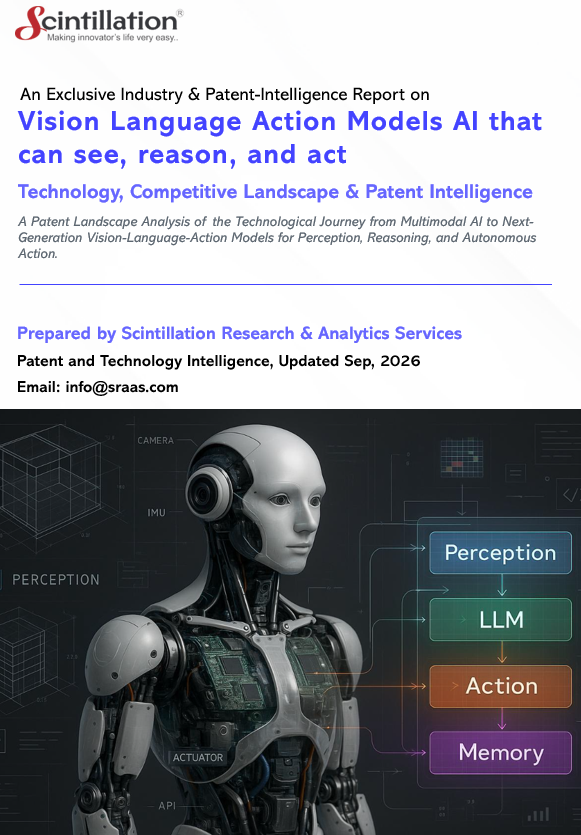
Vision-Language-Action (VLA) Models — Patent & Innovation Landscape Analysis Report
A next-generation AI technology that connects perception, language, and action
This report explores the emergence of Vision-Language-Action (VLA) Models as a next-generation artificial intelligence technology for enabling machines to perceive their surroundings, understand natural-language instructions, reason about tasks, plan actions, and interact with the physical world. It examines the technology's foundations, evolving applications, innovation landscape, and intellectual-property activity, providing insights into who is developing these technologies, where innovation is concentrated, and what these trends mean for future research, commercialization, and IP strategy.
The report covers key VLA technologies, including multimodal perception, vision-language understanding, visual and spatial grounding, multimodal reasoning, action generation, embodied intelligence, robotic control, task planning, imitation learning, reinforcement learning, simulation, and autonomous physical interaction. It also examines leading innovators, patent-filing trends, technology evolution, application areas, competitive dynamics, whitespace opportunities, and the future outlook for AI systems capable of connecting visual perception and language understanding with autonomous physical action.
Built for everyone shaping embodied and physical AI
Each audience gets a clear view of the landscape and what to do with it.
From models that describe the world to models that act in it
Conventional AI systems have tended to specialize: vision models recognize images, language models process text, and robot controllers follow hand-engineered rules for narrow, predefined tasks. Vision-Language-Action models bring these capabilities together in a single system that sees a scene, interprets an instruction expressed in natural language, reasons about what to do, and produces actions a machine can carry out. The approach is powerful but not without limits: it depends on large and varied training data, models that generalize to unfamiliar environments and objects, reliable real-time performance on physical hardware, and the ability to act safely around people and property.
Table of contents
Twelve chapters, from Vision-Language-Action model fundamentals to patent landscape intelligence. Click any chapter to expand.
Core capabilities of Vision-Language-Action models
The building blocks that connect what a machine sees and is told to what it does.
Why conventional AI falls short in the physical world, and what stays hard
What Vision-Language-Action models aim to address, and where the limits are.
Where Vision-Language-Action models create value
Domains where machines that understand instructions and act on them offer a competitive edge.
Who is filing, where, and in which areas
The study covers methodology and scope, strategic insights, the assignee picture, filing activity over time, jurisdiction coverage, technology segmentation across multimodal perception, grounding, reasoning and planning, action generation, and robotic control, representative publications, and the whitespace and strategic opportunities for new filings and licensing.
Request Your Sample Report Now!
