What Makes 10,000-Cycle Sodium-Ion Batteries a Breakthrough in Durable Energy Storage?

  • Home
  • What Makes 10,000-Cycle Sodium-Ion Batteries a Breakthrough in Durable Energy Storage?
10,000-Cycle Sodium-Ion Battery — Patent Intelligence Report | Scintillation Research
Patent Intelligence Report  ·  Energy Storage Technology Series

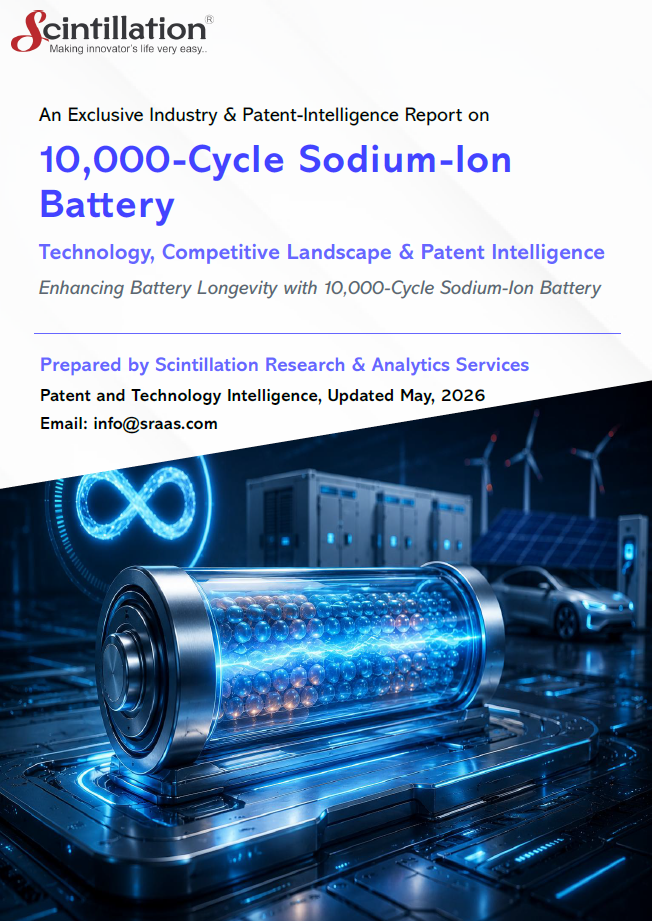
10,000-Cycle Sodium-Ion Battery
Technology & Patent Intelligence

A comprehensive analysis of the materials science, cell engineering, and IP landscape enabling ultra-long-cycle sodium-ion battery performance — covering hard carbon anodes, cathode stabilization, electrolyte chemistry, and the emerging patent ecosystem shaping the future of sustainable energy storage.

10,000Cycle life target
27+ yrsService life at 1 cycle/day
NaEarth-abundant & low-cost
LFP+Competitive energy density

Report details

10,000-Cycle Sodium-Ion Battery — Technology & Patent Intelligence

Publisher Scintillation Research
Technology focus 10,000-Cycle SIB Platform
Chemistry Sodium-ion (Na-ion)
Key materials Hard carbon, layered oxide, PBA
IP coverage Patent landscape + whitespace
Applications Grid storage, EV, industrial UPS
Audience IP, R&D, Strategy, Investment
10,000 Cycle life
27+ Years service life
6th Sodium abundance rank
IP 7-part patent analysis
360° Ecosystem coverage
Introduction

Why 10,000 cycles changes the economics of energy storage

The global energy storage industry is undergoing an unprecedented transformation, propelled by the accelerating deployment of renewable energy infrastructure, the electrification of transportation, and the digitalization of industrial power systems.

As grid operators, vehicle manufacturers, and commercial energy users demand batteries with longer operational lifetimes, lower cost per kilowatt-hour of delivered energy, and greater material security, conventional lithium-ion battery technology increasingly reveals its structural constraints. Sodium-ion battery technology has emerged as the most commercially credible alternative to lithium-ion chemistry for cost-sensitive, longevity-critical applications. Sodium is the sixth most abundant element in the Earth's crust, is geographically distributed without the geopolitical concentration risks of lithium or cobalt, and supports an electrochemical intercalation mechanism that closely parallels that of lithium-ion cells.

The critical remaining barrier to mass adoption of sodium-ion batteries had been cycle life. Early-generation SIB cells demonstrated energy densities approaching lithium iron phosphate (LFP) levels but suffered from accelerated capacity fade under repetitive cycling, limiting practical lifetime to 1,000–3,000 cycles — insufficient for demanding grid storage or long-service EV applications. The emergence of 10,000-cycle SIB platforms fundamentally changes this calculus, delivering a cell chemistry that combines low-cost Earth-abundant materials with a service lifetime exceeding 27 years at one full cycle per day.

This report provides a comprehensive analysis of the materials science, cell engineering, and systems-level innovations enabling 10,000-cycle sodium-ion battery performance — covering hard carbon anode microstructure, layered-oxide and Prussian blue analogue cathode stabilization, electrolyte additive chemistry, solid electrolyte interphase engineering, formation protocol optimization, and sodium-specific battery management algorithms. The study also highlights the rapidly evolving patent landscape and identifies major innovators driving developments across anode carbon engineering, cathode lattice stabilization, and full-cell integration architectures.

Report structure

Table of contents

Ten chapters covering the materials science, patent landscape, and commercialization strategy of 10,000-cycle sodium-ion battery technology. Click any chapter to expand its sections.

Condensed findings on 10,000-cycle SIB technology, key patent holders, filing trends, and strategic implications for the energy storage ecosystem
2.1 Who Will Benefit from This Report — battery engineers, IP counsel, energy storage investors, grid operators, EV strategists, and materials researchers
3.1 Challenges in Conventional Battery Technologies — limited lifespan, high raw material costs, geopolitical supply risks, safety concerns, and sustainability issues in Li-ion systems
4.1 Key Features — hard carbon anode microstructure, layered-oxide and PBA cathode stabilization, electrolyte additive chemistry, SEI engineering, formation protocols, sodium-specific BMS
4.2 Problems Addressed — capacity fade, structural degradation, electrolyte decomposition, anode volume expansion, and thermal instability under high-cycle operation
4.3 Potential Applications — stationary grid storage, low-cost EV propulsion, industrial UPS, telecom backup power, and renewable energy integration
Technology readiness levels, production scale-up timelines, cost per kWh trajectory, competitive positioning vs LFP, and market entry strategies across verticals
6.1 Methodology & Scope — patent database coverage, search strategy, classification framework, and analytical approach for SIB high-cycle technology
6.2 Who Is Filing — leading assignees across battery OEMs, materials suppliers, university research programs, national labs, and emerging SIB startups
6.3 Filing Activity Over Time — trend analysis identifying R&D acceleration and IP maturity signals in high-cycle SIB technology
6.4 Jurisdiction Coverage — CNIPA, USPTO, EPO, KIPO, WIPO, and regional patent office distributions across the sodium-ion IP landscape
6.5 Technology Segmentation — how patents map to anode carbon engineering, cathode lattice stabilization, electrolyte chemistry, SEI design, BMS algorithms, and cell integration
6.6 Legal Status Snapshot — granted, pending, expired, and lapsed portfolio breakdown by technology domain and assignee
6.7 Whitespace & Strategic Opportunities — unprotected technology domains representing filing and competitive positioning opportunities in high-cycle SIB IP
Stakeholder-specific takeaways for battery engineers, IP counsel, grid storage operators, EV manufacturers, materials investors, and energy policy professionals
Synthesis of 10,000-cycle SIB's technical trajectory, IP landscape dynamics, and strategic implications for the global energy storage industry
Publisher profile, research methodology, and service overview — patent analytics, technology scouting, competitive intelligence, and strategic research
Full legal disclaimer covering information accuracy, IP ownership, and terms of use for this intelligence report
Technology Design

Key features & technical innovations

Achieving 10,000 cycles requires innovations across every layer of the cell — from hard carbon anode microstructure and cathode lattice engineering to electrolyte chemistry, SEI formation, and sodium-specific BMS algorithms.

Hard carbon anode microstructure
Engineered pore structure and interlayer spacing in hard carbon anodes optimized for sodium-ion intercalation kinetics and long-cycle structural stability.
Layered-oxide cathode stabilization
Transition metal doping and surface coating strategies that suppress phase transitions and sodium ordering in layered-oxide cathodes under deep cycling conditions.
Prussian blue analogue (PBA) cathodes
Open-framework PBA cathode materials with low synthesis cost, high sodium-ion mobility, and structural resilience enabling superior long-cycle electrochemical performance.
Electrolyte additive chemistry
Sodium-specific electrolyte formulations with targeted additives that form protective interphases, suppress decomposition, and extend electrolyte stability across 10,000 cycles.
Solid electrolyte interphase (SEI) engineering
Controlled SEI formation protocols that produce thin, stable, ionically conductive interphases on hard carbon anodes — the primary enabler of ultra-long cycle life in SIB cells.
Formation protocol optimization
Precisely controlled initial charge-discharge protocols that establish optimal SEI morphology and pre-condition electrodes for maximum cycle life and coulombic efficiency.
Sodium-specific BMS algorithms
Battery management systems calibrated for sodium-ion voltage profiles, state-of-charge estimation, and thermal management — maximizing usable cycle life in real-world deployment.
Li-ion manufacturing compatibility
SIB cell design leveraging existing lithium-ion production infrastructure, equipment, and process knowledge — enabling faster, lower-risk scale-up to commercial volumes.
Challenges addressed

Limitations of conventional battery technologies

The 10,000-cycle SIB platform directly targets five structural limitations that constrain both conventional lithium-ion systems and earlier-generation sodium-ion cells.
01
Limited cycle lifespan
Early sodium-ion cells achieved only 1,000–3,000 cycles before significant capacity fade — inadequate for grid storage or long-service EV applications requiring 10+ year operational lifetimes
Cycle life
02
High raw material costs & supply risk
Lithium, cobalt, and nickel face geopolitical concentration risk and price volatility. Sodium's sixth-place crustal abundance and broad geographic distribution eliminate these structural cost and supply vulnerabilities
Materials
03
Safety concerns in high-energy-density cells
Lithium-ion thermal runaway risk constrains deployment in space-constrained or unmonitored applications. SIB chemistry's inherently lower reactivity and stable cathode materials improve intrinsic cell safety
Safety
04
Capacity fade under repetitive deep cycling
Structural degradation of cathode lattices, SEI growth on anodes, and electrolyte depletion cause progressive capacity loss. 10,000-cycle SIB innovations address each failure mechanism independently
Degradation
05
Sustainability & end-of-life recyclability
Cobalt and nickel recovery from spent Li-ion cells is economically marginal and environmentally complex. SIB's Earth-abundant cathode materials simplify end-of-life processing and improve sustainability metrics
Sustainability

Download Your Sample Report Now:

    Application areas

    Target deployment verticals

    The 10,000-cycle SIB platform's combination of ultra-long service life, low material cost, and safety profile unlocks deployment in applications where lithium-ion economics or supply risk are prohibitive.

    Stationary Grid Storage
    Utility-scale and behind-the-meter storage for renewable energy integration and grid stabilization
    Low-Cost Electric Vehicles
    Entry-level EVs, commercial fleets, and two/three-wheelers requiring affordable long-life propulsion
    Industrial UPS Systems
    Uninterruptible power supply for factories, data centers, and critical infrastructure
    Telecom Backup Power
    Base station and tower backup replacing lead-acid in high-cycling, low-maintenance deployments
    Renewable Energy Integration
    Solar and wind farm storage requiring daily cycling over multi-decade project lifetimes
    Microgrid & Off-Grid Systems
    Remote community and island power systems requiring low-cost, long-life storage without supply chain dependencies
    Commercial & Industrial Energy
    Peak demand management, demand response, and energy arbitrage for industrial and commercial users
    Emerging Market Electrification
    Cost-accessible energy storage for markets where lithium-ion price points limit deployment at scale
    Patent intelligence

    The 10,000-cycle SIB patent landscape — a 7-part analysis

    The patent landscape chapter delivers actionable IP intelligence — from filing trends and assignee benchmarking to technology segmentation and whitespace identification across the high-cycle sodium-ion ecosystem.

    Filing & assignee intelligence
    • Methodology and scope defining the patent search universe for high-cycle sodium-ion battery technology
    • Who is filing — battery OEMs, materials suppliers, university programs, national labs, and SIB startups
    • Filing activity over time — trend analysis identifying R&D acceleration and IP maturity signals
    • Jurisdiction coverage — CNIPA, USPTO, EPO, KIPO, WIPO, and regional patent office distributions
    Technology & strategic analysis
    • Technology segmentation — anode carbon engineering, cathode lattice stabilization, electrolyte chemistry, SEI design, BMS, and cell integration
    • Legal status snapshot — granted, pending, expired, and lapsed portfolio breakdown by domain
    • Whitespace & strategic opportunities — unprotected technology areas and emerging filing opportunities in high-cycle SIB IP
    • Innovation trends and IP positioning insights for licensing strategy and long-term R&D investment
    Who will benefit

    Who should read this report

    Battery Engineers & Materials Scientists
    Technical teams working on hard carbon anodes, cathode stabilization, electrolyte formulation, SEI engineering, and full-cell integration for long-cycle SIB systems.
    IP Counsel & Patent Teams
    Attorneys and patent professionals assessing SIB portfolio positioning, whitespace identification, freedom-to-operate, and filing strategy in high-cycle battery technology.
    Energy Storage Investors
    Investment professionals tracking the SIB ecosystem, competitive dynamics, and emerging IP positions across battery OEMs, materials suppliers, and technology startups.
    Grid Operators & Utilities
    Energy professionals evaluating 10,000-cycle SIB technology for grid storage procurement, long-term project economics, and supply chain diversification from lithium-ion.
    EV & Mobility Strategists
    Vehicle manufacturers and fleet operators assessing SIB technology for cost-sensitive EV applications, commercial fleet electrification, and emerging market mobility platforms.
    R&D Strategists & Industry Analysts
    Researchers and consultants mapping the competitive SIB landscape across cell manufacturers, cathode and anode material suppliers, electrolyte developers, and BMS providers.
    Technology & Patent Intelligence · Scintillation Research

    Understand the IP landscape shaping the future of energy storage

    Get the complete technology and patent intelligence report on 10,000-cycle sodium-ion battery technology — from materials science and cell engineering to the patent landscape defining the next generation of sustainable energy storage.

    Scintillation Research · 10,000-Cycle Sodium-Ion Battery · Patent Intelligence Series

    For a quick demo, schedule a meeting now!

    Service Demo Booking
    About

    About Scintillation Research

    Scintillation Research & Analytics Services is a specialized intellectual property and technology intelligence firm delivering patent analytics, technology scouting, competitive intelligence, and strategic research services.

    Through comprehensive patent and technology intelligence reports, we help organizations understand emerging innovations, identify market opportunities, monitor competitors, and make data-driven decisions across rapidly evolving technology domains. Our reports are designed for professionals at the intersection of technology strategy, IP management, and competitive intelligence.

    Shopping Cart (0 items)

    Subscribe to our newsletter

    Sign up to receive latest news, updates, promotions, and special offers delivered directly to your inbox.
    No, thanks
    Select your currency