Can Metasurface Waveguides Overcome the Brightness and Efficiency Limitations in Full-Colour 3D AR Displays?

  • Home
  • Can Metasurface Waveguides Overcome the Brightness and Efficiency Limitations in Full-Colour 3D AR Displays?
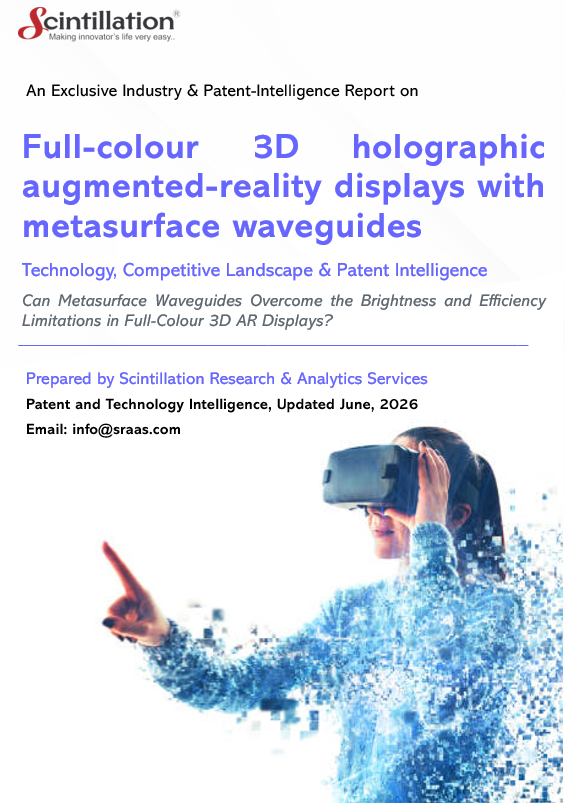
Full-Colour 3D Holographic AR Displays with Metasurface Waveguides: Overcoming Brightness and Efficiency Limitations | Scintillation Research
Patent Intelligence Report  ·  Spatial Computing & Optics Series

Can Metasurface Waveguides Overcome the Brightness and Efficiency Limitations in Full-Colour 3D AR Displays?

A data-grounded look at who is filing, where innovation is concentrated, and why metasurface waveguides are becoming strategically critical for next-generation full-colour 3D holographic augmented-reality displays.

A comprehensive technology and patent intelligence analysis of full-colour 3D holographic augmented-reality displays enabled by metasurface waveguides — examining nanophotonic metasurface optics, computer-generated holography, AI-driven image generation, dispersion compensation, light-coupling efficiency, waveguide architectures, and compact optoelectronic systems enabling next-generation wearable AR and spatial computing platforms.

MetasurfaceNanophotonic waveguide optics
HolographyComputer-generated 3D wavefronts
Full-colourRGB dispersion compensation
PatentLandscape & whitespace analysis

Report details

Full-Colour 3D Holographic AR Displays with Metasurface Waveguides — Technology & Patent Intelligence Report

Publisher Scintillation Research
Technology Metasurface Waveguides
Focus area Holographic AR & Spatial Computing
Key segments Metasurfaces, Holography, AI Image Gen
IP coverage Patent landscape study
Applications Wearables, Industrial, Healthcare, Training
Audience Optics, IP, Strategy, Investment
AR Augmented reality optics
3D Holographic wavefront display
RGB Full-colour reproduction
IP Patent landscape study
nm Subwavelength metasurface scale
Introduction

When conventional waveguide optics can no longer meet the brightness and efficiency demands of full-colour 3D AR

Augmented Reality is one of the latest developments in spatial computing, and as such, AR has become an incredibly important aspect of how we will interact with and combine digital information with the physical environment around us. From the entertainment industry to healthcare, education, communication, and industrial training, AR has the potential to transform how we communicate with and experience the world around us by projecting virtual information on top of our actual physical environment.

Although there have been many advancements made toward creating modalities for AR to display the information being interacted with, there are still many barriers to the widespread adoption of AR that include the need for smaller and better depth perception of physical and virtual objects, and, to date, the limitations of existing AR displays in terms of the ability to create high-quality full-colour images.

Traditional augmented reality displays use a lot of large optical components and conventional waveguide architectures, which create a small field of view, low optical efficiency, and difficulties in recreating 3D depth cues precisely. In addition, achieving full colour is challenging due to chromatic aberration (wavelength-dependent dispersion) and reduced overall image quality.

New advances are being made to address these challenges, including recent efforts to combine nanophotonic metasurfaces with holographic displays. Metasurfaces are composed of subwavelength-scale structures that create waveguide-like properties, enabling high-precision control of light in a flat, compact manner — and can be seen as a viable alternative to conventional optics. By using holography techniques to generate images, specifically computer-generated and AI-driven computer-generated holography, the combination of the two methods allows realistic 3D wavefronts to be reproduced accurately, creating depth perception and an immersive experience.

This report explores this type of display that can enable extremely efficient light coupling, dispersion compensation, and compact optical design that will address many of the limitations of current AR systems. Continued research into and advancement of these technologies will also lead to the creation of difficult-to-manufacture next-generation lightweight and high-performance wearable AR systems and, more broadly, optoelectronic applications.

Report structure

Table of contents

Ten chapters connecting metasurface waveguide AR display fundamentals to patent landscape intelligence and commercialization strategy. Click any chapter to expand.

Condensed findings on metasurface waveguide technology, patent filing trends, assignee dynamics, and strategic implications for full-colour 3D holographic AR display IP
Who Will Benefit from This Report — optics engineers, AR hardware teams, IP counsel, spatial computing strategists, and technology investors tracking next-generation display optics
3.1 Challenges in Conventional AR Display Technologies — bulky optical components, narrow field of view, limited depth perception, chromatic aberration, and full-colour reproduction inefficiency in conventional waveguide architectures
Structural components — subwavelength nanostructure arrays, metasurface coupling gratings, holographic light engines, dispersion-compensating layers, and waveguide substrate architectures
4.1 Key Features — compact flat-optic form factor, high-precision wavefront control, full-colour dispersion compensation, wide field of view, and accurate 3D depth cue reproduction
4.2 Problems Metasurface Waveguides Aim to Solve — low optical efficiency, bulky conventional optics, chromatic aberration, narrow field of view, and depth perception limitations of conventional AR displays
4.3 Potential Applications — wearable AR headsets, entertainment, healthcare, education, communication, and industrial training spatial computing platforms
Metasurface waveguide deployment roadmap, manufacturing scalability challenges, AI-driven holographic rendering maturity, and near-term commercialization opportunities for wearable AR optics
6.1 Methodology & Scope — patent database coverage, search strategy, classification framework, and analytical approach for metasurface waveguide and holographic AR display IP
6.2 Assignee Picture — leading filers across optics specialists, AR hardware makers, and academic research institutions, with notable assignee profiles
6.3 Filing Activity Over Time — trend analysis identifying R&D acceleration and IP maturity signals across metasurface waveguide technology domains
6.4 Jurisdiction Coverage — USPTO, CNIPA, KIPO, JPO, EPO, and WIPO distributions across the metasurface AR display patent landscape
6.5 Technology Segmentation — patents mapped to metasurface optics, holographic light engines, AI-driven image generation, dispersion compensation, and waveguide coupling architectures
6.6 Foundational Anchor Patents — core IP defining the metasurface waveguide AR landscape and their strategic competitive significance
6.7 Whitespace & Strategic Opportunities — underprotected technology domains and emerging filing opportunities across the metasurface AR display IP ecosystem
Stakeholder-specific takeaways for optics engineers, AR hardware designers, IP counsel, spatial computing strategists, and technology investors
Synthesis of metasurface waveguide technology's trajectory, IP landscape dynamics, and strategic implications for next-generation full-colour 3D AR display commercialization
Publisher profile, research methodology, and service overview — patent analytics, technology scouting, competitive intelligence, and strategic research across optics and spatial computing domains
Full legal disclaimer covering information accuracy, IP ownership, and terms of use for this intelligence report
Inside Metasurface Waveguide AR Displays

Structural components & key features

Metasurface waveguides replace bulky refractive and diffractive optical stacks with flat, subwavelength-structured surfaces — enabling significantly higher light-coupling efficiency, finer wavefront control, and a dramatically more compact form factor for full-colour 3D holographic AR displays.

Subwavelength metasurface arrays
Nanostructured arrays of subwavelength-scale elements engineered to manipulate the phase, amplitude, and polarization of light — forming the flat, waveguide-like optical layer at the core of the display architecture.
Holographic light engines
Computer-generated holography modules that compute and project interference patterns to reconstruct accurate 3D wavefronts — enabling natural depth cues and focus accommodation without conventional stereoscopic optics.
AI-driven image generation
Machine-learning models that compute holographic patterns and compensate for optical aberrations in real time — reducing the computational burden of full-colour 3D hologram synthesis for wearable, power-constrained devices.
Dispersion compensation
Wavelength-dependent phase correction structures that counteract chromatic aberration across the red, green, and blue channels — a central requirement for achieving accurate full-colour image reproduction in flat-optic waveguides.
High-efficiency light coupling
In-coupling and out-coupling grating structures engineered at the metasurface level to maximize the proportion of source light delivered to the eye box — directly addressing the brightness and power-efficiency limitations of conventional waveguide AR optics.
Wide field-of-view waveguide architecture
Beam-expansion and pupil-replication structures at the metasurface layer that extend the angular range of projected imagery — overcoming the narrow field-of-view constraint typical of conventional diffractive waveguide combiners.
Compact flat-optic form factor
Thin, planar optical stacks that replace stacked refractive lens assemblies — enabling lightweight, low-profile AR eyewear designs suitable for consumer and industrial wearable applications.
Depth-cue & accommodation reproduction
Wavefront shaping techniques that recreate natural focus cues across multiple depth planes — addressing vergence-accommodation conflict and enabling more comfortable, realistic 3D AR viewing experiences.
Challenges addressed

Why conventional AR display optics cannot meet full-colour 3D demands

Metasurface waveguides directly target five structural constraints that prevent conventional refractive and diffractive AR optics from delivering bright, efficient, full-colour 3D holographic imagery in a wearable form factor.

01
Bulky optical components
Conventional AR displays rely on stacked refractive lenses and bulky diffractive combiners to achieve image projection and focus correction, resulting in heavy, thick headsets. Metasurface waveguides replace these stacks with flat, subwavelength-structured layers, enabling dramatically thinner and lighter wearable AR form factors
Form factor
02
Narrow field of view
Diffractive waveguide combiners used in conventional AR optics struggle to expand the projected image across a wide angular range without significant efficiency loss or non-uniformity. Metasurface-based beam expansion and pupil replication structures are engineered to widen the field of view while preserving image quality
Field of view
03
Low optical efficiency & brightness limitations
Conventional waveguide architectures lose a significant proportion of source light through inefficient in-coupling and out-coupling, requiring brighter — and more power-hungry — light sources to compensate. Metasurface coupling structures are designed to maximize the fraction of light delivered to the eye box, directly addressing brightness and power-efficiency constraints
Efficiency
04
Chromatic aberration & full-colour reproduction
Wavelength-dependent dispersion in conventional optics causes red, green, and blue channels to focus and propagate differently, degrading colour accuracy and image sharpness. Metasurface dispersion-compensation layers correct this wavelength-dependent behaviour, enabling accurate full-colour image reproduction in a flat-optic architecture
Colour fidelity
05
Limited 3D depth perception
Conventional AR displays typically rely on stereoscopic image pairs that approximate depth without reproducing true focus cues, contributing to visual discomfort and vergence-accommodation conflict. Computer-generated and AI-driven holography combined with metasurface wavefront shaping reproduces accurate 3D wavefronts, enabling more natural and comfortable depth perception
Depth perception
Application areas

Where metasurface waveguide AR displays create critical impact

The brightness, efficiency, and compactness advantages of metasurface waveguide displays are most compelling in applications where field of view, depth accuracy, and wearable form factor push conventional AR optics beyond their practical limits.

Consumer Wearable AR
Lightweight AR glasses and headsets requiring compact, high-efficiency optics for all-day comfortable wear and full-colour image quality
Entertainment & Media
Immersive 3D content experiences requiring accurate depth reproduction and wide field of view for gaming, live events, and interactive media
Healthcare
Surgical visualization and medical training platforms requiring high-fidelity 3D imagery overlaid precisely onto the physical field of view
Education
Interactive 3D learning environments where accurate spatial visualization improves comprehension of complex concepts and structures
Communication & Collaboration
Spatial computing platforms enabling shared 3D holographic presence for remote collaboration and telepresence applications
Industrial Training
Hands-on technical training environments overlaying step-by-step holographic guidance onto real equipment and workflows
Spatial Computing Platforms
Broader optoelectronic systems building on metasurface and holographic display innovations beyond dedicated AR eyewear
Next-Generation Optoelectronics
Flat-optic and nanophotonic component innovations with applications extending beyond AR into broader compact optical systems
Patent intelligence

The metasurface waveguide AR patent landscape

The patent landscape chapter delivers data-grounded IP intelligence — from methodology and assignee profiling to filing trends, jurisdiction coverage, technology segmentation, anchor patents, and whitespace identification across the full metasurface waveguide AR ecosystem.

Filing & jurisdiction intelligence
  • Methodology and scope defining the boundaries of metasurface waveguide and holographic AR display patent analysis
  • Assignee picture and notable profiles — optics specialists, AR hardware makers, and research institutions shaping the metasurface waveguide IP landscape
  • Filing activity over time — trend analysis identifying R&D acceleration points and IP maturity signals across the technology domain
  • Jurisdiction coverage — USPTO, CNIPA, KIPO, JPO, EPO, and WIPO distributions across the metasurface AR patent corpus
Technology & strategic analysis
  • Technology segmentation — metasurface optics, holographic light engines, AI-driven image generation, dispersion compensation, and waveguide coupling architectures
  • Foundational anchor patents — core IP defining the metasurface waveguide AR landscape and their strategic competitive significance
  • Whitespace & strategic opportunities — underprotected technology domains and emerging filing and licensing opportunities
  • Strategic implications for freedom-to-operate, partnership, and acquisition decisions across the metasurface AR ecosystem
Download Your Sample Report Now:

    Who will benefit

    Who should read this report

    Optics & Photonics Engineers
    Technical teams designing metasurface nanostructures, holographic light engines, dispersion-compensation layers, and waveguide coupling architectures for next-generation AR displays.
    AR Hardware & Spatial Computing Teams
    Hardware design teams evaluating metasurface waveguides for compact, efficient full-colour 3D AR optics — and assessing performance against conventional refractive and diffractive alternatives.
    IP Counsel & Patent Teams
    Attorneys and patent professionals assessing portfolio positioning, whitespace, freedom-to-operate, and filing strategy across metasurface optics, holography, and AI-driven image generation technologies.
    Technology Investors
    Investment professionals tracking the nanophotonics and spatial computing ecosystem, the metasurface waveguide IP landscape, and emerging companies in flat-optic AR display technology.
    Spatial Computing Strategists
    Strategy professionals evaluating metasurface waveguide investment timelines, competitive IP positioning, and market opportunity across wearable AR and broader optoelectronic applications.
    R&D Strategists & Industry Analysts
    Researchers and consultants mapping the competitive metasurface waveguide AR landscape across optics specialists, AR hardware makers, and research institutions driving adoption.
    Technology & Patent Intelligence · Scintillation Research

    Understand who is building the IP foundation for full-colour 3D holographic AR

    Get the complete technology and patent intelligence report on Full-Colour 3D Holographic AR Displays with Metasurface Waveguides — from nanophotonic optics and holographic light engines to the patent landscape revealing who is filing, where innovation is concentrated, and why metasurface waveguides are becoming strategically critical for next-generation wearable AR.

    Scintillation Research · Metasurface Waveguide AR Displays · Patent Intelligence Series

    For a quick demo, schedule a meeting now!

    Service Demo Booking
    About

    About Scintillation Research

    Scintillation Research & Analytics Services is a specialized intellectual property and technology intelligence firm delivering patent analytics, technology scouting, competitive intelligence, and strategic research services.

    Through comprehensive patent and technology intelligence reports, we help organizations understand emerging innovations, identify market opportunities, monitor competitors, and make data-driven decisions across rapidly evolving technology domains. Our reports are designed for professionals at the intersection of technology strategy, IP management, and competitive intelligence.

    Shopping Cart (0 items)

    Subscribe to our newsletter

    Sign up to receive latest news, updates, promotions, and special offers delivered directly to your inbox.
    No, thanks
    Select your currency