Can Solid-State Batteries Achieve Significantly Higher Energy Density Without Compromising Safety?

  • Home
  • Can Solid-State Batteries Achieve Significantly Higher Energy Density Without Compromising Safety?
Solid-State Batteries: Higher Energy Density Without Compromising Safety? | Scintillation Research
Patent Intelligence Report  ·  Next-Generation Energy Storage Series

Can Solid-State Batteries Achieve Significantly Higher Energy Density Without Compromising Safety?

A data-grounded look at who is filing, where next-generation battery innovation is concentrated, and why solid-state battery technology matters now for electric mobility and energy storage.

A comprehensive technology and patent intelligence analysis of Solid-State Battery (SSB) technology — examining solid electrolyte chemistries, lithium-metal anode engineering, cathode materials, interface engineering, cell manufacturing processes, thermal management, and the evolving IP landscape across automotive OEMs, battery manufacturers, materials companies, and research institutions driving next-generation energy storage commercialization.

SolidElectrolyte architecture
Li-MetalHigh-density anode
SafetyNo flammable liquid
9-partPatent landscape analysis

Report details

Solid-State Batteries (SSB) — Technology & Patent Intelligence Report

Publisher Scintillation Research
Technology Solid-State Batteries (SSB)
Focus area Next-Gen Energy Storage
Key segments Solid Electrolyte, Li-Metal, Interface, Cell Mfg
IP coverage 9-part patent landscape
Applications EV, Aerospace, Consumer Electronics, Grid
Audience IP, R&D, Strategy, Investment
SSB Solid-state batteries
2–3× Energy density potential vs Li-ion
Zero Flammable liquid electrolyte
IP 9-part patent analysis
360° Ecosystem coverage
Introduction

When conventional lithium-ion batteries can no longer meet the safety, density, and longevity demands of next-generation electric mobility

Solid-State Battery technology is an advanced energy storage solution widely regarded as one of the most promising successors to conventional lithium-ion batteries. Unlike traditional lithium-ion cells, which utilize a liquid or gel-based electrolyte to transport lithium ions between the anode and cathode, solid-state batteries employ a solid electrolyte — a fundamental architectural change that unlocks significant improvements in performance, safety, energy density, charging speed, and operational lifespan.

The rapid growth of electric vehicles, renewable energy systems, consumer electronics, and advanced transportation technologies has intensified demand for safer, higher-capacity, and more efficient energy storage solutions. While conventional lithium-ion batteries have enabled widespread electrification, they continue to face limitations that constrain the next generation of applications: flammable liquid electrolytes that create thermal runaway risk, limited energy density approaching the practical ceiling of graphite anode chemistry, long charging times, and gradual performance degradation through cycling.

One of the most significant advantages of solid-state batteries is their ability to utilize lithium-metal anodes, which can store substantially more energy than the graphite anodes used in conventional cells. As a result, solid-state batteries have the potential to provide longer driving ranges for electric vehicles, reduce battery pack size and weight, eliminate the flammability risks associated with liquid electrolytes, and enable faster charging through improved electrochemical kinetics. These advantages make the technology particularly attractive for electric mobility, aerospace, consumer electronics, grid energy storage, and advanced defence applications.

As global demand for sustainable transportation and clean energy solutions continues to grow, solid-state battery technology is expected to play a critical role in the evolution of next-generation energy storage. Although large-scale commercialization is still in development — with significant challenges remaining in solid electrolyte ionic conductivity, electrode–electrolyte interface stability, manufacturing scalability, and cost — solid-state batteries are attracting substantial investment, patent activity, and industry interest from automotive OEMs, battery manufacturers, and materials companies worldwide.

Report structure

Table of contents

Ten chapters connecting solid-state battery technology foundations to patent landscape intelligence and commercialization strategy. Click any chapter to expand.

Condensed findings on solid-state battery technology, top patent assignees, filing trends, competitive dynamics, and strategic implications for the EV, energy storage, materials, and battery manufacturing sectors
Who Will Benefit from This Report — battery materials researchers, EV powertrain engineers, IP counsel, automotive OEM technology strategists, energy storage investors, and cell manufacturing executives tracking SSB commercialization
3.1 Challenges in Traditional Solid-State Batteries — low ionic conductivity of solid electrolytes at room temperature, electrode–electrolyte interface instability, lithium dendrite formation, volume change during cycling, manufacturing scalability, and high production cost versus incumbent lithium-ion technology
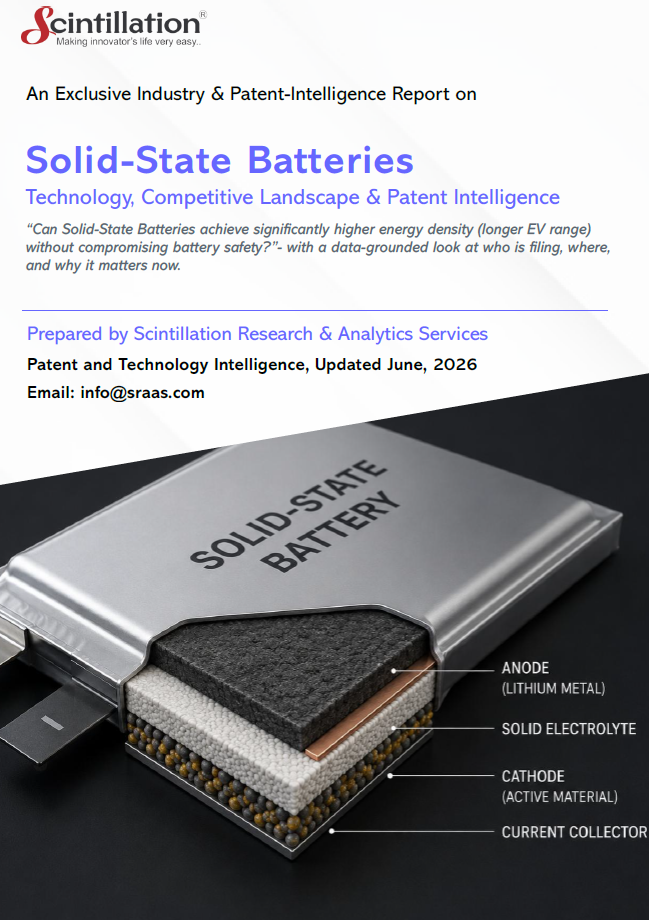
Structural components — solid electrolyte layer, lithium-metal anode, cathode active materials, current collectors, interfacial coating layers, and cell stack and pouch/prismatic packaging architectures
4.1 Key Features — high energy density via lithium-metal anode, non-flammable solid electrolyte, wide electrochemical stability window, improved cycle life, fast-charge compatibility, and reduced battery management system complexity
4.2 Problems SSB Aims to Solve — thermal runaway and fire risk in liquid electrolyte cells, energy density ceiling of graphite anodes, long charging times, cycle-life degradation, and battery pack size and weight constraints limiting EV range
4.3 Potential Applications — long-range battery electric vehicles, aerospace and aviation energy storage, consumer electronics, medical devices, grid-scale stationary storage, defence and military systems, and wearable electronics
SSB commercialization roadmap, OEM production integration timelines, cost reduction trajectory, gigafactory-scale manufacturing challenges, semi-solid and hybrid electrolyte transition strategies, and near-term market entry opportunities in premium EV and specialty applications
6.1 Methodology & Scope — patent database coverage, search strategy, classification framework, and analytical approach for solid-state battery, solid electrolyte, lithium-metal anode, and next-generation energy storage IP
6.2 Who Is Filing — leading assignees across automotive OEMs, battery cell manufacturers, materials and chemical companies, specialist SSB startups, and academic and national laboratory research institutions
6.3 Filing Activity Over Time — trend analysis identifying R&D acceleration points, OEM investment-driven filing surges, and IP maturity signals across solid electrolyte, anode, cathode, and interface engineering technology domains
6.4 Jurisdiction Coverage — USPTO, CNIPA, KIPO, JPO, EPO, and WIPO distributions reflecting key EV market protection priorities and regional battery manufacturing competitive dynamics
6.5 Technology Segmentation — patents mapped to oxide, sulfide, halide, and polymer solid electrolytes; lithium-metal anode engineering; cathode materials; electrode–electrolyte interface coatings; cell manufacturing processes; and thermal management
6.6 Whitespace & Strategic Opportunities — underprotected technology domains and emerging filing, licensing, and partnership opportunities across the solid-state battery IP ecosystem
Stakeholder-specific takeaways for battery materials researchers, EV powertrain engineers, IP counsel, automotive OEM technology strategists, cell manufacturing executives, energy storage investors, and policymakers shaping next-generation battery technology frameworks
Synthesis of solid-state battery technology trajectory, IP landscape dynamics, and strategic implications for next-generation electric mobility, energy storage, and the global transition away from liquid-electrolyte lithium-ion technology
Publisher profile, research methodology, and service overview — patent analytics, technology scouting, competitive intelligence, and strategic research across energy storage, materials science, and mobility technology domains
Full legal disclaimer covering information accuracy, IP ownership, and terms of use for this intelligence report
Inside the Technology

Structural components & key features

Solid-state batteries replace the liquid electrolyte with a solid ionic conductor — a change that cascades through every layer of the cell architecture, enabling lithium-metal anodes, wider electrochemical stability windows, and fundamentally improved safety characteristics at the cost of significant interface engineering and manufacturing challenges.

Solid electrolyte layer
The defining component of SSB architecture — a solid ionic conductor replacing the flammable liquid electrolyte of conventional lithium-ion cells. Leading chemistries include sulfide-based (LGPS, argyrodites), oxide-based (LLZO garnet, NASICON), halide-based, and polymer electrolytes — each with distinct tradeoffs in ionic conductivity, electrochemical stability, and processability.
Lithium-metal anode
The anode architecture enabled by the solid electrolyte — replacing graphite with pure lithium metal, which has approximately ten times the theoretical specific capacity. Lithium-metal anodes dramatically increase cell energy density and enable the longer EV driving ranges SSBs promise, but require careful management of volume change during cycling and suppression of lithium dendrite formation at the anode–electrolyte interface.
High-voltage cathode materials
The wide electrochemical stability window of many solid electrolytes enables the use of high-voltage cathode materials — including lithium nickel manganese cobalt oxides (NMC), lithium cobalt oxide (LCO), and spinel LiNiMnO₄ — that cannot be used with conventional liquid electrolytes, further increasing cell energy density and power capability.
Electrode–electrolyte interface engineering
The critical challenge unique to solid-state cell design — engineering stable, low-resistance ionic contact between the solid electrolyte and both the anode and cathode across thousands of charge-discharge cycles. Interface coating layers, in-situ formed interphases, and surface modification chemistries are among the most actively patented areas in the SSB IP landscape.
Dendrite suppression mechanisms
Structural, chemical, and mechanical strategies that prevent lithium dendrites from nucleating at the anode surface and propagating through the solid electrolyte to cause internal short circuits — the primary failure mode in lithium-metal SSB cells and one of the central technical hurdles to commercialization at the energy densities the technology promises.
Cell stack & packaging architecture
SSB cells require different packaging approaches than liquid-electrolyte cells — often using stack pressure to maintain intimate solid-solid contact between layers, and employing thin-film, pouch, or prismatic formats suited to the mechanical characteristics of solid electrolyte materials. Bipolar stacking architectures are also being developed to maximise voltage and energy density at the module level.
Thermal management & safety systems
While solid electrolytes eliminate the primary flammability risk of liquid-electrolyte cells, SSB packs still require thermal management for performance and longevity — particularly for sulfide electrolytes with moderate ionic conductivity at low temperatures and for managing heat during fast charging of high-energy-density lithium-metal cells.
Scalable manufacturing processes
Dry electrode coating, thin-film deposition, co-sintering, and roll-to-roll processing innovations that adapt SSB cell fabrication to high-volume, low-cost gigafactory-scale manufacturing — a critical enabling step toward the cost competitiveness with incumbent lithium-ion technology required for mainstream EV adoption.
Challenges addressed

Why conventional lithium-ion batteries cannot meet the next generation of EV performance and safety requirements

Solid-state batteries directly target five fundamental limitations of conventional lithium-ion technology that constrain the performance, safety, and longevity of electric vehicle battery packs — limitations that incremental improvements to liquid-electrolyte cell chemistry cannot fully resolve.
01
Thermal runaway and fire risk
Conventional lithium-ion cells use flammable liquid electrolytes that can ignite during thermal runaway events triggered by mechanical damage, overcharge, or internal short circuits — creating fire and explosion risks that demand heavy, expensive battery management systems, fire suppression provisions, and strict thermal management in EV packs. Solid electrolytes are non-flammable by nature, eliminating the primary fuel source for lithium-ion battery fires and allowing a fundamental step change in EV battery pack safety architecture
Safety
02
Energy density ceiling of graphite anode chemistry
The graphite anode used in conventional lithium-ion cells has a theoretical specific capacity of approximately 372 mAh/g — a limit that is now being approached by leading commercial cells. Liquid electrolytes are incompatible with lithium-metal anodes at scale due to dendrite formation and electrolyte decomposition. Solid electrolytes can physically suppress dendrite growth while remaining stable against lithium metal, unlocking anode specific capacities up to 3,860 mAh/g and enabling the step-change in EV driving range that graphite anode chemistry cannot deliver
Energy Density
03
Long charging times limiting EV convenience
Liquid electrolyte lithium-ion cells face rate limitations from lithium-ion transport through the liquid phase and at the graphite anode — constraining fast-charging capability without accelerating degradation. Certain solid electrolyte chemistries with high ionic conductivity and improved interfacial kinetics can support higher charge rates than incumbent liquid-electrolyte systems, reducing charging time toward values that close the convenience gap with internal combustion vehicles
Charge Rate
04
Cycle life degradation and calendar aging
Conventional lithium-ion cells degrade through electrolyte decomposition at the solid electrolyte interphase (SEI), lithium plating, and structural changes in cathode active materials over thousands of cycles and years of calendar aging. Solid electrolytes that are chemically stable against lithium metal and cathode materials over the cell's lifetime can substantially reduce the electrochemical degradation mechanisms that limit the effective service life of EV battery packs
Longevity
05
Battery pack weight and volume constraining EV range
Conventional lithium-ion EV battery packs achieve energy densities of approximately 250–300 Wh/kg at the cell level — requiring large, heavy packs to deliver competitive driving ranges. The combination of lithium-metal anodes, high-voltage cathodes, and the elimination of liquid electrolyte management systems in SSB packs has the potential to increase cell-level energy density to 400–500 Wh/kg or beyond, reducing pack weight and volume for equivalent range or enabling significantly extended range at equivalent pack dimensions
Pack Density

Download Your Sample Report Now:

    Application areas

    Where solid-state batteries create transformative performance and safety impact

    SSB technology is most compelling in applications where energy density, safety, operating temperature range, or cycle life limitations of conventional lithium-ion technology create the greatest product constraints — spanning electric mobility, aerospace, consumer electronics, and grid storage.

    Battery Electric Vehicles (BEV)
    Long-range passenger and commercial EVs requiring higher energy density to extend driving range, reduce pack weight, and eliminate thermal runaway risk within automotive safety and reliability requirements
    Aerospace & Aviation
    Electric aircraft, urban air mobility (eVTOL), and satellite applications requiring the highest energy-to-weight ratios, wide operating temperature range, and the zero-flammability characteristics essential for airworthiness certification
    Consumer Electronics
    Smartphones, laptops, and wearables where SSB thin-film and flexible cell formats enable thinner, lighter devices with improved safety and longer cycle life than current liquid-electrolyte pouch cells
    Medical Devices
    Implantable and body-worn medical electronics requiring ultra-reliable, long-lifetime energy storage with no risk of electrolyte leakage or thermal events within or adjacent to the human body
    Grid-Scale Energy Storage
    Stationary energy storage systems where SSB's improved cycle life, wide temperature tolerance, and safety characteristics reduce lifetime cost and balance-of-plant complexity compared to liquid-electrolyte lithium-ion grid storage
    Defence & Military Systems
    Military vehicles, unmanned systems, and soldier-portable power applications requiring high energy density, extreme temperature performance, and non-flammable energy storage in operational environments where fire risk is unacceptable
    Electric Two-Wheelers & Micromobility
    E-bikes, electric motorcycles, and scooters where SSB's smaller, lighter pack formats and improved safety in confined urban environments represent compelling product differentiators as the technology matures toward cost competitiveness
    Industrial & Robotics Applications
    Autonomous mobile robots, industrial AGVs, and powered tools where higher energy density reduces recharge frequency, wider temperature operation extends deployment environments, and improved safety simplifies indoor use certification
    Patent intelligence

    The solid-state battery patent landscape — a 9-part analysis

    The patent landscape chapter delivers data-grounded IP intelligence — from methodology and assignee profiling to filing trends, jurisdiction mapping, technology segmentation, and whitespace identification across the full solid-state battery ecosystem spanning materials, cell design, and manufacturing.

    Assignee & filing intelligence
    • Methodology and scope — patent database coverage, search strategy, and classification framework for solid-state battery, solid electrolyte, lithium-metal anode, and next-generation energy storage IP
    • Who is filing — leading assignees across automotive OEMs, battery cell manufacturers, materials and chemical companies, specialist SSB startups, and academic and national laboratory research institutions
    • Filing activity over time — trend analysis identifying R&D acceleration points, investment-driven filing surges, and IP maturity signals across solid electrolyte, anode, cathode, and interface engineering domains
    • Jurisdiction coverage — USPTO, CNIPA, KIPO, JPO, EPO, and WIPO distributions reflecting EV market protection priorities and battery manufacturing competitive dynamics
    Technology & strategic analysis
    • Technology segmentation — oxide, sulfide, halide, and polymer solid electrolytes; lithium-metal anode engineering; high-voltage cathode materials; interface coating IP; cell manufacturing processes; and thermal management
    • Whitespace & strategic opportunities — underprotected technology domains and emerging filing, licensing, and partnership opportunities across the SSB IP ecosystem
    • What this means for you — stakeholder-specific takeaways for battery researchers, EV engineers, IP counsel, OEM strategists, manufacturers, and investors across the SSB value chain
    • Future commercialization outlook — OEM production integration timelines, cost reduction trajectory, manufacturing scale-up challenges, and near-term market entry opportunities
    Who will benefit

    Who should read this report

    Battery Materials Researchers
    Scientists and engineers developing solid electrolyte materials, anode and cathode chemistries, interfacial coating layers, and cell manufacturing processes for next-generation solid-state energy storage systems.
    IP Counsel & Patent Teams
    Attorneys and patent professionals assessing SSB portfolio positioning, whitespace, freedom-to-operate, and filing strategy across solid electrolyte chemistry, lithium-metal anode engineering, interface IP, and cell manufacturing technology domains.
    Automotive OEM Technology Teams
    EV battery and powertrain technology teams evaluating SSB integration roadmaps, cell supplier qualification, competitive IP landscape positioning, and the commercialization timeline for solid-state technology in next-generation vehicle platforms.
    Energy Storage Investors
    Investment professionals tracking the solid-state battery ecosystem — mapping IP landscapes, competitive dynamics, and emerging companies across solid electrolyte materials, cell design, manufacturing process technology, and system integration.
    Cell Manufacturing Executives
    Strategy and operations leaders at battery cell manufacturers and gigafactory developers evaluating SSB manufacturing process investment timing, competitive IP positioning, and the transition path from liquid-electrolyte to solid-state production at scale.
    R&D Strategists & Industry Analysts
    Researchers and consultants mapping the competitive SSB landscape — identifying collaboration opportunities, emerging technology directions, and the IP context for novel solid electrolyte, anode, and interface engineering research programs.
    Technology & Patent Intelligence · Scintillation Research

    Understand who is building the IP foundation for next-generation energy storage

    Get the complete technology and patent intelligence report on Solid-State Batteries — from solid electrolyte chemistries and lithium-metal anode engineering to the patent landscape revealing who is filing, where innovation is concentrated, and why SSB technology matters now for the future of electric mobility and energy storage.

    Scintillation Research · Solid-State Batteries · Next-Generation Energy Storage · Patent Intelligence Series

    For a quick demo, schedule a meeting now!

    Service Demo Booking
    About

    About Scintillation Research

    Scintillation Research & Analytics Services is a specialized intellectual property and technology intelligence firm delivering patent analytics, technology scouting, competitive intelligence, and strategic research services.

    Through comprehensive patent and technology intelligence reports, we help organizations understand emerging innovations, identify market opportunities, monitor competitors, and make data-driven decisions across rapidly evolving technology domains. Our reports are designed for professionals at the intersection of technology strategy, IP management, and competitive intelligence.

    Shopping Cart (0 items)

    Subscribe to our newsletter

    Sign up to receive latest news, updates, promotions, and special offers delivered directly to your inbox.
    No, thanks
    Select your currency