Electric Vertical Take-Off and Landing (EVTOLs)

  • Home
  • Electric Vertical Take-Off and Landing (EVTOLs)
eVTOL: From Roads to Skies — How Electric Vertical Take-Off and Landing Technology Is Reshaping Urban Air Mobility | Scintillation Research
Patent & Innovation Landscape Analysis  ·  Urban Air Mobility Series

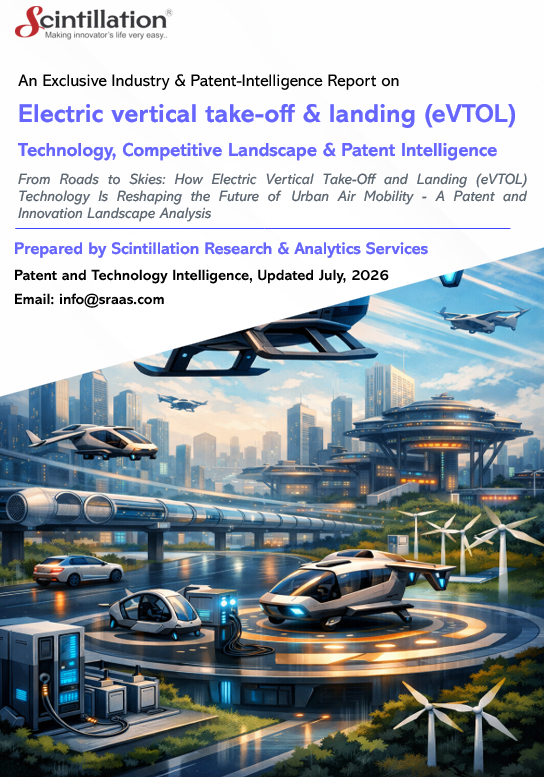
From Roads to Skies: How Electric Vertical Take-Off and Landing (eVTOL) Technology Is Reshaping the Future of Urban Air Mobility

A data-grounded look at who is filing, where innovation is concentrated, and why eVTOL technology is solidifying its position as the foundational platform for next-generation aviation and the Advanced Air Mobility revolution.

A comprehensive technology and patent intelligence analysis of eVTOL technology — examining distributed electric propulsion, tilt-rotor and tilt-wing architectures, battery and energy management systems, autonomous flight control, AI-enabled avionics, detect-and-avoid technologies, hydrogen-electric propulsion, lightweight composite structures, and Urban Air Mobility / Advanced Air Mobility ecosystem enabling technologies.

DEPDistributed electric propulsion
AutonomousAI-enabled flight control
UAM/AAMUrban & advanced air mobility
PatentLandscape & whitespace analysis

Report details

eVTOL Technology — Patent & Innovation Landscape Analysis Report

Publisher Scintillation Research
Technology eVTOL / Urban Air Mobility
Focus area Advanced Air Mobility (AAM)
Key segments DEP, Battery, Autonomy, UAM Ecosystem
IP coverage 10-part patent landscape
Applications Passenger, Cargo, EMS, Regional Transit
Audience IP, R&D, Strategy, Investment
eVTOL Electric vertical take-off & landing
0 Direct operational emissions
DEP Distributed electric propulsion
IP 10-part patent analysis
AAM Advanced air mobility ecosystem
Introduction

When roads, rails, and conventional aviation can no longer meet the urban mobility demands of the 21st century

Electric Vertical Take-Off and Landing (eVTOL) technology represents an emerging interdisciplinary domain that converges electric propulsion, aerospace engineering, advanced battery systems, lightweight composite materials, artificial intelligence, autonomous flight control, sophisticated avionics, and digital air traffic management to enable electrically powered aircraft capable of vertical take-off, hover, and landing.

Distinguished from conventional helicopters and fixed-wing aircraft, eVTOL platforms leverage distributed electric propulsion, high-efficiency electric motors, and intelligent flight control architectures to deliver quieter, lower-emission, and more cost-efficient air transportation across urban, regional, and specialized mobility applications.

The technology is attracting mounting global attention for its potential to address pressing challenges in urban traffic congestion, transportation efficiency, greenhouse gas emissions, noise pollution, and regional connectivity. Core innovations driving this transformation include distributed electric propulsion (DEP), tilt-rotor and tilt-wing aircraft architectures, vectored-thrust propulsion systems, high-energy-density battery technologies, hydrogen-electric propulsion, autonomous flight control, AI-enabled navigation, detect-and-avoid systems, advanced energy management, and integrated Urban Air Mobility (UAM) and Advanced Air Mobility (AAM) ecosystems.

Recent breakthroughs in battery chemistry, electric motor design, power electronics, lightweight structural materials, autonomous navigation, artificial intelligence, digital air traffic management, and aircraft certification frameworks are propelling eVTOL technology beyond prototype development and flight testing toward full-scale commercial deployment.

Report structure

Table of contents

Nine chapters connecting eVTOL's technical foundations to patent landscape intelligence and commercialization strategy. Click any chapter to expand.

Condensed findings on eVTOL technology, top patent assignees, filing trends, competitive dynamics, and strategic implications for urban air mobility IP
Who Will Benefit from This Report — aerospace engineers, urban mobility strategists, IP counsel, certification specialists, and technology investors tracking eVTOL and AAM innovation
3.1 Challenges in eVTOL Technology — battery energy density, aircraft certification complexity, air traffic management integration, noise mitigation, and public acceptance barriers
Structural components and enabling technologies — distributed electric propulsion, tilt-rotor/tilt-wing architectures, battery and energy management, autonomous flight control, and UAM/AAM ecosystem integration
4.2 Problems eVTOL Technology Aims to Solve — urban traffic congestion, transportation inefficiency, greenhouse gas emissions, noise pollution, and regional connectivity limitations
4.3 Potential Applications — urban passenger mobility, cargo logistics, emergency medical services, regional connectivity, and defense and government operations
eVTOL commercialization roadmap, certification timelines, vertiport infrastructure build-out, fleet scaling, and near-term UAM/AAM market deployment milestones
6.1 Methodology & Scope — patent database coverage, search strategy, classification framework, and analytical approach for eVTOL and UAM IP
6.2 Revised Assignee Picture — leading filers across eVTOL OEMs, aerospace primes, automotive entrants, electric motor specialists, and research institutions
6.3 Notable Assignee Profiles — strategic positioning and filing focus of key organizations shaping the eVTOL IP landscape
6.4 Filing Activity Over Time — trend analysis identifying R&D acceleration and IP maturity signals across eVTOL technology domains
6.5 Jurisdiction Coverage — USPTO, CNIPA, KIPO, JPO, EPO, and WIPO distributions across the eVTOL patent landscape
6.6 Technology Segmentation — patents mapped to electric propulsion, battery systems, tilt-rotor architectures, autonomous flight control, avionics, detect-and-avoid, and UAM infrastructure
6.7 Foundational Anchor Patents — core IP defining the eVTOL landscape and their strategic competitive significance
6.8 Representative Publications Across the Field — key academic and industry publications shaping eVTOL research direction
6.9 Whitespace & Strategic Opportunities — underprotected technology domains and emerging filing opportunities across the eVTOL IP ecosystem
Stakeholder-specific takeaways for aerospace engineers, urban mobility strategists, IP counsel, certification specialists, and technology investors
Synthesis of eVTOL's technical trajectory, IP landscape dynamics, and strategic implications for next-generation urban air mobility commercialization
Full legal disclaimer covering information accuracy, IP ownership, and terms of use for this intelligence report
Inside eVTOL Technology

Core enabling technologies & key features

eVTOL aircraft integrate electric propulsion, autonomous control, and advanced materials into platforms that can take off and land vertically without a runway — enabling low-noise, low-emission urban air mobility at a cost and scale that conventional rotorcraft cannot approach.

Distributed electric propulsion (DEP)
Multiple small electric motors and rotors distributed across the airframe, enabling redundancy, aerodynamic efficiency, and independent torque control at a noise signature dramatically below conventional rotorcraft.
Battery & energy management systems
High-energy-density battery chemistries and intelligent energy management architectures that maximize range, payload capacity, and charge-cycle lifespan for commercial air mobility operations.
Tilt-rotor & tilt-wing architectures
Aircraft configurations that rotate propulsion units between vertical lift and horizontal thrust positions, combining helicopter-like VTOL capability with the cruise efficiency of fixed-wing flight.
Autonomous flight control systems
Fly-by-wire, AI-assisted, and fully autonomous control architectures that manage multi-rotor stability, route planning, and emergency response with reduced pilot workload or no pilot onboard.
Advanced avionics & AI-enabled navigation
Next-generation sensor fusion, machine-learning navigation, and real-time situational-awareness systems designed for low-altitude urban airspace operations.
Detect-and-avoid (DAA) technologies
Sensor and algorithmic systems that allow eVTOL aircraft to detect other aircraft and obstacles in urban airspace and autonomously execute avoidance maneuvers — a critical enabler for Beyond Visual Line of Sight (BVLOS) operations.
Hydrogen-electric propulsion
Fuel-cell-based propulsion systems using hydrogen to extend range beyond battery-electric limitations, supporting longer regional air mobility routes without the weight penalty of large battery packs.
Vertiport & UAM/AAM infrastructure
Ground infrastructure — including vertiports, charging hubs, and digital air traffic management networks — enabling the safe, high-frequency operations required for commercial Urban Air Mobility deployment.
Patent landscape preview

Leading eVTOL patent assignees

The eVTOL IP landscape reflects engagement across the full air mobility value chain — dedicated eVTOL OEMs racing toward certification, aerospace primes protecting propulsion and avionics IP, automotive entrants bringing EV expertise to aviation, and research institutions advancing autonomous flight and energy systems.

Top assignees by filing activity

#1 · eVTOL OEM
Joby Aviation
Tilt-rotor eVTOL development · USA
#2 · eVTOL OEM
Archer Aviation
Urban air taxi development · USA
#3 · eVTOL OEM
Lilium
Electric jet-powered eVTOL · Germany
#4 · Aerospace
Airbus
CityAirbus & UAM ecosystem · France
#5 · Aerospace
Boeing / Wisk
Autonomous air taxi programs · USA
#6 · Automotive
Hyundai / Supernal
AAM ecosystem & eVTOL design · Korea/USA
#7 · eVTOL OEM
Volocopter
Urban air taxi & vertiport ops · Germany
#8 · eVTOL OEM
EHang
Autonomous aerial vehicle · China
Challenges addressed

Why conventional aviation and surface transport cannot meet urban mobility demands

eVTOL technology directly targets the congestion, emissions, noise, and accessibility constraints that prevent conventional aviation and surface transport from scaling to the demands of 21st-century urban mobility — while confronting new technical and regulatory hurdles specific to electric urban air operations.
01
Urban traffic congestion
Ground-level transportation networks in major cities face chronic congestion that reduces productivity and quality of life at scale. eVTOL aircraft operating in urban airspace can bypass surface congestion entirely, offering point-to-point travel times that surface transport cannot match
Urban congestion
02
Greenhouse gas emissions from aviation
Conventional fossil-fuel-powered helicopters and fixed-wing aircraft generate significant carbon emissions, noise, and local air-quality impacts. eVTOL's electric propulsion eliminates direct operational emissions and reduces noise to a fraction of conventional rotorcraft
Emissions
03
Battery energy density & range limitations
Current battery energy density limits the range and payload capacity of battery-electric eVTOL aircraft, constraining their initial commercial applications to short urban routes. Advances in battery chemistry and hybrid hydrogen-electric propulsion are expanding the addressable range and use-case envelope
Battery range
04
Aircraft certification complexity
eVTOL aircraft represent a fundamentally new certification category that existing aviation regulatory frameworks — designed for conventional fixed-wing and rotorcraft — were not architected to address efficiently. Aviation authorities globally are developing new eVTOL-specific certification standards, but timelines remain a commercial deployment constraint
Certification
05
Air traffic management & vertiport infrastructure
Scaling eVTOL operations to commercial frequency requires digital Urban Air Mobility traffic management systems and vertiport infrastructure that do not yet exist at scale. UAM ecosystem investment and U-space/UTM regulatory development are addressing this enabling-infrastructure gap
Infrastructure

Download Your Sample Report Now:

    Application areas

    Where eVTOL technology creates critical mobility impact

    eVTOL's low noise, low emissions, and vertical take-off capability are most compelling in applications where congestion, geographic barriers, or emergency response requirements make surface or conventional air transport impractical or cost-prohibitive.

    Urban Air Taxis
    On-demand passenger services connecting city centers, suburbs, and airports with journey times that bypass surface congestion
    Cargo & Logistics
    Time-critical package delivery and logistics operations, particularly in dense urban environments where surface delivery is slow or inaccessible
    Emergency Medical Services
    Rapid medical transport, organ delivery, and emergency response operations where minutes of transit time directly affect patient outcomes
    Regional Connectivity
    Short-range inter-city and rural connectivity routes where existing air and rail infrastructure is absent or economically unviable
    Defense & Government
    Military logistics, surveillance, and personnel transport operations leveraging eVTOL's low acoustic signature and runway-independence
    Offshore & Remote Operations
    Worker transport and logistics for offshore energy platforms, remote infrastructure, and island communities inaccessible by surface transport
    Tourism & Hospitality
    Premium urban and scenic aerial experiences enabled by eVTOL's quieter operation and flexible point-to-point routing
    Disaster Response & Humanitarian
    Rapid deployment to disaster-affected areas where ground infrastructure is damaged or impassable and conventional aircraft access is limited
    Patent intelligence

    The eVTOL patent landscape — a 10-part analysis

    The patent landscape chapter delivers data-grounded IP intelligence — from methodology and revised assignee profiling to filing trends, technology segmentation, anchor patents, representative publications, and whitespace identification across the full eVTOL and UAM ecosystem.

    Assignee & filing intelligence
    • Methodology and scope defining the boundaries of eVTOL patent analysis
    • Revised assignee picture and notable profiles — eVTOL OEMs, aerospace primes, automotive entrants, and research institutions shaping the IP landscape
    • Filing activity over time — trend analysis identifying R&D acceleration points and IP maturity signals across eVTOL technology segments
    • Jurisdiction coverage — USPTO, CNIPA, KIPO, JPO, EPO, and WIPO distributions across the eVTOL patent corpus
    Technology & strategic analysis
    • Technology segmentation — electric propulsion, battery systems, tilt-rotor architectures, autonomous flight control, avionics, detect-and-avoid, and UAM infrastructure
    • Foundational anchor patents — core IP defining the eVTOL landscape and their strategic competitive significance
    • Representative publications — key academic and industry papers shaping eVTOL research direction and commercialization roadmap
    • Whitespace & strategic opportunities — underprotected technology domains and emerging eVTOL filing and licensing opportunities
    Who will benefit

    Who should read this report

    Aerospace & Propulsion Engineers
    Technical teams designing distributed electric propulsion systems, autonomous flight control architectures, and lightweight composite airframe structures for eVTOL platforms.
    Urban Mobility Strategists
    Strategy professionals evaluating eVTOL for passenger transport, cargo logistics, and emergency medical service applications and assessing UAM/AAM ecosystem investment.
    IP Counsel & Patent Teams
    Attorneys and patent professionals assessing portfolio positioning, whitespace, freedom-to-operate, and filing strategy across propulsion, battery, avionics, and UAM infrastructure technologies.
    Certification & Regulatory Specialists
    Teams navigating FAA, EASA, and international eVTOL type-certification processes and UAM airspace integration frameworks.
    Technology Investors
    Investment professionals tracking the eVTOL and AAM ecosystem, the IP landscape, and emerging companies in electric propulsion, autonomous flight, and UAM infrastructure.
    R&D Strategists & Industry Analysts
    Researchers and consultants mapping the competitive eVTOL landscape across OEMs, aerospace primes, automotive entrants, and research institutions driving the AAM revolution.
    Patent & Innovation Landscape Analysis · Scintillation Research

    Understand who is building the IP foundation for urban air mobility

    Get the complete patent and innovation landscape report on eVTOL technology — from distributed electric propulsion and autonomous flight control to the patent landscape revealing who is filing, where innovation is concentrated, and why eVTOL is solidifying its position as the foundational platform for the Advanced Air Mobility revolution.

    Scintillation Research · eVTOL Technology · Patent & Innovation Intelligence Series

    For a quick demo, schedule a meeting now!

    Service Demo Booking
    About

    About Scintillation Research

    Scintillation Research & Analytics Services is a specialized intellectual property and technology intelligence firm delivering patent analytics, technology scouting, competitive intelligence, and strategic research services.

    Through comprehensive patent and technology intelligence reports, we help organizations understand emerging innovations, identify market opportunities, monitor competitors, and make data-driven decisions across rapidly evolving technology domains. Our reports are designed for professionals at the intersection of technology strategy, IP management, and competitive intelligence.

    Shopping Cart (0 items)

    Subscribe to our newsletter

    Sign up to receive latest news, updates, promotions, and special offers delivered directly to your inbox.
    No, thanks
    Select your currency