How Are Non-Invasive Brain-Computer Interfaces (BCIs) Transforming Human-Machine Interaction?

  • Home
  • How Are Non-Invasive Brain-Computer Interfaces (BCIs) Transforming Human-Machine Interaction?
Non-Invasive Brain-Computer Interfaces (BCIs): Transforming Human–Machine Interaction | Scintillation Research
Patent Intelligence Report  ·  Neurotechnology & Human–Machine Interface Series

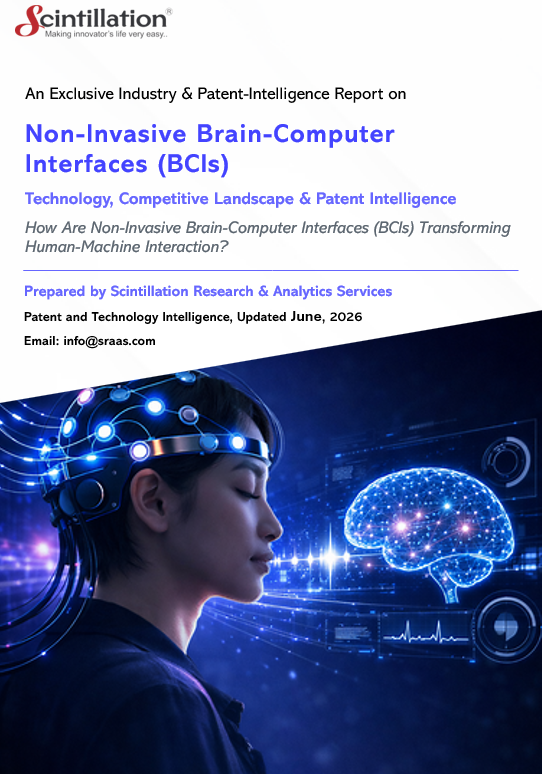
How Are Non-Invasive Brain-Computer Interfaces (BCIs) Transforming Human–Machine Interaction?

A data-grounded look at who is filing patents, where neurotechnology innovation is concentrated, and why non-invasive BCIs are becoming critical infrastructure for healthcare, consumer electronics, and next-generation human–machine interaction.

A comprehensive technology and patent intelligence analysis of non-invasive BCIs — examining EEG-based neural signal acquisition, brain-signal decoding algorithms, AI-driven neural interpretation, wearable neurotechnology platforms, neurofeedback systems, cognitive monitoring solutions, motor imagery and SSVEP paradigms, brain-controlled applications, and the evolving IP landscape across medical device companies, consumer technology firms, research institutions, and defence organisations.

EEGNon-invasive neural acquisition
AIBrain-signal decoding
No SurgeryWearable neurotechnology
10-partPatent landscape analysis

Report details

Non-Invasive Brain-Computer Interfaces (BCIs) — Technology & Patent Intelligence Report

Publisher Scintillation Research
Technology Non-Invasive BCI Systems
Focus area Neurotechnology & HMI
Key segments EEG, AI Decoding, Wearables, Neurofeedback
IP coverage 10-part patent landscape
Applications Healthcare, Consumer, Gaming, Defence
Audience IP, R&D, Strategy, Investment
BCI Brain-computer interface
EEG Non-invasive acquisition
AI Neural signal decoding
IP 10-part patent analysis
360° Ecosystem coverage
Introduction

When physical interfaces can no longer meet the accessibility, speed, and immersion demands of the next generation of human–machine interaction

The global Non-Invasive BCI industry is rapidly evolving as healthcare providers, technology companies, research institutions, and governments increase investments in neurotechnology, digital health, assistive communication, and next-generation human–machine interaction systems. Sectors including healthcare, consumer electronics, gaming, education, defence, and industrial operations are seeking more intuitive and accessible ways for humans to interact with digital devices and intelligent systems.

To address these challenges, organisations worldwide are actively developing advanced Non-Invasive BCI technologies as key enablers of direct brain-to-device communication. These technologies utilise neural signal acquisition systems, electroencephalography (EEG), wearable neurotechnology, artificial intelligence, and brain-signal decoding algorithms to interpret neural activity and convert it into actionable commands. Unlike traditional human–computer interfaces that rely on physical interaction, Non-Invasive BCIs enable communication and device control directly through brain signals — creating new possibilities for accessibility, productivity, and immersive digital experiences without the surgical risk of implanted BCI systems.

One of the most significant advantages of Non-Invasive BCI technologies is their ability to enhance accessibility, improve communication capabilities, enable hands-free device control, support cognitive monitoring, and facilitate neurorehabilitation — all without requiring surgical intervention. Advances in miniaturised dry electrode arrays, AI-powered signal decoding, noise rejection algorithms, and consumer-grade wearable form factors are progressively closing the signal quality gap between non-invasive and implanted BCI systems, making broad deployment across clinical and consumer applications increasingly viable.

These technologies are highly suitable for applications in assistive healthcare, consumer electronics, gaming, virtual and augmented reality systems, education, workforce monitoring, defence operations, and other sectors seeking advanced human–machine interaction solutions. This report explores the technological foundations of Non-Invasive BCIs, the key challenges they address, recent innovations, commercialisation developments, emerging applications, and the future market potential of these technologies within the global neurotechnology and human–machine interface landscape.

Report structure

Table of contents

Ten chapters connecting non-invasive BCI technology foundations to patent landscape intelligence and commercialisation strategy. Click any chapter to expand.

Condensed findings on non-invasive BCI technology, top patent assignees, filing trends, competitive dynamics, and strategic implications for the healthcare, consumer electronics, gaming, defence, and neurotechnology sectors
Who Will Benefit from This Report — neurotechnology engineers, clinical and rehabilitation researchers, IP counsel, consumer electronics product teams, gaming and XR developers, defence technology strategists, digital health investors, and cognitive monitoring solution providers
3.1 Challenges in Non-Invasive BCIs — low signal-to-noise ratio of scalp EEG, motion and environmental artefact contamination, inter-subject variability in neural patterns, limited spatial resolution compared to invasive systems, cognitive fatigue from sustained BCI use, and long calibration requirements limiting practical deployment
Components — EEG electrode arrays, fNIRS and MEG acquisition systems, signal amplifiers and filters, artefact rejection pipelines, feature extraction modules, AI-based neural decoders, command output interfaces, and feedback display systems
4.1 Key Features — non-surgical signal acquisition, wearable and consumer-grade form factors, real-time AI-driven neural decoding, motor imagery and SSVEP paradigm support, neurofeedback loop capability, and multimodal neural signal fusion
4.2 Problems Non-Invasive BCIs Aim to Solve — physical accessibility barriers for motor-impaired users, limited communication speed for ALS and locked-in syndrome patients, dependence on manual controls in high-attention environments, inadequate cognitive state monitoring in safety-critical settings, and constraints in immersive XR interaction
4.3 Potential Applications — assistive communication for ALS and paralysis, neurorehabilitation after stroke, consumer brain-controlled devices, cognitive workload monitoring, gaming and XR immersive control, mental health neurofeedback, education attention systems, and defence situational awareness
Non-invasive BCI commercialisation roadmap, consumer wearable neurotechnology launch timelines, clinical regulatory pathways, AI decoder generalisation across users, dry electrode miniaturisation progress, and near-term market entry opportunities across healthcare, consumer, and enterprise segments
6.1 Methodology & Scope — patent database coverage, search strategy, classification framework, and analytical approach for non-invasive BCI, EEG acquisition, neural decoding, wearable neurotechnology, and brain-signal interface IP
6.2 Scope Corrections — refinements addressing classification overlap between non-invasive BCI, implanted neural interface, medical EEG monitoring, and consumer wearable biometric patent domains
6.3 Top Assignee Picture — leading filers across medical device companies, consumer technology firms, neurotechnology startups, defence contractors, research universities, and national research institutions
6.4 Notable Assignee Profiles — detailed IP portfolio analysis for the most active non-invasive BCI patent filers, including technology focus, filing strategy, and competitive positioning
6.5 Filing Activity Over Time — trend analysis identifying R&D acceleration points, AI-driven filing surges, and IP maturity signals across EEG, neural decoding, wearable, and cognitive monitoring technology domains
6.6 Jurisdiction Coverage — USPTO, CNIPA, KIPO, JPO, EPO, WIPO, and national office distributions reflecting key consumer, clinical, and defence market protection priorities
6.7 Technology Segmentation — patents mapped to EEG electrode systems, fNIRS and hybrid acquisition, artefact rejection, feature extraction, AI neural decoders, motor imagery paradigms, SSVEP systems, neurofeedback, cognitive monitoring, and brain-controlled application interfaces
6.8 Foundational Anchor Patents — core IP defining the non-invasive BCI landscape and their strategic competitive significance across healthcare, consumer, and defence applications
6.9 Representative Publications Across the Field — key academic and industry publications shaping non-invasive BCI research direction, AI decoder development, and commercialisation strategy
6.10 Whitespace & Strategic Opportunities — underprotected technology domains and emerging filing, licensing, and partnership opportunities across the non-invasive BCI IP ecosystem
Stakeholder-specific takeaways for neurotechnology engineers, clinical researchers, IP counsel, consumer electronics product teams, gaming and XR developers, defence technology strategists, digital health investors, and cognitive monitoring solution providers
Synthesis of non-invasive BCI technology trajectory, IP landscape dynamics, and strategic implications for the future of human–machine interaction, digital health, assistive technology, and the global neurotechnology market
Publisher profile, research methodology, and service overview — patent analytics, technology scouting, competitive intelligence, and strategic research across neurotechnology, digital health, and human–machine interface domains
Full legal disclaimer covering information accuracy, IP ownership, and terms of use for this intelligence report
Inside the Technology

Components & key features of non-invasive BCIs

Non-invasive BCI systems combine neural signal acquisition hardware, signal processing pipelines, AI-powered decoding algorithms, and application interfaces into a complete brain-to-device communication architecture — enabling direct control and communication through brain activity without electrodes penetrating the scalp or skull.

EEG electrode arrays & dry electrode systems
Scalp electrode arrays that measure electrical potentials generated by synchronised neural activity — from clinical wet-gel systems with high signal fidelity to miniaturised dry electrodes that require no preparation gel, enabling practical wearable and consumer-grade EEG acquisition for continuous, everyday BCI use without clinical setup overhead.
Functional near-infrared spectroscopy (fNIRS)
Optical neural imaging technology that measures haemodynamic responses to neural activity through the scalp — providing spatial resolution superior to EEG with wearable, motion-tolerant hardware. fNIRS is increasingly combined with EEG in hybrid non-invasive BCI systems to jointly capture fast electrical and slower haemodynamic neural correlates for improved decoding accuracy.
Artefact rejection & signal preprocessing
Signal processing algorithms — including independent component analysis (ICA), adaptive filtering, and deep learning-based artefact classifiers — that identify and remove eye movement, muscle activity, motion, and electrical interference artefacts from raw EEG signals, recovering clean neural information from the highly noisy scalp signal environment without discarding genuine neural content.
AI-driven neural decoding algorithms
Deep learning models — including convolutional neural networks, transformer architectures, and Riemannian geometry classifiers — trained to decode intended motor commands, cognitive states, imagined speech, and SSVEP responses from EEG features, achieving decoding accuracy and speed approaching practical BCI control while progressively reducing the inter-session calibration required from each individual user.
Motor imagery & SSVEP paradigms
The two dominant non-invasive BCI control paradigms — motor imagery exploits the ERD/ERS patterns generated when users imagine limb movements, while SSVEP (steady-state visually evoked potentials) exploits resonant neural responses to flickering visual stimuli of specific frequencies. Both enable reliable, spontaneous brain-state-based device control without requiring the user to perform physical movement or express verbal commands.
Neurofeedback systems
Closed-loop BCI architectures that provide real-time visual, auditory, or tactile feedback to the user based on decoded neural state — enabling users to learn to voluntarily regulate specific neural oscillations associated with attention, relaxation, motor preparation, or cognitive performance. Neurofeedback is used therapeutically for ADHD, anxiety, epilepsy, and neurorehabilitation, and in consumer applications for focus and meditation training.
Wearable neurotechnology platforms
Consumer and clinical wearable EEG headsets, headbands, and earbuds integrating miniaturised electrode arrays, wireless signal transmission, onboard processing, and rechargeable power management into form factors suitable for everyday use — enabling non-invasive BCI deployment outside of clinical and laboratory settings and into consumer, workplace, and gaming applications at commercially accessible price points.
Cognitive state monitoring & workload assessment
BCI systems that continuously decode cognitive state metrics — attention, mental workload, fatigue, stress, and emotional valence — from EEG signals in real time, enabling adaptive interfaces, safety monitoring in high-stakes operational environments (aviation, driving, surgery), personalised learning systems, and wellness applications that adjust content or intervention based on the user's measured neural state.
Challenges addressed

Why conventional input methods cannot meet the accessibility, speed, and monitoring requirements that non-invasive BCIs uniquely address

Non-invasive BCI technologies directly target five structural limitations of conventional human–computer interfaces that prevent accessible, hands-free, and neural-state-aware interaction for users across healthcare, consumer, and enterprise contexts.
01
Physical accessibility barriers for motor-impaired users
Users with amyotrophic lateral sclerosis (ALS), locked-in syndrome, cervical spinal cord injury, and severe cerebral palsy lack the motor control required for conventional keyboard, mouse, or touchscreen interaction — leaving them without reliable independent means of communication and device control. Non-invasive BCIs based on EEG motor imagery, P300 event-related potentials, and SSVEP paradigms enable direct brain-to-device communication without requiring any voluntary muscle movement, restoring communication agency to users for whom all conventional input channels are unavailable
Accessibility
02
Limited communication speed for severely paralysed patients
Eye-tracking and switch-scanning AAC devices — the current standard for severely paralysed communicators — provide character selection rates of 5–15 characters per minute, making extended communication exhausting and limiting the conversational bandwidth available to users. AI-powered non-invasive BCI decoders targeting imagined speech and neural language model integration are advancing toward communication rates that meaningfully approach natural conversation speed without the surgical risk of cortical implants
Communication
03
Absence of real-time cognitive state awareness in safety-critical systems
Aviation, automotive, medical, and industrial control systems operate without any real-time awareness of the operator's cognitive state — creating safety risks when mental fatigue, excessive workload, or inattention degrade performance without triggering any system response. Non-invasive BCI cognitive monitoring systems that continuously decode workload, attention, and fatigue from EEG in wearable form factors enable adaptive automation, early warning alerts, and intervention triggers that respond to the operator's actual neural state rather than waiting for performance to degrade to the point of observable error
Safety
04
Insufficient immersion and interaction bandwidth in XR environments
Virtual and augmented reality systems currently rely on hand controllers and voice commands for interaction — modalities that break physical immersion, require dedicated attention to the controller rather than the virtual environment, and limit the naturalness of human-digital interaction within immersive spatial computing. Non-invasive BCIs that decode intended actions, emotional responses, and attentional state from EEG in wearable headset-integrated form factors can provide a new neural interaction channel that complements or replaces physical controllers within XR environments
XR Interaction
05
Neurorehabilitation limited by passive exercise paradigms
Post-stroke motor rehabilitation depends on neuroplasticity driven by repetitive, voluntary movement practice — but patients with severe motor deficits cannot initiate the voluntary movement required to drive the cortical activation patterns that promote motor cortex reorganisation. Motor imagery-based BCI neurofeedback systems that couple detected cortical motor intention to robotic exoskeleton assistance or functional electrical stimulation enable active, intention-driven neurorehabilitation even in patients with no residual voluntary movement — producing demonstrably superior functional recovery outcomes to passive physiotherapy in clinical trial evidence
Neurorehab

Download Your Sample Report Now:

    Application areas

    Where non-invasive BCIs create transformative human–machine interaction impact

    Non-invasive BCI technology delivers the greatest value in contexts where conventional physical interfaces fail — whether due to motor impairment, the need for hands-free operation, requirements for real-time cognitive monitoring, or the demand for more natural and immersive human-digital interaction.

    Assistive Communication (ALS & Paralysis)
    EEG-based AAC systems enabling independent communication for users with ALS, locked-in syndrome, and high-level spinal cord injury — providing a direct brain-to-text channel where all conventional physical communication modalities are unavailable
    Neurorehabilitation
    Motor imagery BCI-driven neurofeedback combined with robotic exoskeletons or functional electrical stimulation for active, intention-driven post-stroke and spinal cord injury motor rehabilitation that promotes neuroplasticity superior to passive physiotherapy
    Consumer Brain-Controlled Devices
    Wearable EEG headsets enabling consumer applications including brain-controlled smart home systems, hands-free device navigation, meditation and focus training, and early consumer XR neural interaction — the fastest-growing non-clinical BCI market segment
    Gaming & Extended Reality (XR)
    Non-invasive BCI integration with gaming headsets and XR platforms — enabling neural game control, emotional state-adaptive gameplay, and hands-free interaction paradigms within virtual and augmented reality environments that complement physical controller input
    Mental Health & Neurofeedback Therapy
    Closed-loop EEG neurofeedback platforms for ADHD, anxiety, depression, PTSD, and epilepsy management — enabling neural self-regulation training and therapeutic intervention through real-time brain state feedback in clinical and home-use settings
    Cognitive Workload Monitoring
    Real-time EEG-based operator state monitoring in aviation, autonomous vehicle supervision, air traffic control, surgery, and industrial operations — enabling adaptive automation and early fatigue and distraction warnings before performance degradation becomes safety-critical
    Education & Attention Monitoring
    Wearable EEG systems measuring student attention and cognitive engagement in classroom and remote learning environments — enabling adaptive learning platforms that respond to real-time neural learning state indicators and identify when instructional pacing or content needs adjustment
    Defence & Military Operations
    Neural interface systems for military operators enabling hands-free communication, cognitive workload-adapted autonomous system control, threat detection attention monitoring, and enhanced situational awareness in high-tempo operational environments where conventional manual interfaces are insufficient
    Patent intelligence

    The non-invasive BCI patent landscape — a 10-part analysis

    The patent landscape chapter delivers data-grounded IP intelligence — from scope corrections and top assignee profiling to filing trends, jurisdiction mapping, technology segmentation, foundational anchor patents, representative publications, and whitespace identification across the full non-invasive BCI ecosystem.

    Assignee & filing intelligence
    • Methodology, scope corrections, and search strategy addressing classification overlap between non-invasive BCI, implanted neural interface, medical EEG monitoring, and consumer wearable biometric patent domains
    • Top assignee picture and notable profiles — medical device companies, consumer technology firms, neurotechnology startups, defence contractors, research universities, and national research institutions
    • Filing activity over time — trend analysis identifying R&D acceleration points, AI-driven filing surges, and IP maturity signals across EEG, neural decoding, wearable, and cognitive monitoring domains
    • Jurisdiction coverage — USPTO, CNIPA, KIPO, JPO, EPO, and WIPO distributions reflecting key consumer, clinical, and defence market protection priorities
    Technology & strategic analysis
    • Technology segmentation — EEG electrode systems, fNIRS and hybrid acquisition, artefact rejection, feature extraction, AI neural decoders, motor imagery, SSVEP, neurofeedback, cognitive monitoring, and brain-controlled application interface IP
    • Foundational anchor patents — core IP defining the non-invasive BCI landscape and their strategic competitive significance across healthcare, consumer, and defence applications
    • Representative publications — key academic and industry papers shaping non-invasive BCI research, AI decoder development, and commercialisation strategy
    • Whitespace & strategic opportunities — underprotected technology domains and emerging filing, licensing, and partnership opportunities across the non-invasive BCI IP ecosystem
    Who will benefit

    Who should read this report

    Neurotechnology Engineers & Researchers
    Technical teams designing EEG electrode arrays, fNIRS systems, artefact rejection pipelines, AI neural decoders, wearable BCI platforms, and neurofeedback architectures for clinical, consumer, and industrial non-invasive BCI applications.
    IP Counsel & Patent Teams
    Attorneys and patent professionals assessing non-invasive BCI portfolio positioning, whitespace, freedom-to-operate, and filing strategy across EEG acquisition, neural decoding, wearable neurotechnology, cognitive monitoring, and brain-controlled application interface technology domains.
    Consumer Electronics & XR Product Teams
    Product and technology teams at consumer electronics companies, gaming hardware manufacturers, and XR platform developers evaluating non-invasive BCI integration roadmaps, wearable EEG hardware specifications, and competitive IP landscape positioning for next-generation neural interaction products.
    Clinical & Rehabilitation Research Teams
    Clinical researchers and rehabilitation engineers evaluating EEG-based assistive communication, motor imagery neurofeedback for stroke rehabilitation, and cognitive monitoring solutions — with insight into the IP context surrounding the technologies being translated from research to clinical products.
    Digital Health & Neurotechnology Investors
    Investment professionals tracking the non-invasive BCI and wearable neurotechnology ecosystem — mapping IP landscapes, competitive dynamics, regulatory pathways, and emerging companies across EEG hardware, AI neural decoding software, neurofeedback platforms, and cognitive monitoring solutions.
    Defence & R&D Strategists
    Defence technology teams and research strategists evaluating non-invasive BCI for military operator cognitive monitoring, hands-free system control, and human-autonomy teaming — alongside researchers mapping the competitive BCI landscape for collaboration opportunity and IP positioning.
    Technology & Patent Intelligence · Scintillation Research

    Understand who is building the IP foundation for the brain-computer interface era

    Get the complete technology and patent intelligence report on Non-Invasive Brain-Computer Interfaces — from EEG electrode design and AI neural decoding to the patent landscape revealing who is filing, where neurotechnology innovation is concentrated, and why non-invasive BCIs are becoming critical to the future of human–machine interaction.

    Scintillation Research · Non-Invasive BCI · Neurotechnology & Human–Machine Interface · Patent Intelligence Series

    For a quick demo, schedule a meeting now!

    Service Demo Booking
    About

    About Scintillation Research

    Scintillation Research & Analytics Services is a specialized intellectual property and technology intelligence firm delivering patent analytics, technology scouting, competitive intelligence, and strategic research services.

    Through comprehensive patent and technology intelligence reports, we help organizations understand emerging innovations, identify market opportunities, monitor competitors, and make data-driven decisions across rapidly evolving technology domains. Our reports are designed for professionals at the intersection of technology strategy, IP management, and competitive intelligence.

    Shopping Cart (0 items)

    Subscribe to our newsletter

    Sign up to receive latest news, updates, promotions, and special offers delivered directly to your inbox.
    No, thanks
    Select your currency